Episodios

  • The End of Hallucinated Cases: Ross Guberman's RealityCheck Arrives
    Apr 8 2026

    Legal writing authority Ross Guberman has been busy absorbing AI tools into his popular BriefCatch and now-related suite of writing tools. Ross returns to discuss how BriefCatch cousin app RealityCheck uses a traditional authority base plus AI power to ruthlessly search and destroy hallucinations in your briefs.

    Who else is using RealityCheck? Courts. So let RealityCheck find hallucinations for you before it does for the court.

    Ross also talks about the exciting and perilous AI age. Will AI make lawyering less human? Only if, says Ross, you equate “human” with rescheduling meetings over email.

    To the contrary, AI used right makes lawyering more human. Not less.

    Key points:

    • RealityCheck goes beyond hallucinations by catching misquoted language, misstated holdings, and subtle mischaracterizations of case law, as shown by testing on 1990s-era briefs.
    • Courts are already using AI-powered tools for records, dockets, and analytics and are likely to adopt RealityCheck more openly within months, with many courts having contacted BriefCatch after Above The Law’s coverage.
    • RealityCheck uses deterministic checks against court databases plus AI analysis of quotes and propositions, avoiding reliance on LLM-ingested content and consumer sources like Westlaw, Lexis, or FindLaw.
    • BriefChat, trained only on Guberman’s curated materials and the WordRake acquisition (with 12 editing patents), powers BriefChat’s writing guidance and automated editing, with new context-aware tools in development to adapt to jurisdiction, style, judge, and court rules.
    • Changing judicial reading habits (screens, short attention spans, footnote issues) and concerns over AI bias in binding adjudication mean specialized tools should aim to make lawyers more like themselves, not “Sherlocked,” while supporting uses like mediation and pre-filing verification.

    Seen AI hallucinations or bad cites in your cases? Tell us what happened, or how you’re guarding against it.

    Más Menos
    1 h
  • April Fool's Legal Myths: From "One Phone Call" to Dual-Citizenship
    Apr 1 2026

    The law is riddled with things "everybody knows" that aren't actually true. In this April Fool's-themed episode, Tim Kowal and Jeff Lewis discuss several legal myths, half-truths, and courtroom fictions—from rules of evidence to constitutional assumptions to a Scopes Monkey Trial mythology that is more Hollywood script than record.

    Key points:

    • Miranda warnings aren't in the Constitution—but they're constitutionally required anyway: The specific warnings don't appear in constitutional text; they're a prophylactic rule. Yet they're binding—even Congress can’t touch them.
    • Dual citizenship was never authorized—it emerged by accident: No Congress ever passed a statute permitting dual citizenship. Great Britain and German have asserted jurisdiction via conscription of the children of their subjects—even though born in the U.S. This is context directly relevant to Trump v. Barbara arguments this week.
    • "One phone call" is Hollywood fiction: California Penal Code § 851.5 grants at least three completed calls within three hours of booking, plus additional calls for custodial parents.
    • Circumstantial evidence carries the same weight as direct evidence: DNA and fingerprints are circumstantial; CALCRIM 223 instructs juries to treat both types equally.
    • The Scopes Trial was staged, and the textbook taught eugenics: Think this was religious fundamentalism vs. science? Think again. The evolution text in question, George William Hunter's Civic Biology, ranked races hierarchically and endorsed selective breeding. William Jennings Bryan is regarded a buffoon, but his actual argument was more about local curriculum control than creationism.
    • Buck v. Bell has never been overruled: Remember the monstrous 1927 opinion upholding compulsory sterilization? Still good law. Technically.

    What legal tropes get irk you?

    Más Menos
    33 m
  • From BigLaw to Boutiques: David Lat on Trump, VanDyke, and the Art of Oral Argument
    Mar 25 2026

    David Lat—founder of Above the Law and author and host of Original Jurisdiction blog and podcast—explains what these stories reveal about a legal profession navigating ideological warfare, economic disruption, and the enduring craft of persuasion.

    Paul Clement delivered what SCOTUSblog called "a master class in oral argument" in Trump v. Cook. Lat dissects what made it a master class—by listening for the bench's emotional temperature, pivoting through backup arguments without undercutting his primary position, and admitting to Justice Alito that his framing was "heads I win, tails you lose."

    Key points:

    • VanDyke's dissental as a direct call to the public? Lat describes the theory that VanDyke is practicing "postmodern jurisprudence," calling out what he views as liberal colleagues imposing policy preferences while cloaking them in legal doctrine.
    • For California practitioners, ask yourself: are you appearing before a lightning-rod judge on your panel? Your case might become less about the merits and more about signaling beyond your case.
    • The BigLaw executive orders worked—not through litigation, but through capitulation: Four firms fought Trump's security clearance revocations in court and won. But nine firms settled, committing to political non-discrimination and nearly $1 billion in administration-favored pro bono work.
    • A Washington Post study confirms the chilling effect: large firms have dramatically curtailed challenges to Trump policies compared to the first administration. Smaller boutiques are picking up the slack, but they lack BigLaw's resources. Lat predicts the government will lose in the D.C. Circuit and SCOTUS won't take the case—but the damage is already done.
    • Jack Smith's boutique launched with a Costco run for paper towels—and it's part of a broader trend: AI and co-counseling arrangements now enable small firms to handle discovery-heavy work previously requiring armies of associates. But success still depends on established reputations; fresh graduates need BigLaw's name recognition.
    • Clement's oral argument techniques translate to any appellate court: Listen not just for questions but for the bench's emotional temperature—”the vibes.” Stay nimble with backup arguments framed as "We stand by X, but if you're not persuaded..." Keep it conversational and candid—breaking the fourth wall builds credibility.
    Más Menos
    55 m
  • The Myth of the Rule of Law in Nude Female Korean Spas
    Mar 19 2026

    Two explosive First Amendment cases from the Ninth Circuit show how culture-war flashpoints are reshaping speech doctrine and judicial decorum.

    In B.B. v. Capistrano Unified, the court held that elementary students have enforceable free speech rights under Tinker, vacating summary judgment after a first grader was disciplined for giving a classmate a pro-BLM drawing.

    Meanwhile, in Olympus Spa v. Armstrong, a divided panel upheld Washington's requirement that a women-only Korean spa admit pre-operative transgender women, prompting Judge VanDyke to open his dissent with "This is a case about swinging dicks," drawing a rebuke from 28 judges and igniting a firestorm over judicial rhetoric, religious liberty, and whether civility in opinions masks ideological outcomes.

    Key points:

    • Olympus Spa + judicial rhetoric: VanDyke’s vulgar disentail drew a “barroom talk” rebuke; defenders say it was an alarm about what “civil” language hides. • Rule-of-law theme: Majority applied rational basis; dissents argued Tandon strict scrutiny and denominational discrimination under Catholic Charities.
    • B.B. v. Capistrano: Ninth Circuit confirms elementary students have Tinker rights, with age as a factor, not a cutoff.
    • Why it goes back: Disputed facts over intent, impact, and discipline (including recess) made summary judgment improper.
    • AI hallucination fallout: Campos/Munoz sanctions an attorney for fake citations; Westlaw’s blue-link formatting can still mislead.

    Tune in to hear why these cases expose judicial composition, not doctrine, as the real variable, and why the fight over whether a judge can write "swinging dicks" may matter more than the legal tests themselves.

    Más Menos
    43 m
  • CA Trans Law Stay in SCOTUS, and AI Sanctions in SCOCA
    Mar 11 2026

    Justice Kagan has more words about the emergency docket, aka shadow docket. This one is about the 9th Circuit panel injunction of California’s law requiring school officials not to share with parents when their children present as trans. The Supreme Court keeps the injunction in effect.

    And on the fee award front, big firms don’t automatically get a lodestar boost.

    Plus, a debrief from oral argument in the Scientology AI sanctions case—where the court said nothing about the sanctions at all.

    • The shadow docket is now a routine appellate strategy: Mirabelli v. Bonta saw the U.S. Supreme Court reverse a Ninth Circuit stay on an emergency application, reinstating an injunction protecting parental notification rights on substantive due process grounds—despite the majority's stated skepticism of such claims post-Dobbs. Justice Kagan's dissent warned that the Court is bypassing the normal appellate process and deciding cases before en banc review, signaling a procedural shift practitioners are already exploiting.
    • AI cover-ups carry career-ending stakes: In Kjoller v. Superior Court, the California Supreme Court ordered a referee investigation after a prosecutor fabricated eight case citations, then called it "scrivener's error." The lesson is blunt—own the mistake immediately, or face bar referrals and public sanctions modeled on U.S. v. Hayes, where notice went to every judge in the district and every state bar where the attorney held a license.
    • Firm size doesn't cap your fees: In LA International Corp. v. Prestige Brands, the Ninth Circuit vacated a fee award that discounted rates for a four-lawyer firm, holding that "brilliance at the bar is not measured by the number of associates a lawyer commands." Skill, experience, and reputation control the lodestar—not letterhead.
    • Oral argument silence in the Scientology AI case: Despite an Order to Show Cause for sanctions over AI-generated citations, the Second District panel never raised the issue during argument, focusing only on anti-SLAPP merits while the sanctioned attorney sat in the gallery with separate counsel at the podium.
    • Legislative response is coming: A California Senate bill imposing heightened duties of care for AI use by attorneys is advancing with no opposition, suggesting statutory guardrails are imminent.
    Más Menos
    32 m
  • The AI-Work Product Split, & Deadbeat-Dad Deals=Unenforceable
    Mar 4 2026

    Three paradoxes feature in this episode:

    Paradox 1: You must disclose a bankruptcy stay to the Court of Appeal. What about a bankruptcy that does not create a stay?

    Answer: Yes, the disclose-bk-stay rule also means disclose a bk non-stay.

    Paradox 2: Deadbeat dad owes $500k. He settles and agrees to pay $250k. How much does he owe?

    Answer: Still $500k.

    Paradox 3: District court 1 rules AI work product is protected because, among other things, no court has ruled otherwise.

    District court 2 then rules otherwise.

    Key points:

    • Local rules mean what they say: The First District's Local Rule 21 requires "prompt" notice of any bankruptcy that could cause a stay—not just bankruptcies you've confirmed do trigger one. Counsel must explain whether the stay applies, not decide unilaterally that it doesn't and stay silent.
    • No stay for debtor-initiated lawsuits: The automatic bankruptcy stay under 11 U.S.C. § 362(a)(1) does not apply to actions brought by the debtor itself. Debtors need to marshal assets through litigation; they don't need protection from their own lawsuits.
    • Counsel pled ignorance of Local Rule 21 and reliance on "faulty advice" from bankruptcy counsel—neither excuse worked.
    • Courts view violations of notice requirements as a waste of limited judicial time, particularly when discovery occurs days before oral argument.
    • Even without sanctions, the published admonishment serves as a lasting professional rebuke.
    • The broader ethical duty: appellate lawyers must notify courts of any occurrence that could cause the court to lose or question its jurisdiction.
    Más Menos
    33 m
  • California's Appellate Chaos and a Proposed Fix
    Feb 24 2026

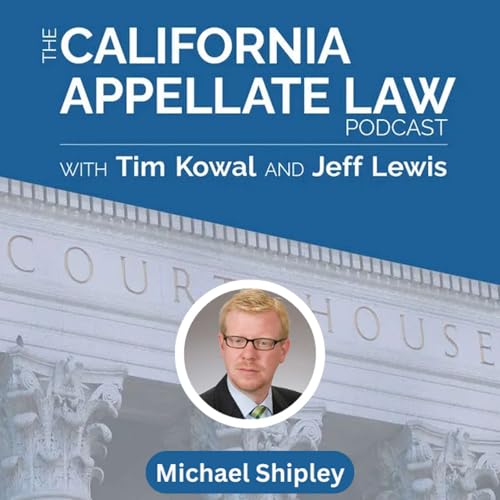
    In Part 2 of our conversation with Michael Shipley, Tim and Jeff dig into the real-world fallout of California's no-horizontal-stare-decisis rule — and the structural fix Shipley has been developing to address it.

    Shipley walks Tim and Jeff through his proposed "mini-en banc" transfer mechanism — a way for the California Supreme Court to empower a designated Court of Appeal panel to issue statewide-binding precedent on conflicting issues without consuming the Supreme Court's own docket. No constitutional amendment required. The fix is already structurally available. The question is whether anyone has the will to use it.

    Key points:

    • The "lonesome judge" problem is worse than it sounds: Under Auto Equity, trial judges caught between conflicting Court of Appeal decisions must predict which rule the California Supreme Court would adopt—effectively playing temporary Supreme Court justice on procedural disputes that may never get high court attention. The result: uncertainty, inconsistent rulings, and frustrated trial judges who just want clear precedent to follow.
    • The anti-SLAPP mixed-cause-of-action split took over a decade to resolve: Before Baral, California Courts of Appeal were hopelessly divided on whether a defendant could bring an anti-SLAPP motion targeting individual claims within a mixed cause of action. The split persisted for years.
    • Forum shopping is a risk—but more at the trial court level: There is a theoretical opportunity to forum-shop between appellate districts, but if shopping actually happens, it’s probably more at the “lonesome trial judge” level.
    • Shipley's fix: a "mini-en banc" transfer procedure: The California Supreme Court would transfer cases back to a designated Court of Appeal panel with authority to disapprove prior conflicting decisions and issue a statewide-binding opinion. The decision would remain subject to Supreme Court review, but would resolve persistent splits on procedural issues without consuming Supreme Court resources.
    • Constitutional constraints make true en banc review impossible: California's Constitution requires three-justice panels—no more, no less.
    • Implementation doesn't require constitutional amendment: The Supreme Court could adopt this procedure unilaterally as a matter of prudence, though a Judicial Council rule would provide helpful procedural uniformity.

    Listen now to understand a concrete reform proposal that could bring much-needed certainty to California's appellate system—and learn how you can support it.

    Más Menos
    25 m
  • California's No-Horizontal-Stare-Decisis Rule: How an Accident Became Law
    Feb 18 2026

    California is the largest common-law jurisdiction where appellate courts don't follow each other—and it happened by accident. In Part 1 of this two-part episode, Michael Shipley explains how Bernard Witkin’s treatise reflections on case dicta became binding law, why the federal circuit model works differently, and what the rule costs practitioners and trial judges every day.

    Key points:

    • The Witkin origin story: No California Supreme Court decision actually establishes the no-horizontal-stare-decisis rule. It developed through dicta, then appeared in Witkin's first edition—which courts then cited as authority.
    • The federal contrast matters for forum strategy: In the Ninth Circuit, Miller v. Gammy binds all panels within the circuit to follow the first published decision on an issue. California trial courts, by contrast, face conflicting appellate authority and must guess which rule the Supreme Court would adopt under Auto Equity—a burden one trial judge called being "appointed to the Supreme Court for temporary purposes."
    • Stare decisis isn't jurisdictional (probably).
    • Unpublished opinions create tension.
    • The pros: California's rule allows multiple perspectives on emerging issues and prevents the first Court of Appeal decision from locking in statewide law before the Supreme Court weighs in.
    • The cons: The rule creates uncertainty, burdens trial courts, and leads to inadvertent inconsistencies on procedural issues too minor for Supreme Court attention—splits that can persist for years or even decades. (In anti-SLAPP law, it took 13 years before Baral v. Schnitt decided how to handle mixed causes of action.)
    • Publication practices hide the problem: Many conflicts never surface because courts strategically leave decisions unpublished, masking the frequency of divergent reasoning and making the appellate landscape harder to navigate.

    Listen to Part 1 now for the full discussion on how California got here and what it costs practitioners—then tune in to Part 2, where Shipley covers forum shopping, the anti-SLAPP mixed-causes-of-action case study, and his proposed reform: precedential transfer.

    Más Menos
    30 m