

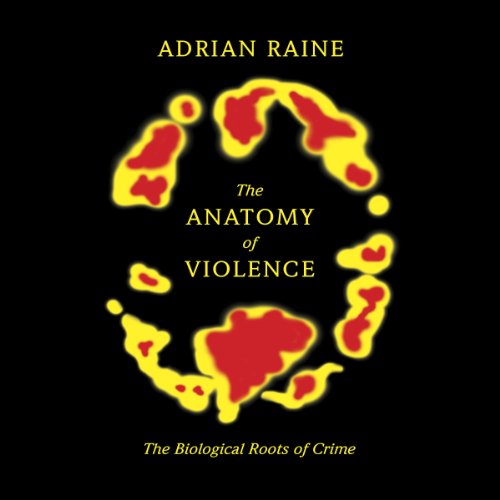
The Anatomy of Violence
The Biological Roots of Crime
No se pudo agregar al carrito
Solo puedes tener X títulos en el carrito para realizar el pago.
Add to Cart failed.
Por favor prueba de nuevo más tarde
Error al Agregar a Lista de Deseos.
Por favor prueba de nuevo más tarde
Error al eliminar de la lista de deseos.
Por favor prueba de nuevo más tarde
Error al añadir a tu biblioteca
Por favor intenta de nuevo
Error al seguir el podcast
Intenta nuevamente
Error al dejar de seguir el podcast
Intenta nuevamente
Prueba gratis de 30 días de Audible Standard
Selecciona 1 audiolibro al mes de nuestra colección completa de más de 1 millón de títulos.
Es tuyo mientras seas miembro.
Obtén acceso ilimitado a los podcasts con mayor demanda.
Plan Standard se renueva automáticamente por $8.99 al mes después de 30 días. Cancela en cualquier momento.

The Anatomy of Violence
Narrado por:
Jonathan Cowley
Compra ahora por $22.50
-
Narrado por:
-
Jonathan Cowley
-
De:
-
Adrian Raine
Why do some innocent kids grow up to become cold-blooded serial killers? Is bad biology partly to blame? For more than three decades Adrian Raine has been researching the biological roots of violence and establishing neurocriminology, a new field that applies neuroscience techniques to investigate the causes and cures of crime. In The Anatomy of Violence, Raine dissects the criminal mind with a fascinating, readable, and far-reaching scientific journey into the body of evidence that reveals the brain to be a key culprit in crime causation.
Raine documents from genetic research that the seeds of sin are sown early in life, giving rise to abnormal physiological functioning that cultivates crime. Drawing on classical case studies of well-known killers in history—including Richard Speck, Ted Kaczynski, and Henry Lee Lucas—Raine illustrates how impairments to brain areas controlling our ability to experience fear, make good decisions, and feel guilt predispose us to violence. He contends that killers can actually be coldhearted: something as simple as a low resting heart rate can give rise to violence. But arguing that biology is not destiny, he also sketches out provocative new biosocial treatment approaches that can change the brain and prevent violence.
Finally, Raine tackles the thorny legal and ethical dilemmas posed by his research, visualizing a futuristic brave new world where our increasing ability to identify violent offenders early in life might shape crime-prevention policies, for good and bad. Will we sacrifice our notions of privacy and civil rights to identify children as potential killers in the hopes of helping both offenders and victims? How should we punish individuals with little to no control over their violent behavior? And should parenting require a license? The Anatomy of Violence offers a revolutionary appraisal of our understanding of criminal offending, while also raising provocative questions that challenge our core human values of free will, responsibility, and punishment.
Los oyentes también disfrutaron:




Las personas que vieron esto también vieron:


The author will also gladly tell you about the shortcomings of cited studies and possible holes in his theories, he's not a know it all, he's an intellectual.
Dry but exceptionally well thought and delivered.
Se ha producido un error. Vuelve a intentarlo dentro de unos minutos.
The author feels that we need to move away from strictly retributive justice by taking in to account the sociobiological basis of violence. Clearly, this is a tall order when the judicial system confronts such tragedies as mass shootings resulting in many deaths.
The author has certainly caused me to rethink my own views as to how society should deal with these criminals.
I slightly downgraded the performance as the reader, who is good, has a very pronounced British accent which I found hard to understand at times. But this is a personal preference.
Very enlightening book on violence
Se ha producido un error. Vuelve a intentarlo dentro de unos minutos.
Very insightful and thought-provoking book
Se ha producido un error. Vuelve a intentarlo dentro de unos minutos.
Not sure if this kind of nonfiction has a "story"
Se ha producido un error. Vuelve a intentarlo dentro de unos minutos.
Violence is not just choice
Se ha producido un error. Vuelve a intentarlo dentro de unos minutos.