

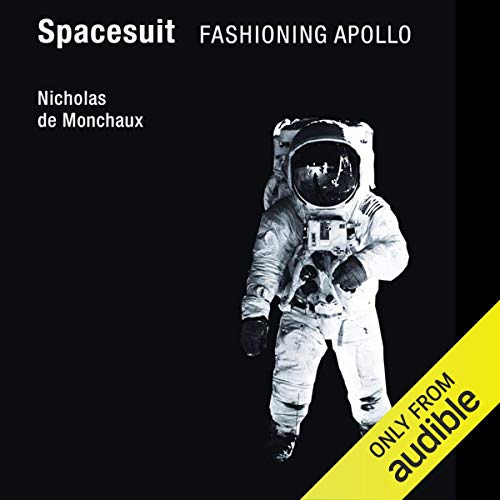
Spacesuit: Fashioning Apollo
No se pudo agregar al carrito
Add to Cart failed.
Error al Agregar a Lista de Deseos.
Error al eliminar de la lista de deseos.
Error al añadir a tu biblioteca
Error al seguir el podcast
Error al dejar de seguir el podcast
Prueba gratis de 30 días de Audible Standard

Spacesuit: Fashioning Apollo
Compra ahora por $20.78
-
Narrado por:
-
Bronson Pinchot
When Neil Armstrong and Buzz Aldrin stepped onto the lunar surface in July of 1969, they wore spacesuits made by Playtex: 21 layers of fabric, each with a distinct yet interrelated function, custom-sewn for them by seamstresses whose usual work was fashioning bras and girdles. This book is the story of that spacesuit. It is a story of the triumph over the military-industrial complex by the International Latex Corporation, best known by its consumer brand of "Playtex" - a victory of elegant softness over engineered hardness, of adaptation over cybernetics.
Playtex's spacesuit went up against hard armor-like spacesuits designed by military contractors and favored by NASA's engineers. It was only when those attempts failed - when traditional engineering firms could not integrate the body into mission requirements - that Playtex, with its intimate expertise, got the job.
In Spacesuit, Nicholas de Monchaux tells the story of the 21-layer spacesuit in 21 chapters addressing 21 topics relevant to the suit, the body, and the technology of the 20th century. He touches, among other things, on 18th-century androids, Christian Dior's New Look, Atlas missiles, cybernetics and cyborgs, latex, JFK's carefully cultivated image, the CBS lunar broadcast soundstage, NASA's Mission Control, and the applications of Apollo-style engineering to city planning. The 21-layer spacesuit, de Monchaux argues, offers an object lesson. It tells us about redundancy and interdependence and about the distinctions between natural and man-made complexity; it teaches us to know the virtues of adaptation and to see the future as a set of possibilities rather than a scripted scenario.
©2011 Massachusetts Institute of Technology (P)2014 Audible Inc.Los oyentes también disfrutaron:


I liked the technical parts.
Se ha producido un error. Vuelve a intentarlo dentro de unos minutos.
Analysis of the human side of making a space suite
Se ha producido un error. Vuelve a intentarlo dentro de unos minutos.
Interesting
Se ha producido un error. Vuelve a intentarlo dentro de unos minutos.
What’s missing: a PDF companion with all the images and figures. You get embarrassingly lost hearing text read to you that was clearly designed to be set next to the image being discussed.
What’s strange: each layer (chapter) can’t quite decide if it’s self-contained or linear with its neighbors. They reference each other in both directions and contain redundant information, but are labeled in sequence and at least seem to be trying to build up some overall story. The lesson: just don’t be confused when a chapter briefly recaps something to you which you thought you’d heard a whole chapter on an hour ago. That’s exactly what’s happening, and you didn’t miss or misunderstand anything.
Has a lot, missing a few things
Se ha producido un error. Vuelve a intentarlo dentro de unos minutos.
Any additional comments?
Great collection of facts. Things to tend to seemingly go off track quite quickly, not appearing to be related to the overall topic but they are brought back in an interesting way. The last hour or so is a little unnecessary and once the book covers the return of the astronauts you will not be missing out on much by skipping the rest.Like a giant collection of "did you know" facts
Se ha producido un error. Vuelve a intentarlo dentro de unos minutos.