

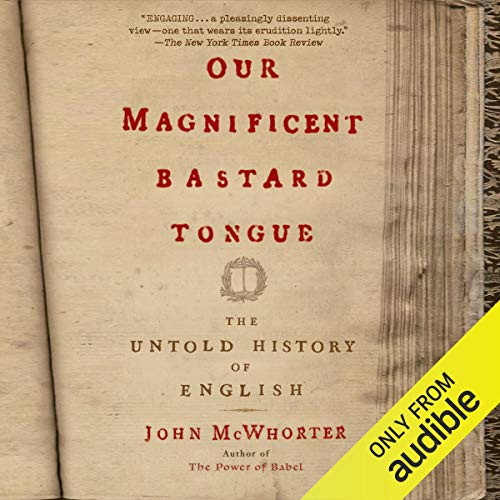
Our Magnificent Bastard Tongue
The Untold History of English
No se pudo agregar al carrito
Add to Cart failed.
Error al Agregar a Lista de Deseos.
Error al eliminar de la lista de deseos.
Error al añadir a tu biblioteca
Error al seguir el podcast
Error al dejar de seguir el podcast
Obtén 30 días de Standard gratis

Our Magnificent Bastard Tongue
Compra ahora por $13.28
-
Narrado por:
-
John McWhorter
-
De:
-
John McWhorter
Covering such turning points as the little-known Celtic and Welsh influences on English, the impact of the Viking raids and the Norman Conquest, and the Germanic invasions that started it all during the fifth century A.D., John McWhorter narrates this colorful evolution with vigor.
Drawing on revolutionary genetic and linguistic research, as well as a cache of remarkable trivia about the origins of English words and syntax patterns, Our Magnificent Bastard Tongue ultimately demonstrates the arbitrary, maddening nature of English - and its ironic simplicity due to its role as a streamlined lingua franca during the early formation of Britain. This is the book that language aficionados worldwide have been waiting for. (And no, it's not a sin to end a sentence with a preposition.)
©2008 John McWhorter (P)2009 Audible, Inc.Los oyentes también disfrutaron:


Reseñas editoriales
There is something about the English language. Belonging to the Proto-Germanic language group, English has a structure that is oddly, weirdly different from other Germanic languages. In Our Magnificent Bastard Tongue: The Untold Story of English, John McWhorter has achieved nothing less than a new understanding of the historic formation of the English language — in McWhorter’s words “a revised conception of what English is and why”. The linguist and public intellectual McWhorter accomplished this scholarly feat outside the tight restrictor box of academic publications. He did it with a popular book and thoroughly convincing arguments framed in richly entertaining, informal colloquial language.
The audiobook production of Our Magnificent Bastard Tongue takes McWhorter’s transformation of scholarship to a new level. The book is about the spoken word and how and why the English language’s structure — that is the syntax, and which linguists term the “grammar” — changed through time. McWhorter tells the story the way it should be told: in spoken English by a master of the subject of how the languages under study sounded. The author has a remarkable, animated narrative voice and his delivery has an engaging and captivating personal touch. He is a great teacher with a world-class set of pipes, who clearly has developed a special relationship with studio microphones.
McWhorter’s intent is “to fill in a chapter of The History of English that has not been presented to the lay public, partly because it is a chapter even scholars of English’s development have rarely engaged at length”. The changes of English under study are from spoken Old English before 787 C.E. and the Viking invasions and the Norman Conquest of 1066 to the Middle English of Chaucer’s time. (With Chaucer we are a hop, skip, and a jump away from the English we easily recognize today.) The influences that altered the language, in McWhorter’s new formulation, include how, beginning in 787 C.E., the Viking invaders “beat up the English language in the same way that we beat up foreign languages in class rooms”, and thus shed some of the English grammar, and the native British Celtic Welsh and Cornish “mixed their native grammars with English grammar”. After the Norman Invasion, French was the language of a relatively small ruling class and was thus the written language. But with the Hundreds Years’ War between England and France, English again became the ruling language, and the changes that had been created in spoken English found their way into written Middle English.
Listening to McWhorter articulate his points with his extraordinarily expressive, polemically powerful voice, and cutting through and continually upending the scrabble board of flabby etymological presumptions of the established view — it is like nothing you’ve ever heard. The audio edition of this groundbreaking work, Our Magnificent Bastard Tongue – an otherwise scholarly study twice transformed into a popular book and then into the audiobook that gives such impressive expressive voice to the changes of the English language — is a milestone in audiobook production. —David Chasey
Reseñas de la Crítica
"McWhorter's iconoclastic impulses and refreshing enthusiasm makes this worth a look for anyone with a love for the language." (Publishers Weekly)
"McWhorter’s energetic, brash delivery of his own spirited and iconoclastic text will appeal to everyone who appreciates the range and caliber of today’s audio production. In some ways, audio is superior to printed text in portraying tone, attitude, values, and in this case, a discussion whose theme is the sound and grammar of words." (AudioFile magazine)
Las personas que vieron esto también vieron:


Fascinating linguistic history
Se ha producido un error. Vuelve a intentarlo dentro de unos minutos.
Not for me
Se ha producido un error. Vuelve a intentarlo dentro de unos minutos.
Good book, but a little too academic
Se ha producido un error. Vuelve a intentarlo dentro de unos minutos.
Deep stuff
Se ha producido un error. Vuelve a intentarlo dentro de unos minutos.
I enjoyed the book greatly.
fascinating and educational
Se ha producido un error. Vuelve a intentarlo dentro de unos minutos.