

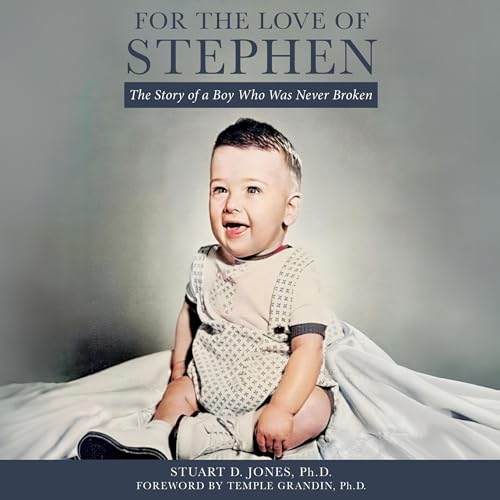
For the Love of Stephen
The Story of a Boy Who Was Never Broken
No se pudo agregar al carrito
Add to Cart failed.
Error al Agregar a Lista de Deseos.
Error al eliminar de la lista de deseos.
Error al añadir a tu biblioteca
Error al seguir el podcast
Error al dejar de seguir el podcast
Prueba gratis de 30 días de Audible Standard

For the Love of Stephen
Compra ahora por $20.46
-
Narrado por:
-
Stuart D. Jones PhD
In 1954, Steve Jones entered the world fragile and premature, quickly labeled “broken” by doctors and dismissed by society. But his parents refused the prevailing wisdom of the time. They chose to keep him home, to raise him with dignity, and to believe in his worth.
For the Love of Stephen: The Story of a Boy Who Was Never Broken is the intimate, heartfelt memoir of a brother who witnessed firsthand the struggles and triumphs of a life lived on the margins of society. Through vivid storytelling, Dr. Stuart D. Jones traces Steve’s journey: his battles with exclusion, his breakthroughs in education, his humor and resilience, his friendships and love, and the tragedy that ended his life too soon.
By turns satirical, humorous, and deeply moving, this book illuminates both the progress made and the injustices that remain in how we treat people with intellectual and developmental disabilities.
Above all, it is a tribute to Steve himself—a man who was never broken, who lived with joy and dignity, and who continues to inspire through the story left behind.
©2025 Stuart D. Jones, Ph.D. (P)2025 Stuart D. Jones, Ph.D.Las personas que vieron esto también vieron:






*For the Love of Stephen* is told in a voice that is unmistakably Stuart Jones: thoughtful, warm, quietly funny, and grounded in both scholarship and faith. His background as a PhD and former minister comes through in the way research, history, and reflection are woven into Stephen’s life story, yet never in a way that feels academic or inaccessible. Despite the depth of knowledge behind it, this memoir is remarkably easy to read, even for those without a background in neurological or developmental disabilities.
What resonated with me most was how fully Stephen (Steven) is presented as human. Not inspirational in a simplified or sanitized sense, but complex, emotional, funny, frustrated, loving, and deeply relational. I especially appreciated the author’s willingness to address the often-avoided truth that people with intellectual and developmental disabilities are sexual beings who long for connection, intimacy, and love. That honesty matters.
I’ll be honest: as an atheist, I was initially put off by the book’s strong Christian presence. However, as I continued reading, something meaningful shifted. Even when belief systems don’t align, the core message did. The book reminds us that science and systems can only take us so far, and that our most human instincts—love, care, advocacy, and responsibility for one another—are just as essential. That message deeply aligned with my own values.
Having grown up abroad in Europe and living with my own neurological disabilities, I found myself wishing for more international perspectives on intellectual disability. Countries such as the Netherlands, New Zealand, Canada, and parts of Europe are often recognized for stronger inclusion, public acceptance, and rights-based frameworks, which led me to wonder what the U.S. could learn from these models. One particularly powerful example is the Hidden Disabilities Sunflower Lanyard, used internationally as a voluntary way to signal non-visible disabilities and the need for understanding or support. It has become a lifeline for many when navigating public transportation, especially international air travel, offering tailored support through long lines, access to handicap lanes to reduce anxiety and overstimulation, and more compassionate interactions with staff from security to boarding.
From a more academic perspective—and speaking to my inner geek—I also wished for deeper historical context around IQ. Its roots in craniology and phrenology, the influence of Henry H. Goddard and early 20th-century classification systems, and the lasting harm those frameworks caused could have added further depth. I also would have appreciated clearer distinctions between Intellectual Disability and other neurological conditions, such as learning disabilities and motor disorders, which also fall under neurological disabilities in the DSM-5-TR. These critiques come from engagement, not disappointment; I wanted more because the book held my attention so completely.
At its heart, this is a love story. A sibling memoir that does not look away from injustice, does not shy away from discomfort, and refuses to reduce Stephen to a symbol. It asks readers to see people fully and to love them fiercely.
I’m grateful this story exists.
More Than a Memoir: Seeing, Loving, Including
Se ha producido un error. Vuelve a intentarlo dentro de unos minutos.
Reading For the Love of Stephen was surprisingly entertaining, but more than that, it was emotionally and intellectually compelling. I expected a heartfelt story. What I didn’t fully expect was how deeply it would draw me in — making me laugh, cringe, reflect, and even shed a few tears.
Stuart introduces us to his older brother, Stephen, in a way that feels deeply personal and unfiltered. There’s no sugarcoating. He’s raw about Steve’s character, his physical appearance, and his innocence. That honesty is what makes the book powerful. Through Stuart’s storytelling, I didn’t just read about Stephen — I felt like I truly got to know his heart.
But what makes this story even richer is that I didn’t just get to know Stephen. I got to know the entire Smith clan — parents, siblings, aunts, uncles, grandparents, and the extended circle that shaped the foundation of this story. They didn’t see Stephen as a burden. They saw him as a blessing — not only to their family, but to everyone he came into contact with. That perspective changes everything. It reframes what the world often mislabels as limitation into something sacred and transformative.
The chapter titled “God Don’t Make No Junk” especially resonated with me. It’s a reminder that every person has inherent value — and that even those of us who claim faith can sometimes fall into judgmental thinking. The book also doesn’t shy away from the painful reality that society can be cruel toward people who are different. It’s disheartening to be reminded that there are individuals who would take advantage of someone who lacks the reasoning to recognize manipulation. But that honesty is necessary.
Having friends and family members with intellectual developmental disorders gave me some understanding of the challenges families face. Still, this book deepened that perspective. It highlights how patience, compassion, and unconditional love truly conquer all — and how much growth we still need as a society when it comes to acceptance.
On a personal note, Stuart — the author of this book — was an upperclassman during our time together in choir at Lafayette Jefferson High School. He was exceptionally kind, the type of person who could have brushed off a younger student but didn’t. Reading his story now gives me a clearer reference point for that kindness and acceptance. It wasn’t accidental. It was formed in a family that saw value where the world often fails to look.
I would recommend this book to anyone impacted by having a family member, friend, co-worker, neighbor, or church congregant with IDD or other physical or mental differences. I would especially recommend it to educators, policymakers, and anyone in a position to influence how society treats those who are often overlooked.
While the forewords and introduction run a bit long and there are some repetitive sections, the heart of the story more than makes up for it. For its honesty, emotional depth, and important message, I give For the Love of Stephen a strong 4.7 out of 5.
This is ultimately a story about dignity, family, faith, and the reminder that every single life carries immeasurable worth.
A heartwarming but raw story of love and acceptance for those who are “different”
Se ha producido un error. Vuelve a intentarlo dentro de unos minutos.