

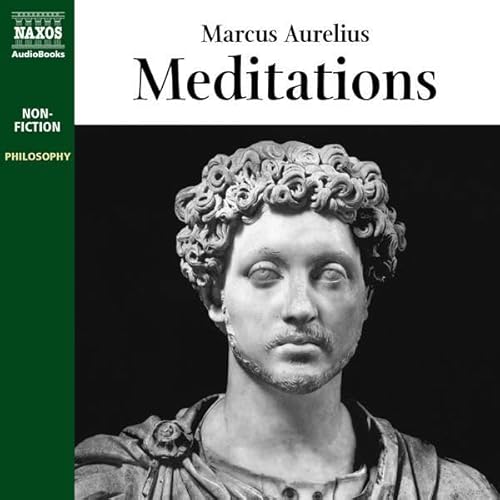
Meditations
No se pudo agregar al carrito
Add to Cart failed.
Error al Agregar a Lista de Deseos.
Error al eliminar de la lista de deseos.
Error al añadir a tu biblioteca
Error al seguir el podcast
Error al dejar de seguir el podcast
Obtén 30 días de Standard gratis

Meditations
Compra ahora por $15.84
-
Narrado por:
-
Duncan Steen
One of the most significant books ever written by a head of state, the Meditations are a collection of philosophical thoughts by the Emperor Marcus Aurelius (121-180 ce). Covering issues such as duty, forgiveness, brotherhood, strength in adversity and the best way to approach life and death, the Meditations have inspired thinkers, poets and politicians since their first publication more than 500 years ago. Today, the book stands as one of the great guides and companions—a cornerstone of Western thought.
Translation by George Long revised by Duncan Steen.
Download the accompanying reference guide.Public Domain (P)2010 Naxos AudioBooksLos oyentes también disfrutaron:








Featured Article: I Think, Therefore I Am—Philosophy for Beginners
Philosophy, the study of knowledge, reality, and so much more, is everything and everywhere. It's thinking, both big and small, about existence and the human experience. Learn about the concepts and insights behind the wide-ranging, mystical subject that is philosophy. Feast your ears on these timeless, brilliant audiobooks by and about famous philosophers, from ancient Rome to modern-day thinkers.

Las personas que vieron esto también vieron:


Nonetheless, the Meditations are worthy of a deep, thoughtful read. Much of what Aurelius "teaches" can be considered common sense guidelines to approaching life, even if you are not a capital-s Stoic.
"You have power over your mind - not outside events. Realize this, and you will find strength."
This is Stoicism in a nutshell: You cannot control other things and people - you can only control yourself. Aurelius belabors this point at length - that whatever happens is meant to happen, that you have no power to change what has happened or will happen, and that therefore your only choice is how you will react to it. And that reacting with emotion is foolish.
Much of his philosophy also boils down to telling oneself to rise above insults, injuries, and idiots.
Begin each day by telling yourself: Today I shall be meeting with interference, ingratitude, insolence, disloyalty, ill-will, and selfishness – all of them due to the offenders’ ignorance of what is good or evil. But for my part I have long perceived the nature of good and its nobility, the nature of evil and its meanness, and also the nature of the culprit himself, who is my brother (not in the physical sense, but as a fellow creature similarly endowed with reason and a share of the divine); therefore none of those things can injure me, for nobody can implicate me in what is degrading. Neither can I be angry with my brother or fall foul of him; for he and I were born to work together, like a man’s two hands, feet or eyelids, or the upper and lower rows of his teeth. To obstruct each other is against Nature’s law – and what is irritation or aversion but a form of obstruction.
Stoicism often seems close to fatalism - one could conclude that if your life is basically out of your control and that everything and everyone will act according to their natures, there isn't much point in making plans or having hopes and dreams. But that isn't what Stoicism teaches, because the one thing you are in control of - yourself - is still a powerful agent in your life. Maybe you are (according to Stoic principles) fated to live a certain way and only that way, but you can choose to enjoy it or not, be miserable or not, be fulfilled or not.
Stoicism is powerful and requires a lot more study than just reading a Wikipedia summary or the meditations of one long-dead philosopher-emperor. But it appeals to me a lot, and so I really enjoyed reading Aurelius's words, even when he was expressing things that don't jive with my modern sensibilities. He was a pagan, of course, so he speaks of the gods as arbiters of our fates and the source of all that is good (a paradox I have always found amusing, given what fickle, spiteful jerks the gods are typically in Greco-Roman mythology), but sometimes he also refers to "God" as if he had also assimilated some monotheistic ideas.
Not everything in Aurelius's Meditations will resonate with everyone, but even if you are not interested in Stoicism per se, this is still a great philosophical and literary classic that is worth reading in its own right, for insights as to why an emperor from two thousand years ago is still so highly regarded.
The audiobook reading was pitch-perfect. I could listen to this guy speaking Stoic philosophy all day. Obviously Marcus Aurelius did not have a rich British accent, nor did he speak English, but still, it's easy to imagine his voice being like this, his accent being the equivalent, just as the words in translations probably don't use the exact same metaphors and figures of speech he did (and of course, in translation it's still quite deliberately stilted and archaic in cadence and sentence structure and vocabulary, when obviously Aurelius would have sounded more contemporary, if formal, to his own ears and those of his peers) but sound authentic.
Excelent reading of an excellent classic
Se ha producido un error. Vuelve a intentarlo dentro de unos minutos.
Highly impressed with the depth of the content.
Excellent reading for the audio book.
Brilliant text. Great performance.
Se ha producido un error. Vuelve a intentarlo dentro de unos minutos.
I think if you take these words in with deep consideration, though simple, you will see that they have tremendous wisdom in them. There is a tremendous economy of language, such that it might go missed if you did not inquire into them deeply. And even though in narration, the words go fairly quickly, if you take them in they will relate to you. I plan to listen over to them many times.
The narrator Duncan Steen is masterful in my opinion. Such a clear, direct, calm, deliberate voice. He is my favorite narrator for any audiobook I have had. The narration is both thoughtful and measured, neither dispassionate nor given over to the passions, as Marcus Aurelius might perhaps put it.
Love this wonderful book and narrator
Se ha producido un error. Vuelve a intentarlo dentro de unos minutos.
Needs a better translation
Se ha producido un error. Vuelve a intentarlo dentro de unos minutos.
A lot of useful material.
Se ha producido un error. Vuelve a intentarlo dentro de unos minutos.