

Beyond Displacement
The Real Economics of Artificial Intelligence
No se pudo agregar al carrito
Add to Cart failed.
Error al Agregar a Lista de Deseos.
Error al eliminar de la lista de deseos.
Error al añadir a tu biblioteca
Error al seguir el podcast
Error al dejar de seguir el podcast
Obtén 30 días de Standard gratis
 ¿Miembros Prime? ¿Nuevo en Audible? Recibes una prueba de 2 meses en su lugar.
Beyond Displacement
Compra ahora por $14.00
-
Narrado por:
-
Virtual Voice
-
De:
-
Paul Ajulufoh

Este título utiliza narración de voz virtual
Beyond Displacement: The Real Economics of Artificial Intelligence
Artificial intelligence is widely described as a force that replaces jobs, increases productivity, and accelerates economic growth. That interpretation captures visible changes, but it fails to explain how the underlying system is evolving.
This book presents a different framework for understanding AI and the economy.
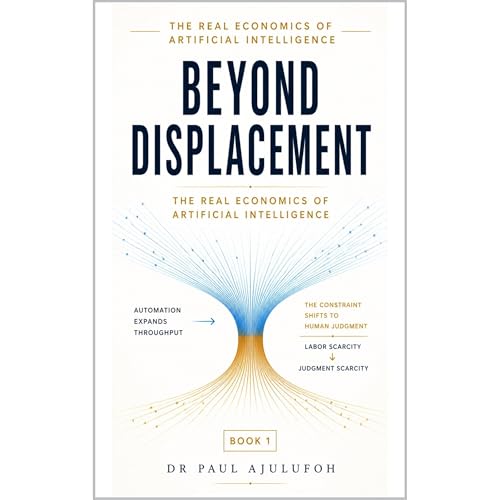
Rather than focusing on job displacement alone, it examines how artificial intelligence reshapes economic constraints. Automation reduces friction in routine and lower-level cognitive tasks, increasing throughput across the system. As output expands, pressure does not disappear—it shifts. The constraint moves upward into human decision-making, where judgment, not computation, determines outcomes.
This transition defines a new economic reality:
the movement from labor scarcity to judgment scarcity.
Through a structured analysis of labor markets, productivity, and system behavior, this book introduces a model of the economy as a constraint-driven system. It explains how AI-driven automation compresses time, increases decision volume, and concentrates pressure on high-responsibility roles. As cognitive load rises, decision quality becomes a critical variable—one that degrades under stress and creates hidden instability within otherwise stable systems.
Key themes explored include:
• The limits of productivity growth in an AI-driven economy
• The relationship between automation, labor displacement, and wage dynamics
• The emergence of judgment scarcity as a binding economic constraint
• Cognitive bandwidth, decision fatigue, and economic output
• Nonlinear declines in decision quality under pressure
• Structural shifts in labor markets across routine, middle-skill, and high-responsibility work
• The buildup of hidden strain beneath stable economic indicators
This is not a book about specific technologies or tools. It is a system-level analysis of artificial intelligence and its impact on economics, labor markets, and productivity dynamics.
Designed for investors, strategists, and analytical readers, it provides a framework for interpreting how AI is reshaping economic structure—not through visible disruption alone, but through the reallocation of constraints within the system.
Understanding that shift is critical for navigating the next phase of economic change.