

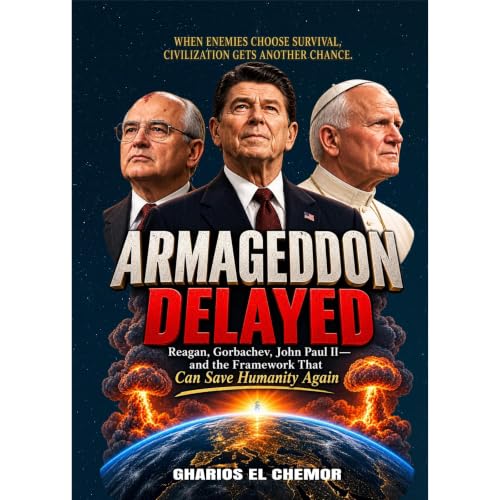
Armageddon Delayed
Reagan, Gorbachev, John Paul II—and the Framework That Can Save Humanity Again
Failed to add items
Add to Cart failed.
Add to Wish List failed.
Remove from wishlist failed.
Adding to library failed
Follow podcast failed
Unfollow podcast failed
Get 30 days of Standard free

Armageddon Delayed
Buy for $14.99
-
Narrated by:
-
Virtual Voice

This title uses virtual voice narration
ARMAGEDDON WAS NOT AVERTED. IT WAS DELAYED.
For decades, two nuclear superpowers prepared to destroy one another in order to prevent one another from attacking. Each side sought greater security, yet every attempt to become safer made the other side more afraid, producing an arms race in which individually rational decisions created a collectively insane system capable of ending civilization.
Somehow, humanity escaped.
ARMAGEDDON DELAYED is not simply another history of the Cold War. It asks a larger and more urgent question: How do intelligent human beings escape a system in which rational individual choices are producing catastrophic collective results?
At the center of the story are Ronald Reagan, Mikhail Gorbachev, and Pope John Paul II. Each approached the crisis from a different direction. Reagan embodied a dominant orientation toward Reason through strategic clarity, deterrence, negotiation, and recognition of the ultimate irrationality of nuclear war. Gorbachev embodied Balance through his willingness to recognize that an apparently stable system had become unsustainable and required transformation. John Paul II embodied Compassion through an insistence on human dignity that helped undermine the legitimacy of oppression without commanding an army.
But ARMAGEDDON DELAYED makes a deeper argument: none of these men succeeded by embodying only one principle. Each also acted through the other two, creating what Gharios El Chemor calls the Triple Accord of Reason, Compassion, and Balance. Their individual coherence, combined with their complementary strengths, offers a model for understanding how seemingly impossible conflicts can be transformed.
From this historical pattern emerges Positive-Sum Meta-Constructivism, a framework that goes beyond conventional conflict resolution. Zero-sum thinking asks who wins, while positive-sum thinking asks whether both sides can gain. Positive-Sum Meta-Constructivism goes further by asking whether the structure producing the conflict itself can be reconstructed so that cooperation becomes more advantageous than mutual defeat.
Sometimes the solution is not to play the game better, but to change the game.
Drawing lessons from the Cold War, Franco-German reconciliation, South Africa, Northern Ireland, and other examples of conflict transformation, ARMAGEDDON DELAYED develops the Human Survival Framework: a practical method for recognizing existential threats, exposing destructive assumptions, applying Reason, Compassion, and Balance, and searching for sustainable positive-sum alternatives.
The final question belongs not to history but to the future. Artificial intelligence, biotechnology, nuclear weapons, pandemics, climate disruption, great-power rivalry, and dangers humanity has not yet imagined could confront civilization with new versions of the same ancient problem. We cannot predict every future Armageddon, but we can become better at recognizing the systems that create them and better equipped to reconstruct those systems before catastrophe becomes inevitable.
The Cold War did not prove that humanity is wise. It demonstrated something more useful: under the right conditions, human beings can recognize a suicidal game and change it before everyone loses.
Armageddon was delayed once, and this book asks whether humanity can learn how to do it again.