

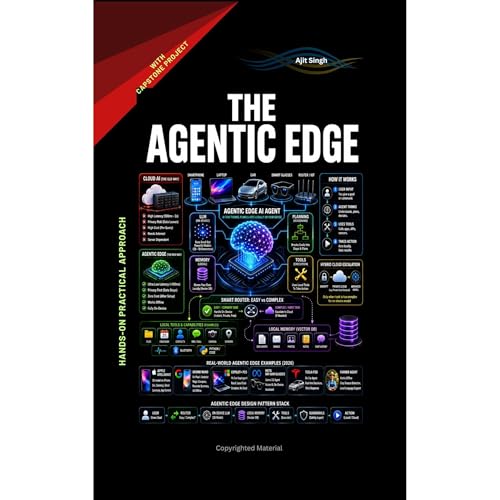
The Agentic Edge
Failed to add items
Sorry, we are unable to add the item because your shopping cart is already at capacity.
Add to Cart failed.
Please try again later
Add to Wish List failed.
Please try again later
Remove from wishlist failed.
Please try again later
Adding to library failed
Please try again
Follow podcast failed
Please try again
Unfollow podcast failed
Please try again
Get 30 days of Standard free
Auto-renews at $8.99/mo after 30-day trial. Cancel anytime

The Agentic Edge
Narrated by:
Virtual Voice
Buy for $8.90
-
Narrated by:
-
Virtual Voice
-
By:
-
Ajit Singh

This title uses virtual voice narration
Virtual voice is computer-generated narration for audiobooks.
Philosophy
The core philosophy of this book is empowerment through local intelligence. I worked on the principle that the most effective, private, and responsive AI is one that is close to the user—not in a remote data center, but integrated directly into their personal devices. This "edge-first" philosophy dictates our entire approach.
Key Features
1. Implementation-Oriented: Over 80% of the content is dedicated to practical, hands-on tutorials, code examples, and step-by-step project development.
2. Beginner to Advanced Trajectory: The book starts with zero assumptions and guides the reader to a point where they can build sophisticated, multi-tool edge agents.
3. Focus on Modern, Accessible Tools: We utilize industry-standard, open-source tools like Ollama, Llama 3, Phi-3, and LangGraph, ensuring the skills learned are immediately relevant and transferable.
4. End-to-End Project-Based Learning: The book culminates in a full-fledged capstone project in Chapter 10, where readers build a complete AI desktop assistant that can read local files and execute local scripts—integrating all the concepts learned throughout the book.
5. Holistic Coverage: Each chapter, where applicable, touches upon the full lifecycle: design considerations, architectural patterns, model selection, component implementation, deployment strategies, and future scope.
6. Real-World Case Studies: Practical case studies, such as building an offline health report summarizer or a low-latency smart-glasses assistant, are interspersed to demonstrate the application of learned concepts.
7. Performance and Optimization: A dedicated chapter covers crucial techniques like model quantization to ensure agents run efficiently on resource-constrained devices like smartphones and laptops.
Key Takeaways
Upon completing this book, you will be able to:
1. Articulate the fundamental advantages of Agentic Edge (Latency, Privacy, Cost, Offline) over traditional cloud AI.
2. Select, set up, and run small, powerful language models (e.g., Phi-3, Llama-3-8B) on your local machine using tools like Ollama.
3. Design the architecture for an autonomous AI agent, including components for planning, memory, and tool execution.
4. Implement agentic logic using frameworks like LangGraph to create goal-oriented, multi-step task execution.
5. Connect your local agent to a variety of tools, enabling it to read local files, execute code, access calendars, and interact with your operating system.
6. Apply optimization techniques like quantization to make your agents faster and more memory-efficient.
7. Build and deploy a complete, end-to-end DIY capstone project: a local AI desktop assistant that demonstrates the full power of the Agentic Edge.
Disclaimer: Earnest request from the Author.
Kindly go through the table of contents and refer kindle edition for a glance on the related contents.
Thank you for your kind consideration!
adbl_web_anon_alc_button_suppression_c
No reviews yet