

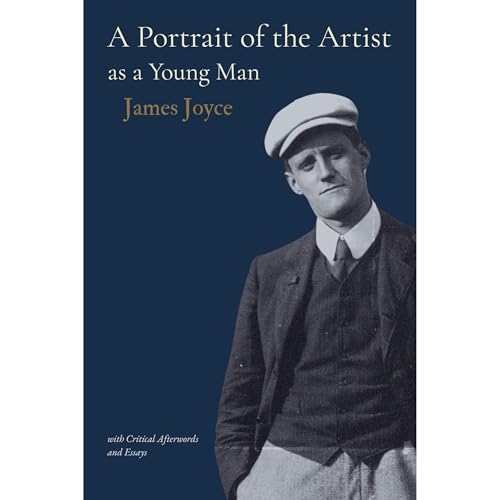
A Portrait of the Artist as a Young Man (Annotated)
Critical Edition with Literary Analysis, Historical Context & Author Biography | James Joyce | Erato Press
Failed to add items
Add to Cart failed.
Add to Wish List failed.
Remove from wishlist failed.
Adding to library failed
Follow podcast failed
Unfollow podcast failed
Audible Standard 30-day free trial

A Portrait of the Artist as a Young Man (Annotated)
Buy for $5.99
-
Narrated by:
-
Virtual Voice
-
By:
-
James Joyce

This title uses virtual voice narration
Every technique that defines modern literary fiction was invented in this novel.
Stream of consciousness, the epiphany as aesthetic form, free indirect style pushed to its outermost limit, prose that changes register and syntax as a character's mind changes — none of these existed in literature before James Joyce sat down, between 1904 and 1914, to write the story of a boy named Stephen Dedalus growing up in Catholic Ireland. A Portrait of the Artist as a Young Man (1916) is not merely a great novel. It is the instrument by which the novel became something it had never been before.
Stephen Dedalus — brilliant, proud, physically fragile; the boy who feels everything too intensely; the young man who dismantles, one by one, every claim that Ireland, the Church, and his family make on his conscience, until nothing remains but the bare conviction that he must forge, in the smithy of his soul, the uncreated conscience of his race.
Simon Dedalus — Stephen's father, a man of extraordinary verbal gifts and spectacular moral failure; the embodiment of a particular Irish tragedy: charm that cannot sustain itself, eloquence that cannot pay a debt.
Cranly — Stephen's closest friend and the one voice willing to question his grand refusals; the skeptic who asks whether Stephen is fleeing toward art or simply fleeing, and who does not receive a satisfying answer.
E.C. — the girl who is barely a person in this novel, barely allowed to exist outside Stephen's consciousness; a projection, an ideal, a muse who reveals, in her own near-absence, everything troubling about the artistic imagination's relationship to actual human beings.
✦ The complete text of A Portrait of the Artist as a Young Man in James Joyce's original 1916 edition.
This edition also includes:
✦ The Forge and the Smithy: A Literary Analysis of A Portrait of the Artist as a Young Man — an original critical essay by Henry Bugalho in fourteen chapters: the form that has no precedent and why it is not a Bildungsroman; how Joyce's prose changes syntax and register chapter by chapter as Stephen's mind develops; the theory of the epiphany as aesthetic method; the Daedalus myth and the architecture of flight; a close reading of the Christmas dinner scene as Ireland's political wound made domestic; the sermon of Father Arnall as rhetorical masterpiece and theological theatre; the colonized tongue and the "tundish" scene; the diary as formal dissolution; and the devastating retrospective judgment Portrait receives in Ulysses ✦ The World That Made the Portrait: Historical Context and the Birth of Modernism — an original historical essay in eleven sections: Ireland under the long shadow of Parnell; the Catholic Church as total institution; the Jesuit educational system and its intellectual legacy; the Irish Literary Revival and Joyce's complicated relationship to it; Dublin 1904; the European context of Ibsen and Flaubert; the composition history from Stephen Hero to Portrait; and the Künstlerroman tradition in which Portrait stands apart ✦ James Joyce and Stephen Dedalus: The Man Behind the Portrait — an original biographical essay examining the autobiography that isn't: the real institutions Joyce transformed; the real people behind Cranly, Davin, MacCann, and E.C.; Joyce's own ambivalent relationship to his younger self; and what it means that when Stephen reappears in Ulysses, he has not written a single word
For readers who enjoy:
✦ Modern literary fiction and the novels that invented its techniques ✦ Irish fiction, Irish history, and the literature of exile and return ✦ Critical editions with analysis that illuminates rather than summarizes ✦ James Joyce, Samuel Beckett, Virginia Woolf, and the modernist tradition