

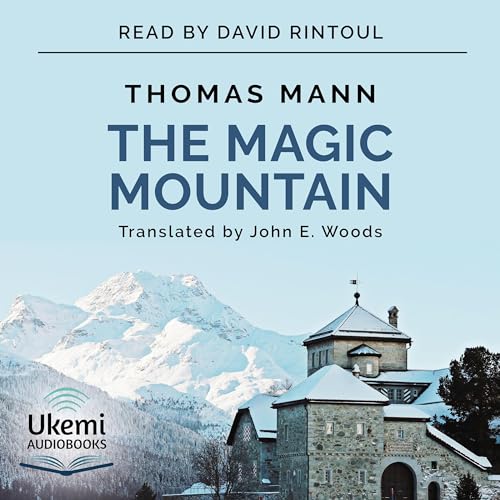
The Magic Mountain
Failed to add items
Sorry, we are unable to add the item because your shopping cart is already at capacity.
Add to Cart failed.
Please try again later
Add to Wish List failed.
Please try again later
Remove from wishlist failed.
Please try again later
Adding to library failed
Please try again
Follow podcast failed
Please try again
Unfollow podcast failed
Please try again
Get 30 days of Standard free
Auto-renews at $8.99/mo after 30-day trial. Cancel anytime

The Magic Mountain
Narrated by:
David Rintoul
Buy for $29.75
-
Narrated by:
-
David Rintoul
-
By:
-
Thomas Mann
Its unusual story - it opens with a young man visiting a friend in a tuberculosis sanatorium in the Swiss Alps - was originally started by Mann in 1912 but was not completed until 1924. Then, it was instantly recognised as a masterpiece and led to Mann’s Nobel Prize in 1929.
Hans Castorp is, on the face of it, an ordinary man in his early 20s, on course to start a career in ship engineering in his home town of Hamburg, when he decides to travel to the Berghof Santatorium in Davos. The year is 1912, and an oblivious world is on the brink of war. Castorp’s friend Joachim Ziemssen is taking the cure, and a three-week visit seems a perfect break before work begins. But when Castorp arrives he is surprised to find an established community of patients, some of whom have been there for years, and little by little, he gets drawn into the closeted life and the individual personalities of the residents.
Among them are Hofrat Behrens, the principal doctor, the curiously attractive Clavdia Chauchat and two intellectuals: Ludovico Settembrini and Leo Naphta with their strongly contrasted personalities and differing political, ethical, artistic and spiritual ideals. Hans Castorp’s stay is extended, once, twice and still further, as he appears to develop symptoms which suggest that his health, once so robust, would benefit from the treatments and the mountain air.
As time passes, it becomes clear that the young man, with a particular interest in shipbuilding and not much else, finds his outlook and knowledge broadened by his mountain companions, his intellect stretched and his emotional experience deepened and enriched. Hans Castorp is changing, day by day, month by month, year by year, sometimes imperceptibly, sometimes with a sudden advance, as he encounters the varied range of sparkling characters, their comedies and tragedies, their aspirations and their defeats.
The Magic Mountain is a classic bildungsroman, an educational journey of growth - a genre that began with an earlier novel in the German tradition: Goethe’s Wilhelm Meister’s Apprenticeship. It is presented here in the acclaimed modern translation by John E. Woods and is told by David Rintoul with his particular understanding for Thomas Mann as displayed in his widely praised Ukemi recording of Buddenbrooks.©1996 Knopf Translation (P)2020 Ukemi Productions Ltd
Listeners also enjoyed...





adbl_web_anon_alc_button_suppression_t1
People who viewed this also viewed...


Decades after first learning about it, TMM did not disappoint. So subtle, so sly, even witty. Like certain works of Beethoven, it feels primal, like it was forever waiting for its historical moment to be discovered by this great writer.
And the performance is flawless. I’ve thought about this book constantly since when I started reading it during the COVID quarantine until long after finishing. I hope my life is long enough to read it again some day.
Thank God it finally came to audiobook
Something went wrong. Please try again in a few minutes.
sublime
Something went wrong. Please try again in a few minutes.
A Book for Our Age
Something went wrong. Please try again in a few minutes.
The protagonist, Hans Castorp, is a young man in his early 20's, when the story begins. The time period is the early 1910's. The Magic Mountain is actually an international TB sanatorium located in the Swiss Alps, or the sanatorium is on the "magic mountain," which is not "magic" at all. It is merely a place of rest.
It is apparently a time when such sanatoriums were common. Tuberculosis had not yet been subdued by modern medicine, and cures were unclear.
The novel weaves a tapestry of colorful characters around Castorp - his austere cousin, an elusive love, the director and doctor of the sanatorium, and two eventual anti-heroes - an Italian humanist and am unorthodox Jesuit.
There are a number of sub-plots, but Mann resolves them all satisfactorily.
I kept wanting to compare Mann with Dostoevsky because Mann is a skilled writer whose breadth is comparable, including his character development. But in the end, Mann's sub-plots are more disjointed. They could be short stories without detracting from the whole.
However, I do recommend this audiobook because of the overall story and the skill of the narrator.
Interesting but somewhat laborious
Something went wrong. Please try again in a few minutes.
"My good engineer"
Something went wrong. Please try again in a few minutes.