Episodios

  • Sevastopol Sketch II (Part 2 of 3): Mikhailov & Co.
    Apr 1 2026
    This is part 2 of 3 on Tolstoy’s 2nd Sevastopol Sketch, which focuses on May of 1855 and declares the ineffable value of Truth as hero.I’m presenting this episode after covering Austerlitz, a conflict symbolic of the vain pursuits of rulers. Further, similar to the result of Austerlitz, the Crimean War was a extraordinary humiliation for Russia that forced societal change. This sketch also contains memorable depictions of death amidst armed conflict.This story places the reader 6 months into the 11-month siege where “the Angel of Death hovers over all. “ This includes the 4.5 mile-long defensive line made of trenches with 8 major bastions. Notably, the Crimean War marks one of the rare times in the 19th century where France, England & Ottomans where allies. The War is also notable for advances in technology by the victors, including in naval artillery and how it was documented using telegraphs and photos. Florence Nightingale also gained recognition for her approach to nursing. This sketch focuses on a handful of fictional low-ranking officers. The climax is an artillery shell landing between two, where time slows down. Tolstoy brings you into their souls.The book begins with an introduction then focuses on the lead, Mikhailov, who is unmarried and noted not to own land. He is physically awkward and simple, but still “a man of worth.” He is thinking of a letter from a friend and day-dreams how his macabre reality can be a ladder for advancement. He realizes how many men he knew perished and how many he will meet who will meet the same end. He is lamenting transferring to Crimea. Mikhailov walks to the main boulevard an encounters his fellows - a small group imbued with basic decency as well as vice. In describing their hierarchy, it is pointed out how in any walk-of-life, there is someone higher – a so-called aristocrat. The various characters profiled include: Kalugin - an adjunct depicted as having a Gentleman’s demeanor; Prince Galstin - who holds the highest rank among this group; and Col. Neferdoff and Calvary Captain Praskukhin, who share the designation as two of the “122 men of the world” who volunteered from retirement. The group commiserates about their war stories and complaints. In describing the superficial natures of these men, Tolstoy paraphrases the first chapter of Ecclesiastes, similar to how he did when Andrei was lying on his back at Austerlitz. In a narrator’s voice, Tolstoy cries out:Vanity! vanity! Vanity everywhere, even on the brink of the grave, and among men ready to die for the highest convictions. Vanity! It must be a … peculiar malady of our century…Why did Homer and Shakespeare talk of love, of glory, of suffering, while the literature of our age is nothing but an endless narrative of aspiring elitists and vanity?Mikhailov, before his assignment, travels to his apartment and realizes his next trip to bastion would be his 13th. He felt he would be killed but would vacillate and fathom: “if I make it…..I will be promoted.” All the men had similar forebodings. Mikhailov then writes a farewell note to his father. His servant of 12 years, Nikita, was inebriated and prepared his Master. This included dressing Mikhailov and putting together a bundle of cheese and vodka. Mikhailov insults Nikita yet an affection is portrayed and both share a poignant goodbye.The other men went to Prince Galtsin’s quarters, where he has multiple servants and a piano. The men have tea and crackers and discuss tales of heroic actions and the latest updates on casualties. Prince Galstin then sat at his piano and Praskukhin sings along. The men know what lies ahead and make the best of their situation.As they leave for their posts, they notice the bombs overhead, with Kalugin observing how the “real work of the night has begun.” Tolstoy has the men to regard the visual of artillery fire as a celestial show.A Cossack soldier arrives and mentions how reinforcements are needed to replace the many killed. Kalugin follows the Cossack but Prince Galtsin doesn’t have to and walks the streets, where the cannon and rifle fire are palpable. He passes wounded soldiers, many carried on stretchers, others supported by the arms of a comrade. He was able to question one of them. The wounded met the onrush of a contingent of the Ottomans, yelling Allah! Nearly all of this unit were killed and the Ottomans took a valuable position.Galtsin was shocked and was nearly arguing with the man, hoping the hear that the enemy was repulsed. Others join in to relay the reality and Galtsin feels ashamed for impugning the man. He follows the wounded to a vast hall serving as a triage center, where after being looked at, some would get transported to a hospital and others to a chapel serving as a morgue. Tolstoy then takes us to the Horror inside.
    Más Menos
    12 m
  • Bk. 1, Pt. 3, Ch. 19: little napoleon
    Mar 8 2026

    Andrei lies moaning from a head wound on the Pratzen Heights, symbolic of the numerous souls dead or wounded.

    The depiction of Andrei chasing military glory but falling short, was influenced by how Kutuzov historically lost his son-in-law, Theodor von Tiesenhausen, at Austerlitz. Kutuzov sent the young noble, who served as an aide-de-camp, to rally retreating troops. After Tiesenhausen seized a fallen standard and ran forward, he was quickly shot in the chest. Frenchmen swarmed him and there was a barbaric scuffle over his military decorations. When Napoleon took a victory lap, he noticed the “glorious” sight of the barely alive Tiesenhausen still holding the flagstaff.

    Andrei is a physical causality but was imbued with a realization of the baseness of war. Going in and out of consciousness, Andrei held onto the value of his vision. Unable to open his eyes, he thought, “Where is it, that lofty sky that I did not know?” He did not remember the intricate battle plans nor leading the charge. What brought him back to earth was the burning pain in his head. When he heard the sound of approaching horses and French voices, he finally opened his eyes and captured the clouds floating majestically and the blue infinity beyond.

    Tolstoy has Napolean have a fictional interaction with Andrei while making his triumphant walk. Napolean comments on the gallantry of the fallen, notably a grenadier whose body was swelling and blackening. It is sinking in for Andrei that there is very little admirable about such a man’s life being wasted. Napolean approached Andrei, whose hand was still on the flagstaff and asserted: “That’s a fine death!” Andrei now regarded Bonaparte’s words as the buzzing of a fly. Napoleon seemed insignificant compared with the sky, which is representative of the Almighty.

    Andrei desperately wished to be assisted back to life. He collected all his strength to utter a sickly groan. Napoleon immediately ordered Andrei to be treated and rode on met Marshal Lannes, who congratulated his Master. Andrei remained in agony, but regained his bearings after he was placed with other wounded officers.

    Napoleon encounters Andrei once again when he inspects the overflow of valuable prisoners. The senior officer captured was Nikolai Repnin-Volkonsky, an Imperial Guard Colonel, who Andrei recognized from Petersburg. Napoleon commended Repnin, saying: “Your regiment was honorable in fulfilling their duty.” Repnin responded “The praise of a great commander is a soldier’s highest reward.” More kind yet superficial words were bestowed on a young lieutenant. Napoleon then sees and remembers Andrei and calls him, “mon brave” an old fashioned term meaning “my good fellow” or “my good man.” Andrei remains silent on the only occasion he would meet his one-time idol. All the vain interests that absorbed men like Napoleon now seemed so insignificant. This is Tolstoy’s comment on the value of military glory. Andrei thought of the pettiness of such men compared to the lofty, equitable and gentle sky. His mind was on a plane of solemnity. Various factors led to his mental state including: the loss of blood, nearness of death and appreciation of the divine. Napoleon instructed that Andrei and others be cared for by his own doctor and bid Prince Repnin, Au revoir!” He galloped away -- shining with satisfaction.

    Frenchmen who had carried Andrei had stolen the gold icon his sister gave him. However, seeing the favor the Emperor bestowed, quickly returned the charm. Beholding the icon made Andrei consider: “it would be good if everything were as clear and simple as it seems to Mar’ya.” He yearns to know where he should seek for help and what to expect beyond the grave. Andrei considered the nature of the Almighty and how to address his prayers. Andrei realizes that he understands the greatness of something incomprehensible but paramount. He conceptualized the Almighty’s ineffable power and contrasted this with image on his amulet, which is a critique of graven images.

    When Andrei’s stretcher moved on, he again felt pain that was difficult to endure. He experienced visions of his father, wife, sister, and future son. He considered his quiet home life and peaceful happiness that he never appreciated. He realized only the heavens promised a similar peace.

    Upon examination, Napoleon’s doctor pronounced a grave prognosis: “He is a nervous and sickly subject…and will not recover.” Inevitably, the doctor and War Machine moved on leaving Andrei and others to the care of the inhabitants of the district.

    That finally ends analysis of Book 1, which is about 25% of the novel.

    Cover Image is from the painting: Eruption of Vesuvius, 1824, by Johan C. Dahl.

    Más Menos
    10 m
  • Aleksei Nikitin: In the Spirit of Tolstoy
    Mar 3 2026
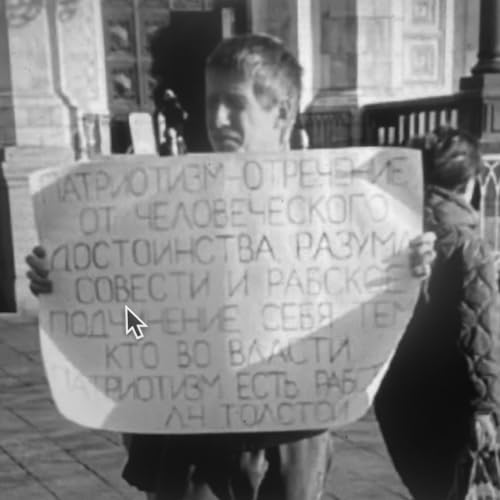
    This project is approaching the final chapter of Book I, a critical juncture with Napoleon victorious and holding the greatest reputation man can bestow. Even after Napoleon suffered a string of defeats years later, his reputation was colossal when Tolstoy wrote War &Peace. Many readers coming to this book do not realize Napoleon is something of a dark force utilized to portray how to view those who send others to die for a ruler's vain ambitions. In this regard, it is important to recall how Tolstoy was influenced the Bible book of Ecclesiastes, which comments on vainglorious ambitions as well as the meaningless of everything without an appreciation of the Transcendent. Tolstoy is reaching to you from another age, highlighting how you can recognize War’s profane nature compared to what is above. Tolstoy recognizes how calls to war are a siren’s song as well as how easy it is to get young men to answer, usually via a small bounty or appeal to patriotism.Acknowledging the idiosyncratic pacifist Tolstoy became, his work still recognizes how a defensive war is more justified than the type of conflict at Austerlitz. Further, Tolstoy was exceptionally critical of his own government, which makes War & Peace so relevant in our times. In this spirit, I bring up the following story:Upon Russia’s mass invasion of Ukraine in early 2022, Aleksei Nikitin, a regular citizen from Moscow, tried to make a difference and stood up to power.Aleksei recognized crossing his neighbors’ border and unleashing the largest land invasion since the Second World War is the type of aggression Tolstoy condemned. Aleksei brought Tolstoy into his public protest by writing an excerpt on a poster-board from the 1894 essay “On Patriotism.” It read:“Patriotism is the abdication of human dignity, reason and conscience and a slavish submission to those in power. Patriotism is slavery.”It was a controversial sentiment then and remains so. This essay described Tolstoy’s conception of patriotism -- in that militaristic age -- as a vulgar sentiment used by governments to justify their war machines. He argued it is opposite to what he took out of the Bible, namely Christian brotherhood. Aleksei’s use of the essay speaks to what Tolstoy has Andrei grasp as Andrei views the senselessness of a red-haired Russian artilleryman squaring off against a French attacker – both Christians struggling over a mop as if it was the Holy Grail. Tolstoy was speaking to the baseness of what he witnessed, as a soldier on campaigns in Chechnya and being on the losing side of the Crimean War.Tolstoy points out that men mercilessly hacking one another have a great deal more in common with one another – than the men of supposedly higher status, who sent them to die. Tolstoy described, in another part of the essay:"It is even impossible to imagine, how and for what, Russian and German workmen, peacefully and conjointly working on the frontiers or in the capitals, should clash. And much less easily can one imagine animosity between some Kazan peasant who supplies Germans with wheat, and a German who supplies the peasant with scythes and machines. It is the same between French, German, and Italian workmen."Aleksei Nikitin was arrested and the Moscow police statement on the proceeding was carefully worded and likely came from their Intelligence Service:“This writer’s (Tolstoy’s) works and articles were harshly critical of the ruling (Czarist) regime, including justifying violence against the government. Therefore, the actions of Citizen Nikitin should be interpreted as a call to overthrow the existing authorities and also to follow the ideology of Tolstoy.”This was a revealing acknowledgement that the philosophy of Tolstoy is threat to a system throwing countless men into their War Machine. Nevertheless, the Russian government succeeded in stunting that portion of citizenry who were in line with the ideals of Tolstoy. Once the internal dissension was suppressed, the Russian leader found it prudent to create, a “Tolstoy Peace Prize.”Over his career, Tolstoy brought out how such aggression brings out an ever-lasting hatred by those affected. Some of such work involves Chechnya. One of Tolstoy’s first short stories, “The Raid,” from 1853, explored amidst the Chechen landscape -- what motivates man to kill his fellow. Further, one of his final works, “Hadji Murad,” tells the story of brutal campaigns against Chechnya, which involved the burning of villages, fields, and livestock. Tolstoy took to heart how raids would leave the helpless crying in despair.He recognized, how such aggression promotes a natural resistance, like many Chechens have demonstrated for generations; and like the overwhelming majority of Ukrainians have capably demonstrated in our times.
    Más Menos
    10 m
  • Bk. 1, Pt. 3, Ch. 18(B): Breaking the Ice
    Feb 15 2026

    This pivotal short section depicts one of the iconic episodes of Austerlitz, namely retreating Russian forces falling through ice amidst an artillery barrage.

    French General Adolphe Marbot provided a contemporary report on this phenomenon and Czar Alexander appears to have relayed to his inner circle, years later in 1814, that he watched helplessly as thousands of his men perish in the frozen waters. A large number is realistic given accepted casualty figures. Estimates of allied losses indicate 12,000 Russians and 4,000 Austrians dead or wounded and 12,000 captured. French losses were around 1,400 killed and 7,000 injured.

    For nearly a century, which covers the period Tolstoy was writing, it was accepted that thousands perished in this dramatic way. However, academic scrutiny on the episode gained steam in 1902 when Oxford historian Reginald L. Poole published an influential article in The English Historical Review. Poole notes that accounts of the weather in the local Oberamtmann newspaper for early December 1805 indicate the ice was relatively thin, so Poole suggests a vast army retreat would not have been realistic. Nevertheless, a report of relatively thin ice is...relative...and the weather was naturally subject to getting colder from publication. Poole also notes that French engineers drained some of the waters within a few days of the battle, whereupon they discovered 30 cannons and the remains of 150 horses but only three people. Still there are few specifics on the actual draining. While there remains a great deal of mystery surrounding the event, cannon balls assuredly pierced the ice, leading to a grand spectacle.

    Tolstoy puts the fictional Fedor Dolokhov in this mix of the columns retreating in the southern portion of the field after the fight was lost at all points. Dolokhov is among a group crowding around an escape route by a dam and the attendant waters near the Village of Augesd (Awg-est or Ow-gest), which was reachable by cannon fire from the Pratzen Heights. It was within the rules of engagement to fire at such retreating soldiers, provided it was done at active combatants and not those surrendering or too injured to pose a threat.

    Tolstoy makes a critical contrast, remarking how this area only knew peace for generations. On the quant dam, which also served as a bridge, an old miller would ordinarily sit in his tasseled cap fishing with his grandson nearby while locals steered their two-horse carts back and forth with goods. On December 2, 1805, however, terrified men crowded together, nearly crushing one another amidst an artillery barrage. Many were struck down like bowling pins. At intervals, they took fire and some went down while others were forced to step over the dead. It was something of a macabre carnival game.

    Dolokhov is a character men & women love and actors would love to play. Youthful, masculine, handsome, with a dark and wild side. Not wealthy and of privilege like the plentiful assembly of aristocrats Tolstoy crafts, Dolokhov still reflects a side of Tolstoy as in the author’s younger days he was quite the debauched gambler. Dolokhov had been wounded and imbued with survival instincts. He was escaping with some ten men of his company, representing all that was left of it. His contingent got stymied at an approach because a dead horse had to be dragged out of the narrow path.

    Soon enough, a cannon ball takes someone out behind Dolokov and another fell in front of him, so Dolokhov was splashed with blood. He is desperate.

    Each of these men thought, “If we get a hundred yards further and we are saved, but shall we remain here another two minutes….it is certain death.” Dolokhov frees himself, leaves the edge of the dam and runs onto the ice. Come this way!” he beckons, jumping about the ice which creaked under him. “It bears!” The ice swayed and it was plain that it would give way under his weight alone. The men hesitated in stepping onto the ice, but realized they had no choice.

    A nearby general on horseback tried to say something but was quickly taken out and it was an ugly death. Seeing their leader fall, the men realized they had to try and ran onto that ice. So they went, running and sliding away from danger.

    Very soon, the ice gave way. First under one man, then another, and on and on. Cries of horror were heard as a group went down in a great mass and struggled in the freezing water. Tolstoy puts a number as forty men, which is well within reason. As the chapter ends, cannon balls continue to pound the ice.

    Más Menos
    9 m
  • Czar Alexandr: A Background
    Feb 8 2026

    This episode explores the background of the Czar reduced to tears after the Battle of Austerlitz.

    Many readers know little of the ruler Nicholas Rostov and countless officers were so devoted to.

    Over the last few years, you may have watched Ridley Scott’s film “Napoleon.” I argue that the casting of Alexandr embraces a view of the filmmaker that aligns with the perception the fictional Nicholas held.

    Edouard Philipponnat as Alexandr was the standout in the film and embraced a youthful exuberance. Handsome and dashing, Scott captured the energy that Tolstoy depicts.

    Should you view a portrait of Alexandr, however, you will not see the equivalent of an Edourd or Brad Pitt. You will discover something that fits of Alexander Pushkin’s description of Alexandr of being a “Balding Dandy.” Pushkin was exiled by Alexandr for anti-Czarist sentiments.

    Napoleon even wrote Josephine in 1807: “I am satisfied with Alexander and he ought to be satisfied with me. If he were a woman, I think I would make him my mistress.” Historically, the opposite may have been true. Alexandr may have taken up an affair with Josephine and assuredly did so with numerous beautiful and intelligent woman of the aristocracy.

    More Importantly, Alexandr has a fascinating background which contributes to turning him into the lamenting Sovereign at Austerlitz.

    Alexander’s grandfather was Peter III, who was born in northern German speaking lands and was also, for a time, the presumptive heir for the throne of Sweden. Peter served as Czar for only six months before his wife, Catherine, plotted to overthrew him in 1762. Catherine was Germanic royalty who converted to Orthodoxy upon her marriage. Catherine moved quickly against her husband, who she regarded as lacking sense and maturity. She also considered him a drunk. Nevertheless, some German historians find Peter to be cultured and open-minded. Peter did have an openness to adapting European technology and placed the sciences on a prestigious level. After the coup, Peter was held in a prison and likely strangled. The official account was that the cause was a stroke or bowel obstruction.

    Catherine then ruled as regent for her son Paul, but never gave up any authority when Paul became of-age, around 1772. Catherine alleged, in memoirs and conversation, that Paul was sired by one of her lovers, which would mean Alexandr was not of any so-called Royal blood. Nevertheless, she took notable efforts to educate Paul’s two sons, Alexandr and Konstantin.

    When Catherine died in 1796, Paul assumed leadership and met a similar end as Peter after a five year reign. Paul shares a complex reputation and was quite notably influenced by his love of Prussia, especially their military. Paul was most assuredly strangled in 1801. This second murder of a Czar within 40 years is what brought Alexandr (then 23) to the throne.

    As referenced, Catherine dedicated time to instruct Alexandr and his brother Konstantin. She would relay the importance of the French Revolution and read to them the Declaration of the Rights of Man. More consequentially, Catherine assigned Alexandr a Swiss tutor, Frédéric-César de La Harpe, to teach Enlightenment ideals. For generations, aristocratic households were commonly hiring French and Swiss educators. Peter the Great had a Swiss soldier and advisor, François Lefort, instruct him on how to follow the path of Europe.

    Alexandr took to his Swiss tutor and had a keen mind toward European ways. As soon as he became Czar, he put aspects of his education into practice, including creating an intellectual inner circle. Early on, this close group planned various reforms such as easing censorship and planning for a Constitution of the type sprouting around Europe.

    There was a recognition that serfs were the agricultural and military backbone – but this system would eventually have to change. Alexandr desired phase out serfdom but it didn’t end until 1861. Alexandr went as far as issuing a voluntary decree - noting landowners could free their serfs and give them land if they desired. He understood what could and could not be done.

    Reports are that Alexandr considered himself to be inspired – something of a Chosen One. He felt it was ordained that he would prevail at the pivotal battle at Austerlitz, which he chose to be present at. The all-encompassing loss caused him to become utterly devastated.

    Más Menos
    9 m
  • Bk. 1, Pt. 3, Ch. 18(A): Alexandr Among the Ash Heap
    Feb 1 2026

    Nicholas continues on his mission looking for Kutuzov or the Emperor. He notices broken carriages along the roads and hordes of troops in worsening levels of disorganization. Many are wounded. He reaches an area safe from cannon fire coming from the Pratzen Heights and slows to realize that there is no point to what he is doing. He has nothing of import to convey to the Tsar or to Kutuzov, should they remain alive. He learns the direction surviving commanders headed and hears conflicting reports about Alexandr being wounded or killed. One soldier, however, expressed confidence the Tsar was driven away at full speed in a carriage pulled by his customary driver, Illya Ivanych,

    Rostov rides on -- not knowing how to direct himself. He took in the scenery and local architecture, including a church, symbolic of the sacred blotted out by War. He felt that if the Emperor was slain, he should have no desire to save himself. The point is that Alexandr, who does not know the thousands of young men he sent to their ignominious end, remains Rostov’s end-and-be-all. This is a contrast to Andrei, who finally realizes there is something much greater than ambitious rulers.

    Rostov soon passes the battlefield where the largest number perished. Here, “men lied like heaps of manure on well-kept plowland.” There were 10 to 15 dead to each couple of acres. Those wounded stumbled together in twos and threes and Rostov absorbed their screams and groans.

    Rostov became noticeable on his horse and some French on higher ground trained a few shots at him. He was snapped out of his moroseness through thinking of his mother’s love. Once again Nicholas adopts the instincts of a rabbit who senses danger and escapes.

    He made it to a small village many utilized as a Haven. Upon hearing more rumors about the Emperor, he continued on for a couple of miles, coming to a ditch where he saw two men who seemed out of place on their grand horses. Another stood by a tree and Rostov noticed it was his Monarch. Such a scenario may be thought fictional or symbolic – namely, Alexandr becoming virtually alone in the disorder of the retreat. However, there is enough truth in this description to commend Tolstoy for weaving fiction and history in the way that Shakespeare did with his Histories, where the Bard’s writing often stands for a greater truth.

    What happened historically was that the struggle for The Pratzen Heights decided the Battle and Kutuzov remained at the center of the conflict for as long as prudent. Both Kutozov and even Weyrother were shouting orders, trying to rally men, dispatching messengers -- all actions of reputable commanders. Amidst the chaos, there are reports that Alexander was separated from his Guard and wound up with some of the survivors of Gen. Miloradovich’s brigade. At one point, Alexandr was found “on damp ground under a tree, with his face covered with a handkerchief, bitterly crying.” This was the account of Gen. Carl Freidrich Graf von Toll.

    The sentiment portrayed by Tolstoy is that Alexandr started the day envisioning he would be at the head of His army, like a Greek Warrior-King, at least at the moment of Triumph. Yet the accounts are that he was reduced to the image of something like……Job among the ash heap. So Tolstoy depicts Rostov as having the opportunity to comfort his Beloved. Yet Tolstoy does NOT have Nicholas take that step. Instead, Rostov backs down with the fear of a youth who cannot approach his true love. Though Nicholas had played over a million speeches in his head on what he would say to Alexandr should they meet, he was now immobilized by fear. Instead he convinces himself of the imprudence of an approach at such an unpleasant moment. He felt any such interaction should be reserved for when Rostov was dying on the field and there would be a poetic moment of thanks. Tolstoy then has Von Toll come into the scene and upon seeing the Emperor, comfort him while the two spend a few moments under an apple tree.

    Más Menos
    7 m
  • Bonus: For Whom Do You Sacrifice?
    Jan 23 2026

    Tolstoy hardly ends the novel with the revelation imparted to Andrei. Instead, it continues for another 1000 pages, in substantial part, exploring the triviality so paramount to those without such vision.

    The story moves back to earth to focus on the historic disgrace for Alexandr and Francis. It is entirely the opposite for Napoleon, who came out on top of The Battle of Three Emperors. Yet the bravado with which men enter a fight for those like Bonaparte, has lost some of the luster.

    So many of us can be brought to both planes by the right presentation – either recognizing the responsibility of answering a call to arms; or appreciating the Sublime. Tolstoy is presenting this contrast as one of the great humanists, who wrote his masterpiece 60 years after Austerlitz.

    The segue of Nicholas taking on his futile mission with such fervor after Andrei takes in the infinite sky, highlights how vulnerable we are to mindsets of emperor worship and patriotic devotion – more so at younger ages without the experience of war.

    Just before the battle, Andrei was imagining, ”this will be the battle that makes me.” He is thinking of how the Battle of Toulon, in 1793, was a springboard for Napoleon. Tolstoy is showing how common it is for decent men to reach the point they will sacrifice their lives for military glory.

    The point of this episode is to appreciate how easy a man can pulled into that mindset; and it is one of the great lessons of War & Peace.

    This episode brings you through a few examples of such calls, in fiction and history.

    What often comes to mind for the American audience is the speech in Braveheart – iconic fiction based on the historic Battle of Stirling Bridge (1297), written by Randall Wallace & Mel Gibson and naturally delivered by Mel.

    Napoleon assuredly had the knack of attracting men to risk their lives for his vision and also referenced is one of his inspirational appeals that came shortly after the Battle of Lodi in 1796:

    “To you, soldiers, will belong the immortal honor of redeeming the fairest portion of Europe. The French people, free and respected by the whole world, shall give to Europe a glorious peace, which shall indemnify it for all the sacrifices which it has borne the last six years. Then, by your own firesides you shall repose and your fellow citizens, when they point out any one of you, shall say: ‘He belonged to the army of Italy that fought in the Italian campaign!’”

    The last reference is to a speech attributed to St. Bernard, an abbot from Clairvaux, France, in the 1100s, where he motivated the Knights of the Second Crusade in a Palm Sunday speech:

    “Christian warriors, He who gave His life for you, today demands yours in return. These are struggles worthy of you, combats in which it is glorious to conquer and advantageous to die. Illustrious knights, generous defenders of the Cross, remember your fathers, who conquered Jerusalem, and whose names are inscribed in Heaven. Abandon the things that perish, to gather unfading palms and conquer a Kingdom that has no end.”

    These are appeals to a sense of manhood and patriotism, and once again it is the spirit Andrei relinquishes. He is now is given a more ideal, godly and transcendent point of view.

    Más Menos
    6 m
  • Bk. 1, Pt. 3, Ch. 17: Decimation of Uvaróv's Calvary
    Jan 11 2026

    Tolstoy brings you back from Andrei’s spiritual revelation to focus on Nicholas Rostov, who is imbued with the Confidence of Youth. General Bagratión had assented to Rostov’s request to be brought off the reserve line and selected him for a fool’s errand – as Bagratión is presented as understanding the futility of the attack.

    This is in contrast to Prince Dolgorúkov, part of Alexandr’s inner circle, who felt victory was ordained. Dolgorúkov holds much of the blame for this debacle as reports indicate that he told Alexandr it would be cowardice to avoid confrontation.

    Rostov is to be sent to either Kutuzov or the Emperor, who are thought to be near the Pratzen Heights, under the rubric of seeking guidance on how to advance. However, Bragratión knows that the distance the messenger would cover would likely have him killed or never be able to deliver the message. Rostov perceived no such danger and was overjoyed to be selected. He serves the literary vehicle that brings you through a historic military folly.

    Nicholas moved along Bagratión’s troops and then came upon General Feodor Uvárov’s revered cavalry, where he noticed fine horseman preparing for battle. Uvárov commanded a reserve force of the Imperial Guard. As Rostov moved passed them, the sound of cannon and musketry was growing louder. Around Pratzen, volleys of musketry and cannon from the slopes merged into a general roar. Rostov took it in, including the sight of masses of infantry moving in all directions and getting into action. Soon came first sign of trouble, which didn’t really register -- there were Uhlans, a light calvary unit, in disordered ranks retreating from an attack. At that point Tolstoy has Rostov sense the rolling thunder of Uvárov’s famous charge. He perceived the thud of hooves and jingle of weaponry. As Rostov turned toward the horsemen in the open expanse of field he shared, he realized there was a stampede headed straight toward him. He barely gets out of their way amidst the order to charge.

    The look of these men was of complete earnestness. Yet the reality was most were headed to their demise. Rostov had to turn his horse and briefly join them, to avoid getting crushed. One of the last to pass scowled at what he considered an idiot impeding the way. As the calvary passed, he could here the common chant of “Ura!” He got his bearings and soon noticed much of the calvary likely reached their destination as their ranks were mixed with some foreign cavalry. He could see nothing more, as smoke from cannon fire enveloped everything and he continued on.

    Tolstly points out, in a nod to military history that this brilliant charge amazed the French themselves – and for a few moments broke the French infantry and captured a regimental eagle.

    Rostov was afforded the luxury of envying doomed men he thought glorious. He considered that while these men had positions of honor, he may get to see the Emperor again. Through a mix of men running about and cannon fire, he heard a voice he recognized as Boris. Boris shared the elated smile of a vane young man who survives fire for the first time and relayed his own success story, that his Imperial Guard unit unexpectedly got into action after they took fire and drove the French back.

    Rostov soon reveals how he is delivering a letter to “His Majesty.” He clarifies he means Alexandr, not the nearby Grand Duke, who commands the Guard. Their common friend Berg gets in this mix and the three are united. Berg cannot stop bragging about a minor wound to his hand, referencing his own lineage from a warrior class of German knights

    When Rostov extricated himself from this reunion reality soon hit. It was all coming together – the retreating Uhlans, Boris’s unit involved in action, and the French getting behind parts of his army around Pratzen. He later learned that large sections of Russian and Austrian soldiers had been firing at one another. When he again observed Russian and Austrian forces running in confused crowds, he was seized by a panic and started to sense the battle was lost. He realized how many were dying and that perhaps he would meet the same end.

    Rostov heard, in different languages, blame being cast. He considered, “My God! What does it all mean?” He could not believe these soldiers could act so dishonorably when the Emperor might see them. Finally, he noticed French cannons and troops on the Pratzen Heights themselves, in the spot where he had been ordered to look for Kutuzov.

    Más Menos
    10 m