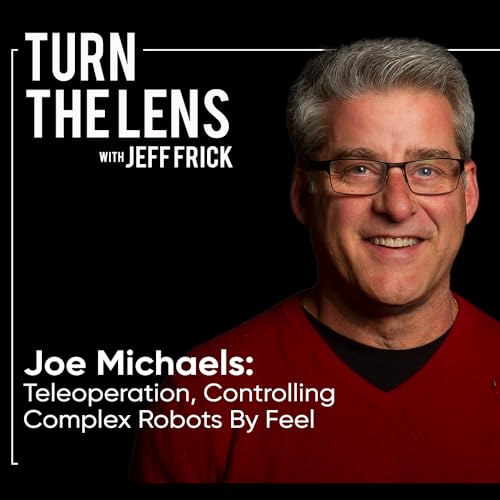
Turn the Lens with Jeff Frick Podcast Por Jeff Frick arte de portada

Turn the Lens with Jeff Frick

Turn the Lens with Jeff Frick

De: Jeff Frick
Escúchala gratis

Turn the Lens is about exploring the people, topics, and pieces of media that help shape my perspective on the world. The concept behind 'turn the lens' is to look beyond the foreground, beyond the obvious, to see things in a different context, to see things that you might have missed before. Let's get past our own bias and point of view to try and look from a broader point of view, to expand our learning beyond the obvious.© Menlo Creek Media, 2020 All rights reserved. Economía
Episodios
  • Werner Kraus: Clean Room Humanoids, Got Particles? Get Certified | Turn the Lens Ep54
    Feb 17 2026

    Werner Kraus leads robotics research at Fraunhofer IPA, where 1,000 engineers work on production systems and the unglamorous infrastructure that makes humanoids commercially viable: standards. Not the headline-grabbing demos, but the 30-40 tests required before a robot can enter a semiconductor clean room. The certification processes that determine if particle emissions from gear grease will contaminate pharmaceuticals. The biomechanical measurements proving that 500 Newtons of collision force is 3x too high for human safety.

    Standards enable commercialization. Without them, you can't get insurance. You can't satisfy business buyers. You can't scale beyond pilot programs. Werner's team at Fraunhofer IPA does the methodical work of defining what "safe" and "clean" actually mean in measurable terms—then working with ISO committees and robot manufacturers to close the gaps between current performance and certification requirements.

    I sat down with Werner to explore how clean room certification works across nine ISO classes, why the Unitree G1 currently achieves ISO Class 5 (semiconductor standard), what 500 Newtons of collision force actually means for human safety, and the surprising discovery his team made about data transmission to China when testing cybersecurity.

    Werner walks through the reality that robots themselves are contamination sources—emitting particles from wear, harboring dirt in crevices, and requiring steel surfaces instead of coatings in pharma environments. He explains why energy efficiency standards matter (the Unitree consumes 280W and requires battery swaps every 100 minutes), how ISO/TS 15066 sets different force limits for different body regions, and why his team consults with manufacturers on design changes to improve safety ratings rather than simply issuing pass/fail grades.

    Clean room certification, collision biomechanics, ISO standards development, cybersecurity testing, energy consumption benchmarking—top concepts covered. But what struck me most was the systematic rigor: not rushing humanoids to market, but methodically defining the thresholds that protect both workers and product integrity.

    That is a robot future built on engineering discipline rather than hype cycles.

    CHAPTERS

    00:00 Introduction: Why Standards Enable Commercialization
    00:45 Fraunhofer IPA: 1,000 Engineers Working on Standards
    02:15 Collision Safety: 500 Newtons is 3-4x Too High
    04:30 Clean Room Certification: Nine ISO Classes, 30-40 Tests
    06:20 Robots Themselves Emit Contaminants
    07:45 Energy Efficiency: 280W Consumption, 100-Minute Battery Life
    09:10 Cybersecurity Discovery: Data Transmission to China Confirmed
    10:30 Consulting with Manufacturers on Design Improvements

    KEY TAKEAWAYS

    • 500N = 112 lbs of force – The Unitree G1's collision force is 3-4x the ISO/TS 15066 safe limit of ~150N for human contact

    • ISO Class 5 for semiconductors – Current humanoid clean room capability, with 30-40 distinct tests required for certification

    • 100-minute battery life – Unitree G1 at 280W consumption; future high-density batteries targeting 4-8 hour shifts

    • Cybersecurity confirmed – Testing verified Unitree robots transmit data to China when connected to internet

    • Robots contaminate too – Gear grease, wear particles, surface materials, and edge geometry all create clean room challenges

    ABOUT WERNER KRAUS

    Werner Kraus is Head of Robotics at Fraunhofer IPA (Institute for Manufacturing Engineering and Automation) in Stuttgart, Germany. He leads standards development and certification testing for collaborative and humanoid robots, working directly with ISO committees and manufacturers on safety, clean room, and performance requirements.

    ABOUT THE SHOW

    Turn the Lens explores the future of work, technology adoption, and the human side of innovation. Hosted by Jeff Frick, the show features in-depth conversations with leaders shaping how we'll work tomorrow.

    This interview is a collaboration between Turn the Lens and Humanoids Summit, and was conducted at Humanoids Summit SV, Computer History Museum, Mountain View, California, December 2025. Humanoids Summit is organized and hosted by ALM Ventures.

    Learn more:
    Humanoids Summit: www.humanoidssummit.com

    Turn the Lens: www.turnthelenspodcast.com

    Work 20XX: www.work20xx.com

    Más Menos
    12 m
  • Chris Kudla: A Humanoid to Hug,' Just Right' Level of Human | Turn the Lens Ep53
    Feb 15 2026

    Chris Kudla, Co-Founder and CEO of Mind Children, explains why his company is building social humanoid robots instead of utility workers. While most humanoids focus on warehouse tasks and manufacturing, Mind Children is tackling the harder problem: creating robots for education, healthcare, hospitality, and elder care—applications where empathy and emotional connection matter most.

    In this conversation from Humanoids Summit 2025, Chris walks through the challenging engineering problem of avoiding the "Uncanny Valley"—that unsettling feeling when robots look almost, but not quite, human. He explains Mind Children's deliberate design choices for their prototype Codey: a 3-foot tall robot with a gray silicone face, nine servo motors creating expressions, and proportions intentionally kept away from human-like features to stay "just right."

    KEY TOPICS:

    • Why social humanoids require different engineering than utility robots

    • The Uncanny Valley phenomenon and strategies to avoid it

    • Codey's animatronic face: 9 servo motors with silicone skin

    • How children naturally engage with robots versus screens

    • Teachers using humanoids as in-class assistants for breakout sessions

    • Students teaching concepts back to Codey to reinforce learning

    • The comfort animal analogy: empowering workers, not replacing them

    • Spinning off from SingularityNET's open-source AI research

    • MVP roadmap: 10-30 pilot units by late 2026

    STANDOUT QUOTES: "We're building a social humanoid robot. Everything revolves around human interaction—education, health care, hospitality—applications where empathy really matters."

    "When we put Codey in front of children, they just run up and want to talk to him. They're not looking at a screen—they're actually communicating in the real world."

    "We made the face gray. A gray face is not very human, but it still maintains emotional expressiveness while staying as far away from the Uncanny Valley as we can be."

    "A really effective learning method is for the student to teach it back to someone else. Students could actually teach Codey, and that reinforces their own learning."

    ABOUT CHRIS KUDLA: Chris Kudla is Co-Founder and CEO of Mind Children, leading development of empathetic humanoid robots for social applications. The company originated as a spinoff from SingularityNET, an open-source, decentralized AI research organization focused on beneficial AI development. Mind Children is currently mid-seed round with plans to deploy pilot units in education and healthcare settings by late 2026.

    PRODUCTS DISCUSSED:

    • Codey: 3-foot tall social humanoid with animatronic face, motorized wheeled base, and mechanical arms/legs designed for educational and healthcare applications

    This interview was conducted in collaboration with Humanoids Summit SV 2025. Humanoids Summit is organized by ALM Ventures.

    LINKS:
    Mind Children : https://mindchildren.com
    SingularityNET: https://singularitynet.io
    Humanoids Summit: https://humanoidssummit.com
    Turn the Lens: https://turnthelenspodcast.com

    Turn the Lens explores how technology impacts work, organizations, and human potential through in-depth conversations with innovators shaping the future of work.

    #HumanoidRobotics #SocialRobots #EmpatheticAI #EducationTechnology #UncannyValley #MindChildren #HumanoidsSummit #FutureOfWork #HumanoidsSummit #TurnTheLens

    Más Menos
    13 m
  • Joe Michaels: Teleoperation, Controlling Complex Robots By Feel | Turn the Lens Ep52
    Feb 13 2026

    Joe Michaels, SVP of Sales and Marketing at 1HMX, explains why haptic feedback and teleoperation are critical for training humanoid robots. While synthetic data and video help robots learn basics, the fine-tuning that makes them truly functional comes from human operators using advanced haptic gloves with 135 points of tactile feedback.

    In this conversation from Humanoids Summit 2025, Joe walks through how HaptX's microfluidic technology creates realistic touch sensations, why video training alone can't handle dexterous manipulation, and how the newly announced Nexus NX1 full-body system enables operators to control humanoid robots with their entire body.

    KEY TOPICS:

    • Why 20-degree-of-freedom robot hands require human teleoperation
    • How 135 tactile actuators provide bidirectional feedback loops
    • The microfluidic technology behind realistic touch sensation
    • Training robots to handle corner cases and edge situations
    • Why industry standards matter more than proprietary solutions
    • Full-body teleoperation with Nexus NX1 (shipping Q2 2026)
    • The economics of robot-as-a-service versus ownership models
    • Safety challenges in deploying powerful machines near humans

    STANDOUT QUOTES:
    "There's a dream of just showing enough video to robots so they can do everything. But that's really not how humans or robots learn complicated things."

    "When you take away someone's sense of touch, their capabilities drop off tremendously. Bringing that back into the robot equation creates a closed loop that makes a very natural and powerful control system."

    "Today's humanoids are getting dexterous—20 degree of freedom robot hands with five digits. You're not going to control that with video. You need to teach that how to behave."

    "When mobility comes into the picture, you don't want to just control it with an Xbox controller. Your full body should be involved. That's what Nexus NX1 is about."

    ABOUT JOE MICHAELS:
    Joe Michaels is Senior Global Vice President of Sales and Marketing at 1HMX (formerly HaptX). With 20+ years building strategic partnerships at Microsoft and as co-founder of Nexchange Corporation, Joe brings deep expertise in emerging technology commercialization. He holds an MBA from The Wharton School and undergraduate degree from Georgetown University.

    PRODUCTS DISCUSSED:

    • HaptX Gloves G1: 135 tactile actuators, 40 lbs force feedback, sub-millimeter motion tracking
    • Nexus NX1: First whole-body teleoperation system combining HaptX Gloves, Virtuix Omni One treadmill, Freeaim robotic shoes, and 72-DOF motion capture

    This interview was conducted in collaboration with Humanoids Summit 2025, organized by ALM Ventures at the Computer History Museum in Mountain View, California.

    LINKS:
    1HMX: https://www.1hmx.com
    HaptX Gloves: https://haptx.com/gloves-g1/
    Nexus NX1: https://www.1hmx.com/nexus
    Humanoids Summit: https://humanoidssummit.com
    Turn the Lens: https://turnthelenspodcast.com

    Turn the Lens explores how technology impacts work, organizations, and human potential through in-depth conversations with innovators shaping the future of work.

    #HumanoidRobotics #Teleoperation #HapticFeedback #RobotTraining #EmbodiedAI #HaptX #FutureOfWork

    Más Menos
    20 m
Todavía no hay opiniones