

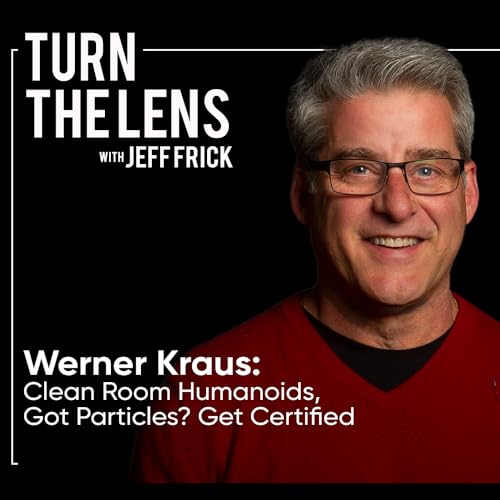
Werner Kraus: Clean Room Humanoids, Got Particles? Get Certified | Turn the Lens Ep54
No se pudo agregar al carrito
Add to Cart failed.
Error al Agregar a Lista de Deseos.
Error al eliminar de la lista de deseos.
Error al añadir a tu biblioteca
Error al seguir el podcast
Error al dejar de seguir el podcast

Werner Kraus: Clean Room Humanoids, Got Particles? Get Certified | Turn the Lens Ep54
-
Narrado por:
-
De:
Werner Kraus leads robotics research at Fraunhofer IPA, where 1,000 engineers work on production systems and the unglamorous infrastructure that makes humanoids commercially viable: standards. Not the headline-grabbing demos, but the 30-40 tests required before a robot can enter a semiconductor clean room. The certification processes that determine if particle emissions from gear grease will contaminate pharmaceuticals. The biomechanical measurements proving that 500 Newtons of collision force is 3x too high for human safety.
Standards enable commercialization. Without them, you can't get insurance. You can't satisfy business buyers. You can't scale beyond pilot programs. Werner's team at Fraunhofer IPA does the methodical work of defining what "safe" and "clean" actually mean in measurable terms—then working with ISO committees and robot manufacturers to close the gaps between current performance and certification requirements.
I sat down with Werner to explore how clean room certification works across nine ISO classes, why the Unitree G1 currently achieves ISO Class 5 (semiconductor standard), what 500 Newtons of collision force actually means for human safety, and the surprising discovery his team made about data transmission to China when testing cybersecurity.
Werner walks through the reality that robots themselves are contamination sources—emitting particles from wear, harboring dirt in crevices, and requiring steel surfaces instead of coatings in pharma environments. He explains why energy efficiency standards matter (the Unitree consumes 280W and requires battery swaps every 100 minutes), how ISO/TS 15066 sets different force limits for different body regions, and why his team consults with manufacturers on design changes to improve safety ratings rather than simply issuing pass/fail grades.
Clean room certification, collision biomechanics, ISO standards development, cybersecurity testing, energy consumption benchmarking—top concepts covered. But what struck me most was the systematic rigor: not rushing humanoids to market, but methodically defining the thresholds that protect both workers and product integrity.
That is a robot future built on engineering discipline rather than hype cycles.
CHAPTERS00:00 Introduction: Why Standards Enable Commercialization
00:45 Fraunhofer IPA: 1,000 Engineers Working on Standards
02:15 Collision Safety: 500 Newtons is 3-4x Too High
04:30 Clean Room Certification: Nine ISO Classes, 30-40 Tests
06:20 Robots Themselves Emit Contaminants
07:45 Energy Efficiency: 280W Consumption, 100-Minute Battery Life
09:10 Cybersecurity Discovery: Data Transmission to China Confirmed
10:30 Consulting with Manufacturers on Design Improvements
• 500N = 112 lbs of force – The Unitree G1's collision force is 3-4x the ISO/TS 15066 safe limit of ~150N for human contact
• ISO Class 5 for semiconductors – Current humanoid clean room capability, with 30-40 distinct tests required for certification
• 100-minute battery life – Unitree G1 at 280W consumption; future high-density batteries targeting 4-8 hour shifts
• Cybersecurity confirmed – Testing verified Unitree robots transmit data to China when connected to internet
• Robots contaminate too – Gear grease, wear particles, surface materials, and edge geometry all create clean room challenges
ABOUT WERNER KRAUSWerner Kraus is Head of Robotics at Fraunhofer IPA (Institute for Manufacturing Engineering and Automation) in Stuttgart, Germany. He leads standards development and certification testing for collaborative and humanoid robots, working directly with ISO committees and manufacturers on safety, clean room, and performance requirements.
ABOUT THE SHOWTurn the Lens explores the future of work, technology adoption, and the human side of innovation. Hosted by Jeff Frick, the show features in-depth conversations with leaders shaping how we'll work tomorrow.
This interview is a collaboration between Turn the Lens and Humanoids Summit, and was conducted at Humanoids Summit SV, Computer History Museum, Mountain View, California, December 2025. Humanoids Summit is organized and hosted by ALM Ventures.
Learn more:
Humanoids Summit: www.humanoidssummit.com
Turn the Lens: www.turnthelenspodcast.com
Work 20XX: www.work20xx.com