Episodios

  • The Hormuz Shock + Why the Fed is “On Hold”
    Apr 16 2026

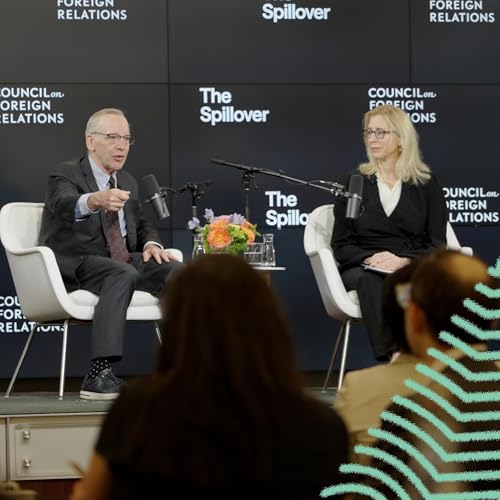
    Live from Washington, DC, this episode unpacks how war, AI, financial innovation, and global institutions are reshaping monetary policy, market stability, and the future of the international economic order.

    Host:

    Rebecca Patterson, Senior Fellow, Council on Foreign Relations

    Guest:

    William C. Dudley, Chair, Bretton Woods Committee; Former President and CEO, Federal Reserve Bank of New York

    We discuss:

    • Whether monetary policy can still do the heavy lifting in a war-shaken macro environment.
    • AI, productivity, and the inflation debate.
    • The future of the Fed as an institution.
    • The rise of non-bank finance and new financial stability risks.
    • How global financial institutions and digital finance must adapt to structural change.

    Mentioned on the Episode:

    Pierre-Olivier Gourinchas, “War Darkens Global Economic Outlook and Reshapes Policy Priorities,” International Monetary Fund (IMF)

    “Chair Powell’s Press Conference”

    The Bretton Woods Committee

    Want to keep up with The Spillover? Sign up to receive an email alert when new episodes are released.

    The Spillover is a production of the Council on Foreign Relations. The opinions expressed on the show are solely those of the hosts and guests, not of the Council, which takes no institutional positions on matters of policy.

    Más Menos
    30 m
  • The Modern Oppenheimer + Mailbag Contest Winners
    Apr 7 2026

    This episode unpacks cohost Sebastian Mallaby’s new book The Infinity Machine and answers audience questions on AI, dollar dominance, the impact of Trump’s foreign policy on midterm elections, and more.

    Hosts:

    Sebastian Mallaby, Paul A. Volcker Senior Fellow for International Economics, Council on Foreign Relations (CFR)

    Rebecca Patterson, Senior Fellow, Council on Foreign Relations (CFR)

    We discuss:

    • Demis Hassabis as a key architect of modern AI and the force behind DeepMind.
    • AI’s upside in medicine and science, especially through AlphaFold and faster drug discovery.
    • The tension between building powerful AI quickly and making it safe.
    • Why the biggest AI winners may be the ones that turn models into useful products.
    • Why the dollar still dominates, even as China and Europe look for ways to challenge it.
    • How Trump’s foreign policy decisions on the Middle East and immigration could sway voters in the upcoming midterm elections.
    • How drones and supply chain choke points are reshaping global conflict.

    Mentioned on the Episode:

    Sebastian Mallaby, The Infinity Machine: Demis Hassabis, DeepMind, and the Quest for Superintelligence, Penguin Random House

    Want to keep up with The Spillover? Sign up to receive an email alert when new episodes are released.

    The Spillover is a production of the Council on Foreign Relations. The opinions expressed on the show are solely those of the hosts and guests, not of the Council, which takes no institutional positions on matters of policy.

    Más Menos
    43 m
  • Private Credit's Black Box + Why It's Not 2008 (But Still Risky)
    Mar 31 2026

    This episode dives into how the opaque growth and structural risks in private credit, combined with global supply shocks and market stress spurred by the Iran war, are creating a uniquely fragile and unpredictable economic landscape.

    Hosts:

    Sebastian Mallaby, Paul A. Volcker Senior Fellow for International Economics, Council on Foreign Relations (CFR)

    Rebecca Patterson, Senior Fellow, Council on Foreign Relations (CFR)

    We discuss:

    • The rapid rise of private credit, its lack of transparency, and why recent bankruptcies are raising red flags.
    • How $10 billion in redemption requests were submitted to major private credit funds in the first quarter of 2026—including major funds Apollo, Ares, and Blackstone.
    • Why this moment isn’t a repeat of 2008, but still presents real risks due to government debt levels and the lack of safety nets for private credit.
    • As Rebecca Patterson, CFR senior fellow, puts it: “No one has any idea what’s going to happen—and that’s exactly the challenge right now.”
    • Current structural risks in private credit, including liquidity mismatches, redemption limits (“gates”), and growing exposure to retail investors.
    • Why financial markets are behaving unusually, with rising bond yields and weakening traditional safe-haven assets.
    • How central banks are stuck between fighting inflation and supporting growth, creating a far more complex policy environment than past crises.

    Mentioned on the Episode:

    Sebastian Mallaby, The Infinity Machine: Demis Hassabis, DeepMind, and the Quest for Superintelligence, Penguin Random House

    Want to keep up with The Spillover? Sign up to receive an email alert when new episodes are released.

    The Spillover is a production of the Council on Foreign Relations. The opinions expressed on the show are solely those of the hosts and guests, not of the Council, which takes no institutional positions on matters of policy.

    Más Menos
    39 m
  • U.S.-China AI Race Escalates + Chip Bans Aren’t Working + A Lesson From Nuclear Proliferation
    Mar 25 2026

    This episode unpacks the evolving U.S.-China AI rivalry, the limits of technological export controls, and what’s really at stake as both countries race to shape the future of intelligence.

    Submit Your Question For a Chance to Win a Copy of Sebastian Mallaby’s Book The Infinity Machine!

    Host:

    Sebastian Mallaby, Paul A. Volcker Senior Fellow for International Economics, Council on Foreign Relations (CFR)

    Guest:

    Chris McGuire, Senior Fellow for China and Emerging Technologies, CFR

    We discuss:

    • How U.S. export controls on chips are slowing China’s AI progress, but not stopping it, as loopholes, smuggling and cloud access weaken enforcement.
    • Why China’s progress is stronger than expected, with competing models only months behind the U.S.
    • As Chris McGuire, CFR senior fellow, puts it: “Whoever has the better AI is going to have the offense-defense advantage in the cyber realm.”
    • Why compute and advanced chips are the real bottleneck.
    • Why the “AI intelligence explosion” is overstated, with real-world deployment slowed by infrastructure, regulation, and human constraints.
    • The tension between containing China and working with it on global AI safety and governance.

    Mentioned on the Episode:

    Sebastian Mallaby, The Infinity Machine: Demis Hassabis, DeepMind, and the Quest for Superintelligence, Penguin Random House

    Chris McGuire, “The New AI Chip Export Policy to China: Strategically Incoherent and Unenforceable,” CFR.org

    Chris McGuire, “Trump’s Reversal on AI Chips is a Historic Blunder,” The Washington Post

    Want to keep up with The Spillover? Sign up to receive an email alert when new episodes are released!

    The Spillover is a production of the Council on Foreign Relations. The opinions expressed on the show are solely those of the hosts and guests, not of the Council, which takes no institutional positions on matters of policy.

    Más Menos
    58 m
  • Iran War Spirals + Oil Shocks Keep Coming + China’s Advantage
    Mar 18 2026

    Submit Your Question For a Chance to Win a Copy of Sebastian Mallaby’s Book The Infinity Machine!

    As the U.S.-Israel conflict with Iran escalates, global markets are absorbing the shocks: oil prices are swinging, inflation expectations are rising, and safe-haven assumptions are being tested. China, by contrast, is looking relatively resilient, buoyed by strategic energy reserves, diversified supply chains, and policy flexibility. This episode examines how the conflict is driving inflation, complicating monetary policy, and handing China a geoeconomic edge.

    Want to keep up with The Spillover? Sign up to receive an email alert when new episodes are released!

    Mentioned on the Episode:

    Sebastian Mallaby, The Infinity Machine: Demis Hassabis, DeepMind, and the Quest for Superintelligence, Penguin Random House

    Coco Feng, “China Issues New Safety Rules for OpenClaw. Here Are the Dos and Don’ts” South China Morning Post

    Hany Abdel-Latif and Adina Popescu, “Spillovers From Large Emerging Economies: How Dominant Is China?,” International Monetary Fund (IMF)

    Michael Langemeier and Joana Colussi, “Farmer Sentiment Drops Sharply at the Start of 2026 as Economic Concerns Increase,” Purdue University/CME Group

    The Spillover is a production of the Council on Foreign Relations. The opinions expressed on the show are solely those of the hosts and guests, not of the Council, which takes no institutional positions on matters of policy.

    Más Menos
    55 m
  • Introducing The Spillover
    Mar 17 2026

    How do critical international developments shape economic and financial markets worldwide? Each week, The Spillover examines the ripple effects of global events across policy, geopolitics, economics, technology, and finance. This podcast helps you better understand what’s happening, and why it matters to businesses, the markets, and the world.

    Más Menos
    2 m
  • Adam Smith’s “The Wealth of Nations” Turns 250 + Free Markets Face Off Against Industrial Policy
    Mar 11 2026

    On the 250th anniversary of Adam Smith’s The Wealth of Nations, this episode revisits a book that laid the foundations of modern economics and then considers the tensions between free markets and industrial policy today. It highlights the ways in which specialization and global trade remain powerful drivers of prosperity, reflecting Smith’s insight that self-interest can benefit society when shaped by competition and institutions, while noting the ongoing relevance of his warnings about moral judgment, the rule of law, and resistance to cronyism.

    Hosts:

    Sebastian Mallaby, Paul A. Volcker Senior Fellow for International Economics, Council on Foreign Relations (CFR)

    Rebecca Patterson, Senior Fellow, Council on Foreign Relations (CFR)

    Mentioned on the Episode:

    “Adam Smith is Misinterpreted and His Influence Overstated,” Economist

    Gita Gopinath, “Geopolitics and its Impact on Global Trade and the Dollar,” International Monetary Fund (IMF)

    Caitlin Oprysko, “Trump’s Return Supercharges Lobbying Revenues,” Politico

    Want to keep up with The Spillover? Sign up to receive an email alert when new episodes are released!

    The Spillover is a production of the Council on Foreign Relations. The opinions expressed on the show are solely those of the hosts and guests, not of the Council, which takes no institutional positions on matters of policy.

    Más Menos
    49 m
  • Iran War Ignites Oil-Shock Stagflation Fears + Who Really Controls the Energy Market?
    Mar 4 2026

    U.S. and Israeli strikes on Iran are disrupting energy markets. Iran’s production capacity has been hit, the Strait of Hormuz has essentially been closed, and Iran’s energy-producing neighbors have been dragged into the conflict. This episode looks at the spillovers from the resulting energy price shock and explores how structural shifts, including a surge in U.S. oil production, China’s emergence as a dominant buyer, and the growth of renewables have reshaped oil’s geopolitical and economic role.

    Hosts:

    Sebastian Mallaby, Paul A. Volcker Senior Fellow for International Economics, Council on Foreign Relations (CFR)

    Rebecca Patterson, Senior Fellow, Council on Foreign Relations (CFR)

    Guest:

    Natasha Kaneva, Head of Global Commodities Research, J.P. Morgan

    Mentioned on the Episode:

    “Outlook for Energy Demand,” International Energy Agency (IEA)

    Ignacio Presno and Andrea Prestipino, “Oil Price Shocks and Inflation in a DSGE Model of the Global Economy,” Federal Reserve

    John Kehoe, “Iran War Oil Inflation is a Nightmare for RBA,” Financial Review

    Want to keep up with The Spillover? Sign up to receive an email alert when new episodes are released!

    The Spillover is a production of the Council on Foreign Relations. The opinions expressed on the show are solely those of the hosts and guests, not of the Council, which takes no institutional positions on matters of policy.

    Más Menos
    44 m