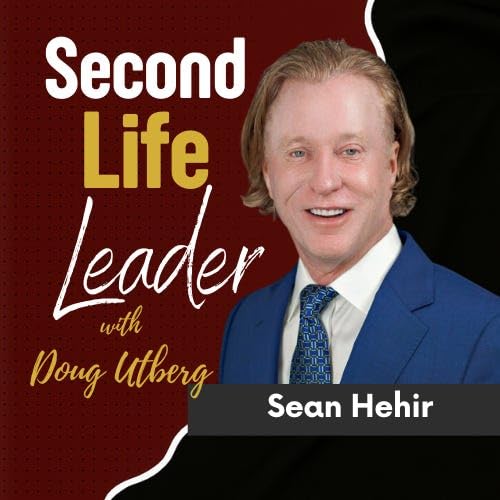
Second Life Leader Podcast Por Doug Utberg arte de portada

Second Life Leader

Second Life Leader

De: Doug Utberg
Escúchala gratis

From Setback to Sovereignty. This platform is for founders, executives, and rebuilders who’ve been knocked down by layoffs, burnout, betrayal, or failure—and refuse to stay down. I’m Doug Utberg. I rebuilt my career, my finances, and my identity from zero, and now I have raw conversations with leaders who’ve walked through fire and rebuilt stronger. Every episode cuts directly into the moments that forge a leader: Career reinvention and self-leadership Burnout recovery and nervous system restoration Ethical entrepreneurship in a post-growth world Systems thinking, AI, and automation for sovereign execution No hype. No guru scripts. Just clarity, truth, and the architecture required to rebuild a life—and a company—that cannot be taken from you. 🔧 CFO Operator Clinic If you lead a finance function, this is where we dismantle the chaos and build real structure: KPI trees Universal journals Transformation architecture Decision systems Semantic-layer design This is the tactical advantage most CFOs never get—and it’s where operators rise. 📍 Book your spot at SecondLifeLeader.com 📩 Go Deeper The show sparks the rebuild. But the newsletter is the operating system—your weekly cadence for clarity, structure, and execution. 👉 Subscribe at DougUtberg.com

www.dougutberg.comDoug Utberg
Economía Exito Profesional Gestión Gestión y Liderazgo
Episodios
  • From Terminal Diagnosis to Total Ownership — Health, Identity, and Survival Value
    Feb 27 2026

    Wellness entrepreneur and former Mr. America Dr. Chris Zaino joins me to unpack what happens when your body collapses—and how that crisis can become the catalyst for a completely different life.

    At 23, Chris had just won Mr. America. Magazine covers. A fitness career taking off. His identity was built on physical strength and appearance.

    Then he was diagnosed with ulcerative colitis. Autoimmune. Incurable. Terminal. Surgery scheduled. Colon removal likely. No guarantee of surviving the procedure. No guarantee of having children.

    Within months, he lost 60 pounds and hit public rock bottom.

    This episode does not sanitize that moment.

    Chris walks through the humiliation, the fear, the failed treatments, and the turning point when someone challenged the belief that he had “tried everything.” That crack in certainty forced him to confront something deeper: responsibility.

    We explore the difference between symptomatic intervention and root-cause ownership. We talk about inflammation, food sourcing, nervous system regulation, and why most people wait for a health crisis before changing behavior. We also unpack the psychology of momentum — how improvement doesn’t start with positivity, but with small evidence that you’re moving in the right direction.

    The conversation expands beyond illness.

    We discuss autonomy in modern life. Cooking from scratch. Learning mechanical skills. Understanding what your food eats. Recalibrating internal economics. Choosing long-term capacity over convenience.

    Chris introduces the idea of “survival value” — structuring your days around actions that increase your long-term strength rather than immediate comfort.

    This is a candid conversation about health, masculinity, identity, discipline, divorce, financial setbacks, and the reality that ownership is rarely convenient.

    The lesson isn’t anti-medicine or motivational hype.

    It’s this: your health is your first business. And without capacity, nothing else scales.

    TL;DR

    Health crises expose identity fragility.Momentum matters more than positivity.Most people change only when pain forces them.You are what your food eats.Autonomy compounds into resilience.Convenience erodes capability.Survival value is a daily filter for better decisions.

    Memorable Lines

    “If you had tried everything, you’d have your health.”“I didn’t need perfect — I just needed progress.”“You are what your food eats.”“Once you see it, you can’t unsee it.”“Health is your greatest asset.”

    Guest

    Dr. Chris Zaino — Wellness entrepreneur, speaker, and founder of one of the largest holistic health clinics in the world.Former Mr. America turned performance health authority focused on inflammation, corrective care, and personal responsibility.

    Instagram: @drzaino

    Why This Matters

    Executives obsess over revenue dashboards while ignoring their own biomarkers.

    Founders track burn rate but neglect the biological system carrying the company.

    In volatile environments, the ultimate edge isn’t intensity — it’s capacity.

    If your health collapses, so does your optionality.

    This episode reframes health not as a lifestyle aesthetic, but as strategic infrastructure.

    Because rebuilding after the hit isn’t only financial.

    It’s physiological.


    This is a public episode. If you would like to discuss this with other subscribers or get access to bonus episodes, visit www.dougutberg.com
    Más Menos
    22 m
  • AI at the Edge, Power Limits, and Why the Future Won’t Live in Data Centers
    Feb 26 2026

    BrainChip CEO Sean Hehir joins me to unpack where artificial intelligence is actually headed—and why the dominant “everything in the data center” narrative is incomplete.

    Most AI conversations fixate on massive models, GPU farms, and trillion-dollar infrastructure bets. This episode shifts the frame. Sean and I explore the structural reality that power consumption, latency, and grid constraints are forcing AI to decentralize—and what that means for founders, engineers, and the broader economy.

    Sean explains how neuromorphic computing and ultra-low-power silicon enable AI inference outside the data center—inside wearables, medical devices, drones, manufacturing systems, and even space applications. We examine why CPUs and GPUs aren’t optimized for edge workloads, how custom silicon changes the economics, and why power efficiency isn’t a side issue—it’s the bottleneck that determines what scales.

    The conversation expands into workforce displacement, labor fluidity, productivity cycles, and whether technological acceleration inevitably creates unemployment crises—or simply reshuffles value creation again, as history repeatedly shows.

    This isn’t a speculative futurism episode. It’s a grounded look at model trends, infrastructure limits, and how companies survive inside a market moving at month-scale rather than decade-scale.

    The lesson isn’t that AI replaces everything.It’s that architecture determines outcomes.

    TL;DR

    * AI is centralizing in data centers—but it’s also rapidly decentralizing to the edge

    * Power constraints will shape the next phase of AI more than hype cycles

    * Neuromorphic and event-driven silicon drastically reduce energy per compute

    * Edge AI enables medical wearables, safety detection, space systems, and industrial automation

    * Models are getting larger—but optimization techniques will shrink them into smaller form factors

    * Productivity gains historically displace tasks—not human adaptability

    * The future isn’t about bigger servers—it’s about smarter distribution

    * Lowest power per compute is a strategic advantage, not a marketing line

    Memorable Lines

    * “Don’t bet against humanity. We’re very creative.”

    * “The future of AI isn’t just in data centers.”

    * “Power isn’t a feature—it’s the constraint.”

    * “If you’re the lowest power solution, you will always have customers.”

    * “Architecture decides what becomes possible.”

    Guest

    Sean Hehir — CEO of BrainChipTechnology executive leading the commercialization of neuromorphic AI processors focused on ultra-low-power edge inference. Oversees BrainChip’s evolution from early engineering innovation to market-driven, customer-focused deployment.

    🔗 https://www.brainchip.com

    Why This Matters

    AI isn’t just a software revolution. It’s an infrastructure decision.

    As compute demand accelerates faster than power grids can sustain, the market will force efficiency. Companies positioned around distributed, power-conscious architecture may shape the next generation of intelligent devices—while centralized models hit physical limits.

    For founders, operators, and executives, this episode highlights a broader strategic reality: technological waves don’t reward hype. They reward positioning at the constraint.

    Right now, the constraint is power.

    And whoever solves that wins.


    This is a public episode. If you would like to discuss this with other subscribers or get access to bonus episodes, visit www.dougutberg.com
    Más Menos
    30 m
  • Beating the Machines, and Whether You Should Even Try
    Feb 25 2026

    Investor and entrepreneur Kevin Steuer joins me to examine whether Main Street investors can compete in a market dominated by algorithms—and whether competing is even the right goal.

    Most investing conversations reduce themselves to slogans: “Just buy index funds” or “Learn to trade like the pros.” This episode does neither. Kevin and I unpack the uncomfortable reality that nearly 90% of U.S. equity volume is now algorithmic—and what that means for individuals trying to generate alpha in a machine-driven market.

    Kevin shares how he acquired Stock TA, a technical analysis platform that had previously been shut down, and why he chose to rebuild it. We explore trend-following versus value investing, passive allocation versus active sector rotation, and the psychology that sabotages most retail traders long before the market does.

    The conversation moves beyond tactics into something deeper: the cost of time. At what point does investing become another job? When does persistence turn into hubris? And how do you measure expected value—not just in portfolio returns, but in hours spent chasing marginal gains?

    This isn’t a promise that trading beats indexing. It’s a sober look at risk, discipline, asymmetric bets, and the reality that markets don’t reward narratives—they reward positioning.

    The lesson isn’t that everyone should trade.It’s that if you do, you need structure, probabilities, and the humility to know what game you’re actually playing.

    TL;DR

    * ~90% of U.S. equity volume is algorithm-driven

    * Retail traders compete against rule-based systems, not other humans

    * Passive indexing may outperform most active traders long-term

    * Trend-following requires discipline—not prediction

    * False breakouts and stop hunts erode returns

    * Scaling into and out of positions reduces emotional decision-making

    * Expected value matters more than win rate

    * Time spent trading is an invisible cost most ignore

    * Persistence without edge becomes hubris

    Memorable Lines

    * “The human brain doesn’t think like a computer.”

    * “The price of anything can be anything.”

    * “Escalator up, elevator down.”

    * “Trend exhaustion—not emotion—should trigger exits.”

    * “If investing becomes a job, calculate the hourly rate.”

    Guest

    Kevin Steuer — Investor and entrepreneurAcquirer and rebuilder of Stock TA, a technical analysis platform focused on trend scores, confluence levels, and sector-based strategy to help Main Street investors navigate algorithmic markets.

    🔗 Stock TA🔗 Kevin Steuer (LinkedIn)

    Why This Matters

    Markets have changed.

    Liquidity is deeper. Machines execute faster. Information spreads instantly. The old debates—value versus growth, passive versus active—don’t capture the structural shift.

    For founders, operators, and executives, investing mirrors business strategy:You’re always allocating capital under uncertainty.

    This episode reframes investing not as prediction—but as risk management, discipline, and clarity about your own personality.

    Because beating the market isn’t just about edge.

    It’s about knowing whether the pursuit itself is worth the cost.


    This is a public episode. If you would like to discuss this with other subscribers or get access to bonus episodes, visit www.dougutberg.com
    Más Menos
    41 m
Todavía no hay opiniones