Saints & Feasts Homilies Podcast Por Fr. Michael Black arte de portada

Saints & Feasts Homilies

Saints & Feasts Homilies

De: Fr. Michael Black
Escúchala gratis

Saints & Feasts Homilies delivers Catholic reflections tied to the yearly cycle of Catholic Masses and rooted in the deepest of deep traditions.Copyright Fr. Michael Black Cristianismo Espiritualidad Ministerio y Evangelismo
Episodios
  • 3-1-26: 2nd Sunday of Lent Readings + Homily
    Mar 1 2026
    A Reading from the Book of Gensis


    The LORD said to Abram: “Go forth from the land of your kinsfolk and from your father’s house to a land that I will show you.“I will make of you a great nation, and I will bless you; I will make your name great, so that you will be a blessing. I will bless those who bless you and curse those who curse you. All the communities of the earth shall find blessing in you.”Abram went as the LORD directed him.


    The Word of the Lord

    Responsorial Psalm

    Lord, let your mercy be on us, as we place our trust in you.

    Upright is the word of the LORD,
    and all his works are trustworthy.
    He loves justice and right;
    of the kindness of the LORD the earth is full.


    R. Lord, let your mercy be on us, as we place our trust in you.

    See, the eyes of the LORD are upon those who fear him,
    upon those who hope for his kindness,
    To deliver them from death
    and preserve them in spite of famine.

    R. Lord, let your mercy be on us, as we place our trust in you.

    Our soul waits for the LORD,
    who is our help and our shield.
    May your kindness, O LORD, be upon us
    who have put our hope in you.

    R. Lord, let your mercy be on us, as we place our trust in you.


    A reading from the 2nd letter off St. Paul to Timothy

    Beloved: Bear your share of hardship for the gospel with the strength that comes from God.He saved us and called us to a holy life, not according to our works but according to his own design
    and the grace bestowed on us in Christ Jesus before time began, but now made manifest
    through the appearance of our savior Christ Jesus, who destroyed death and brought life and immortality to light through the gospel.


    The Word of the Lord


    A reading from the Holy Gospel according to Matthew

    Jesus took Peter, James, and John his brother, and led them up a high mountain by themselves.
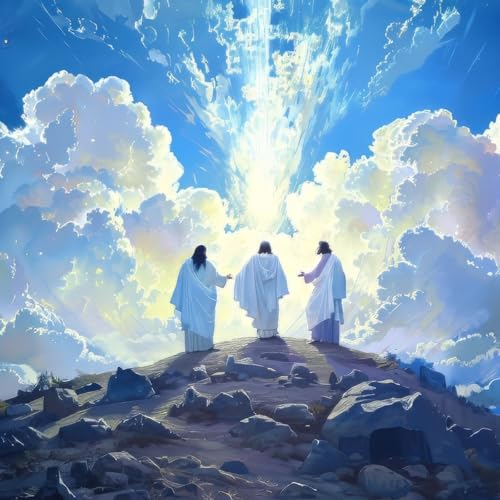
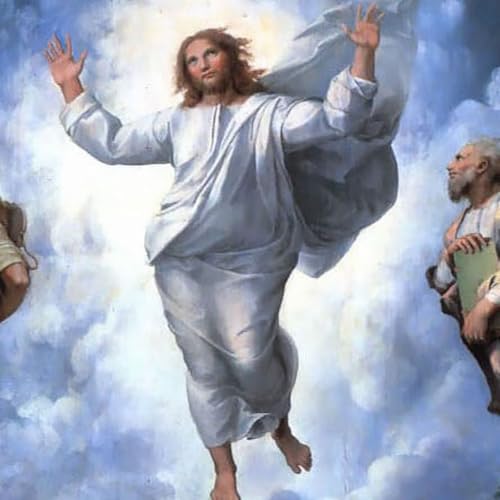
    And he was transfigured before them; his face shone like the sun and his clothes became white as light. And behold, Moses and Elijah appeared to them, conversing with him. Then Peter said to Jesus in reply, “Lord, it is good that we are here. If you wish, I w ill make three tents here,
    one for you, one for Moses, and one for Elijah.” While he was still speaking, behold,
    a bright cloud cast a shadow over them, then from the cloud came a voice that said, “This is my beloved Son, with whom I am well pleased; listen to him.”

    When the disciples heard this, they fell prostrate and were very much afraid. But Jesus came and touched them, saying, “Rise, and do not be afraid.” And when the disciples raised their eyes,
    they saw no one else but Jesus alone.As they were coming down from the mountain,
    Jesus charged them, “Do not tell the vision to anyone until the Son of Man has been raised from the dead.”

    The Gospel of the Lord


    Más Menos
    12 m
  • 3-1-26: 2nd Sunday of Lent Homily
    Mar 1 2026
    Second Sunday of Lent – 3-1-2026 Year A – The Transfiguration The Cloud of Knowing The oldest surviving depiction of Christ’s crucifixion is in Rome. It dates from the 430s and is carved into the wooden doors of the church of Santa Sabina on Rome's Aventine Hill. The carving is not particularly expressive of Christ’s suffering. He is alive and rather dignified. He is between two thieves, and his arms are extended in the traditional pose of the crucifixion. It’s a bit surprising but showing Christ crucified was uncommon in the first few centuries of the Church. Crucifixes, and even paintings and icons of the crucifixion, did not proliferate until the 6th through the 9th centuries, and even then, very slowly. It wasn’t until the dawning of the high Middle Ages, around 1000 AD, that the suffering, bloodied, forlorn Christ on the cross became common in churches throughout the known world. Before he was shown pinned to the cross, Christ was more commonly shown as the Good Shepherd, young and sometimes beardless, or at the table of the Last Supper flanked by his apostles. He was very often shown in the orans, or praying, position. Sometimes he was shown in a Roman toga holding a book or a scroll, resembling a philosopher. Or he was shown as he appears in today’s gospel – Transfigured on a high mountain. It makes sense, culturally and sociologically, that early Christians were reluctant to depict their founder struggling, pained and dead. Crucifixion was an act of capital punishment. And in a world of barbaric cruelty towards prisoners and criminals, showing your leader on a common instrument of torture would probably have been counter-productive. Imagine displaying a painting in your home of a man dying in an electric chair, or wearing a gold medal showing a man with a noose around his neck, hanging from a branch. We have become habituated to the crucifix, but for early Christians it may have been too raw and too confusing to bend their knee or bow their head toward a bloody man stuck to a wooden beam. Not showing Christ on the cross also made sense theologically for early Christianity. A crucifix is easily understood by us today because we have a wealth of teaching and solid traditions to help us interpret it – the God-man dies for our sins and then opens for us the doors to paradise through his bodily resurrection. Christ’s immolation was a multi-layered theological event. It took many centuries for the Church’s best minds to cogently plumb the depths of Christ’s great act of redemptive suffering in its full biblical, historical, liturgical, and philosophical richness. Christ’s miracles, His resurrection, His preaching, and His transfiguration, as opposed to his crucifixion, require less theology to grasp. These events explain themselves. They don’t require knowledge of the Old Testament to make sense. And so the most common artistic motifs of the first millenium show Christ praying, performing miracles, being transfigured, teaching, or rising from his tomb. Centuries were to pass before Christ’s self-offering on the cross could be fully understood by the common mind and fully displayed in common art. Roughly speaking, very roughly, the second millennium church gathered around Christ’s death on Calvary in Jerusalem, while the first millennium church gathered around his crib in Bethlehem. Christ’s humble self-gift in the incarnation led, over centuries, to a deeper comprehension of his self-gift on the cross. The spiritual refreshment pulled from the well of the incarnation is based on humility, a humility witnessed by Peter, James, and John in today’s gospel Christ shows this select core of three apostles his radiant glory – and the apostles are dumbfounded. They have not met this man before. What happened to the carpenter’s son from little Nazareth? The Church fathers consistently commented that the real miracle of the transfiguration was not this one moment in which Christ revealed his divinity but that he consistently suppressed his divinity throughout his life. His ordinariness, the mundane, day in and day out humdrumness of his life was the real miracle to behold. Christ could have been surrounded by today’s super-halo as He planed a board in his workshop. But he wasn’t. He could have walked around in the midst of a cloud of witnesses such as Moses and Elijah. But he didn’t. The voice of His father could have thundered in appreciation at every holy act he performed. But it didn’t. Christ wore a common tunic. He slept on the ground. He ate fish baked over a campfire. He walked long miles on dusty trails. And few discerned his divine nature until his resurrection and ascension. Christ’s first and most significant transfiguration was becoming a baby. His sustained suppression of his divinity was what made him unique. Like superman ripping open his shirt to reveal ...
    Más Menos
    9 m
  • 1st Sunday of Lent 2026 Readings & Homily
    Feb 22 2026
    First Sunday of Lent Readings 2-22-2026 Year C A reading from the Book of Genesis The LORD God formed man out of the clay of the ground and blew into his nostrils the breath of life, and so man became a living being. Then the LORD God planted a garden in Eden, in the east, and placed there the man whom he had formed. Out of the ground the LORD God made various trees grow that were delightful to look at and good for food, with the tree of life in the middle of the garden and the tree of the knowledge of good and evil. Now the serpent was the most cunning of all the animals that the LORD God had made. The serpent asked the woman, “Did God really tell you not to eat from any of the trees in the garden?” The woman answered the serpent: “We may eat of the fruit of the trees in the garden; it is only about the fruit of the tree in the middle of the garden that God said, ‘You shall not eat it or even touch it, lest you die.’” But the serpent said to the woman: “You certainly will not die! No, God knows well that the moment you eat of it your eyes will be opened and you will be like gods who know what is good and what is evil.” The woman saw that the tree was good for food, pleasing to the eyes, and desirable for gaining wisdom. So she took some of its fruit and ate it; and she also gave some to her husband, who was with her, and he ate it. Then the eyes of both of them were opened, and they realized that they were naked; so they sewed fig leaves together and made loincloths for themselves. The Word of the LordResponsorial Psalm R. Be merciful, O Lord, for we have sinnedHave mercy on me, O God, in your goodness; in the greatness of your compassion wipe out my offense. Thoroughly wash me from my guilt and of my sin cleanse me. R. Be merciful, O Lord, for we have sinnedFor I acknowledge my offense, and my sin is before me always: “Against you only have I sinned, and done what is evil in your sight.” R. Be merciful, O Lord, for we have sinned. A clean heart create for me, O God, and a steadfast spirit renew within me. Cast me not out from your presence, and your Holy Spirit take not from me. R. Be merciful, O Lord, for we have sinned. Give me back the joy of your salvation, and a willing spirit sustain in me. O Lord, open my lips, and my mouth shall proclaim your praise. R. Be merciful, O Lord, for we have sinned. A reading from the letter of St. Paul to the Romans Brothers and sisters: Through one man sin entered the world, and through sin, death, and thus death came to all men, inasmuch as all sinned— for up to the time of the law, sin was in the world, though sin is not accounted when there is no law. But death reigned from Adam to Moses, even over those who did not sin after the pattern of the trespass of Adam, who is the type of the one who was to come. But the gift is not like the transgression. For if by the transgression of the one, the many died, how much more did the grace of God and the gracious gift of the one man Jesus Christ overflow for the many. And the gift is not like the result of the one who sinned. For after one sin there was the judgment that brought condemnation; but the gift, after many transgressions, brought acquittal. For if, by the transgression of the one, death came to reign through that one, how much more will those who receive the abundance of grace and of the gift of justification come to reign in life through the one Jesus Christ. In conclusion, just as through one transgression condemnation came upon all, so, through one righteous act, acquittal and life came to all. For just as through the disobedience of the one man the many were made sinners, so, through the obedience of the one, the many will be made righteous.The Word of the LordA reading from the Hoiy Gospel according to MatthewAt that time Jesus was led by the Spirit into the desert to be tempted by the devil. He fasted for forty days and forty nights, and afterwards he was hungry. The tempter approached and said to him, “If you are the Son of God, command that these stones become loaves of bread.” He said in reply, “It is written: One does not live on bread alone, but on every word that comes forth from the mouth of God.” Then the devil took him to the holy city, and made him stand on the parapet of the temple, and said to him, “If you are the Son of God, throw yourself down. For it is written: He will command his angels concerning you and with their hands they will support you, lest you dash your foot against a stone.” Jesus answered him, “Again it is written, You shall not put the Lord, your God, to the test.”Then the devil took him up to a very high mountain, and showed him all the kingdoms of the world in their magnificence, and he said to him, ""All these I shall give to you, if you will prostrate yourself and worship me.” At this, Jesus said to him, “Get away, Satan! It is written: The Lord, your God, shall ...
    Más Menos
    18 m
Todavía no hay opiniones