3-1-26: 2nd Sunday of Lent Homily Podcast Por  arte de portada

3-1-26: 2nd Sunday of Lent Homily

3-1-26: 2nd Sunday of Lent Homily

Escúchala gratis

Ver detalles del espectáculo
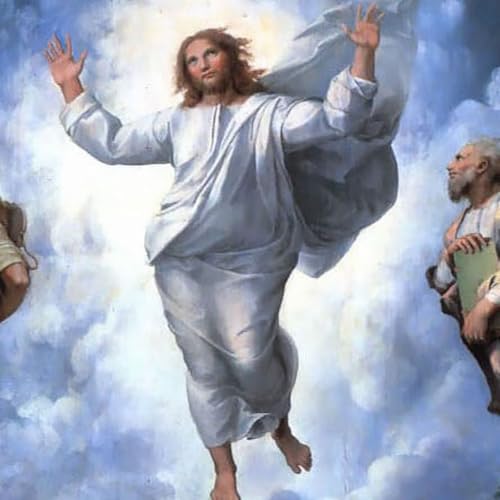
Second Sunday of Lent – 3-1-2026 Year A – The Transfiguration The Cloud of Knowing The oldest surviving depiction of Christ’s crucifixion is in Rome. It dates from the 430s and is carved into the wooden doors of the church of Santa Sabina on Rome's Aventine Hill. The carving is not particularly expressive of Christ’s suffering. He is alive and rather dignified. He is between two thieves, and his arms are extended in the traditional pose of the crucifixion. It’s a bit surprising but showing Christ crucified was uncommon in the first few centuries of the Church. Crucifixes, and even paintings and icons of the crucifixion, did not proliferate until the 6th through the 9th centuries, and even then, very slowly. It wasn’t until the dawning of the high Middle Ages, around 1000 AD, that the suffering, bloodied, forlorn Christ on the cross became common in churches throughout the known world. Before he was shown pinned to the cross, Christ was more commonly shown as the Good Shepherd, young and sometimes beardless, or at the table of the Last Supper flanked by his apostles. He was very often shown in the orans, or praying, position. Sometimes he was shown in a Roman toga holding a book or a scroll, resembling a philosopher. Or he was shown as he appears in today’s gospel – Transfigured on a high mountain. It makes sense, culturally and sociologically, that early Christians were reluctant to depict their founder struggling, pained and dead. Crucifixion was an act of capital punishment. And in a world of barbaric cruelty towards prisoners and criminals, showing your leader on a common instrument of torture would probably have been counter-productive. Imagine displaying a painting in your home of a man dying in an electric chair, or wearing a gold medal showing a man with a noose around his neck, hanging from a branch. We have become habituated to the crucifix, but for early Christians it may have been too raw and too confusing to bend their knee or bow their head toward a bloody man stuck to a wooden beam. Not showing Christ on the cross also made sense theologically for early Christianity. A crucifix is easily understood by us today because we have a wealth of teaching and solid traditions to help us interpret it – the God-man dies for our sins and then opens for us the doors to paradise through his bodily resurrection. Christ’s immolation was a multi-layered theological event. It took many centuries for the Church’s best minds to cogently plumb the depths of Christ’s great act of redemptive suffering in its full biblical, historical, liturgical, and philosophical richness. Christ’s miracles, His resurrection, His preaching, and His transfiguration, as opposed to his crucifixion, require less theology to grasp. These events explain themselves. They don’t require knowledge of the Old Testament to make sense. And so the most common artistic motifs of the first millenium show Christ praying, performing miracles, being transfigured, teaching, or rising from his tomb. Centuries were to pass before Christ’s self-offering on the cross could be fully understood by the common mind and fully displayed in common art. Roughly speaking, very roughly, the second millennium church gathered around Christ’s death on Calvary in Jerusalem, while the first millennium church gathered around his crib in Bethlehem. Christ’s humble self-gift in the incarnation led, over centuries, to a deeper comprehension of his self-gift on the cross. The spiritual refreshment pulled from the well of the incarnation is based on humility, a humility witnessed by Peter, James, and John in today’s gospel Christ shows this select core of three apostles his radiant glory – and the apostles are dumbfounded. They have not met this man before. What happened to the carpenter’s son from little Nazareth? The Church fathers consistently commented that the real miracle of the transfiguration was not this one moment in which Christ revealed his divinity but that he consistently suppressed his divinity throughout his life. His ordinariness, the mundane, day in and day out humdrumness of his life was the real miracle to behold. Christ could have been surrounded by today’s super-halo as He planed a board in his workshop. But he wasn’t. He could have walked around in the midst of a cloud of witnesses such as Moses and Elijah. But he didn’t. The voice of His father could have thundered in appreciation at every holy act he performed. But it didn’t. Christ wore a common tunic. He slept on the ground. He ate fish baked over a campfire. He walked long miles on dusty trails. And few discerned his divine nature until his resurrection and ascension. Christ’s first and most significant transfiguration was becoming a baby. His sustained suppression of his divinity was what made him unique. Like superman ripping open his shirt to reveal ...
Todavía no hay opiniones