SaaS Fuel Podcast Por Jeff Mains arte de portada

SaaS Fuel

SaaS Fuel

De: Jeff Mains
Escúchala gratis

Want to know why some SaaS companies scale while others stagnate? It's not just code and capital. You've found SaaS Fuel, where every Tuesday and Thursday, we're brewing up the kind of conversations you wish you could have over coffee with successful founders and industry experts. Join five-time entrepreneur and adventure seeker Jeff Mains every Tuesday as he gets real with visionary founders and executives who've built stellar software companies. They share the raw truth about their ups, downs, and 'I can't believe that worked' moments. Looking for practical tips you can use right now? Our Thursday 'SaaS Fuel Expert Series' brings you the smartest minds in the game, dishing out actionable advice on everything from AI and marketing to sales strategies and leadership. No fluff, just real tactics that are working right now. This isn't your typical 'how I built this' show. Whether you're figuring out product-market fit, building your first real team, or pushing past that million-dollar milestone, each episode packs the kind of insights you'd normally have to learn the hard way. Let's face it – running a SaaS company can feel like juggling while riding a unicycle. But you're not alone. Join our growing crew of founders and leaders who are figuring it out together, one episode at a time. New episodes drop every Tuesday and Thursday. Fuel your next big move. Hit subscribe and let's grow something amazing.Copyright 2026 Jeff Mains Ciencias Sociales Economía Escritos y Comentarios sobre Viajes Gestión y Liderazgo Liderazgo Marketing Marketing y Ventas
Episodios
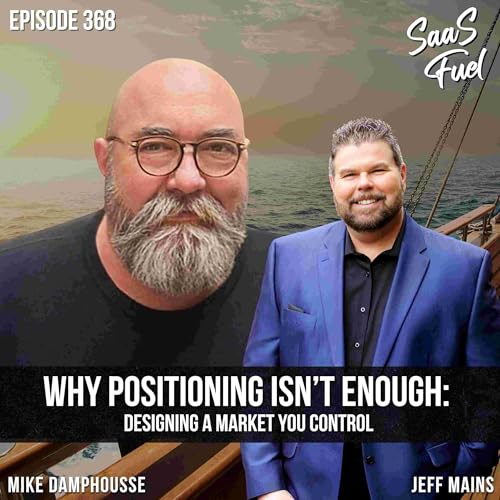
  • Why Positioning Isn’t Enough: Designing a Market You Control | Mike Damphousse | 368
    Mar 5 2026
    In this episode of SaaS Fuel, host Jeff Mains sits down with Mike "Damp" Damphousse, co-founder of Category Design Advisors and co-author of "The Category Creation Formula." With three decades of experience as a founder, CEO, CMO, investor, and advisor, Mike reveals why most companies lose before they even start—not because their product is weak, but because they're competing in categories defined by someone else.Key Takeaways[4:05] - The product-market fit trap: Mike's 1990s startup had amazing product configuration technology, but failed because they didn't condition the market to understand the new category emerging[9:18] - Category winners take 75% of economics: Research from "Play Bigger" shows category designers capture 75% of the economic value in their category over time—Apple takes 75% of smartphone profits despite not having the most revenue[12:02] - Why positioning is dangerous: The word "positioning" implies you're positioning against somebody—if you're comparing yourself to others, you've already lost the battle because someone else set the rules[14:11] - The anchoring effect: The first company that introduces you to the solution to your problem becomes the company you remember over time—this cognitive bias is the underlying strength of categories[22:23] - Category POV as constitution: When you write your category point of view, have people sign it like the constitution—one CEO painted it on the cafeteria wall. It becomes the DNA of everything from product development to hiring[23:15] - The 800-word story structure: A category point of view is an 800-1000-word narrative that starts with the problem (50% of the story), paints ramifications so clearly the audience sees the solution, then introduces the category—not the brand—as the answer[39:36] - The category formula: Context + Missing + Innovation = New Category. Every successful category has these three attributes: a context shift (like COVID for Zoom), something missing in the market, and your innovation that fills the gap[44:00] - Apple's "There's an app for that": Apple didn't just create a better phone—they introduced a point of view that every problem you have, there's an app that'll solve it. That's category-level thinkingTweetable Quotes💡 "If you're comparing yourself to others, you've already lost the battle because somebody else set the rules for that category." - Mike Damphousse🎯 "Category designers take 75% of the economics. Apple takes 75% of smartphone profits—they don't even have the most revenue." - Mike Damphousse🔥 "Most marketers say 'we're bigger, better, faster.' What causes people to react? 'I have a cut on my finger and you gave me a bandaid.' That's category solution thinking." - Mike Damphousse⚡ "The first company that introduces you to the solution to your problem becomes the company you remember over time. It's called the anchoring effect." - Mike DamphousseSaaS Leadership Lessons1. Market-Product Fit = Product-Market Fit You can have the greatest product in the world, but if you don't condition the market to accept it with a solid point of view people are willing to adopt, you'll miss the boat. Start with the problem, not the product. When you lead with the problem, people emotionally embrace your solution.2. Set the Rules or Play by Someone Else's Category leaders get the luxury of defining the rules everyone else must follow. Uber set the rules for rideshare—every competitor now looks like Uber. If you're positioning against competitors, you're playing an uphill battle in a game where they control the scoring system.3. The Whole Executive Team Must Be Aligned Category design only works when the CEO leads and the entire C-suite is committed. This isn't a marketing initiative—it requires group therapy for the executive team where every word is chosen together. When everyone owns it, they march to the same drum and plant the category flag together.Guest ResourcesFree Office Hours: Book 30 minutes with Mike and Kevin at categorydesignadvisors.commike@categorydesignadvisors.comTheCategoryCreationFormula.comCategoryDesignAdvisors.com(617) 804-6222 [TEXT]LinkedIn Link: https://www.linkedin.com/in/damphoux/X: https://x.com/damphouxEpisode SponsorThe Captain's KeysSmall Fish, Big Pond – https://smallfishbigpond.com/ Use the promo code ‘SaaSFuel’Champion Leadership Group – https://championleadership.com/SaaS Fuel ResourcesWebsite - https://championleadership.com/Jeff Mains on LinkedIn - https://www.linkedin.com/in/jeffkmains/Twitter - https://twitter.com/jeffkmainsFacebook - https://www.facebook.com/thesaasguy/Instagram - https://instagram.com/jeffkmains
    Más Menos
    54 m
  • Scaling SaaS in the Early Days—and What Founders Can Learn Today | Drew Sechrist | 367
    Mar 3 2026
    Drew Sechrist, CEO and co-founder of Connect the Dots, takes us on a journey from being Salesforce's 36th employee to building his own venture addressing one of B2B sales' most persistent challenges: unlocking the hidden power of professional networks. In this conversation, Drew shares inside stories from Salesforce's scrappy early days in 1999, when "SaaS" didn't even exist as a term and the company spent VC money "like drunken sailors" to hire account executives who gave away a beta product for free.The core of the episode focuses on Connect the Dots' mission: making warm introductions scalable and measurable. Drew explains why the traditional sales pillars of inbound and outbound are suffering in the AI era, and why "Go-to-Network" (GTN) represents the critical third pillar that AI can't destroy because it's built on real human relationships. This is essential listening for any SaaS founder struggling with cold outreach fatigue and looking to unlock their most underutilized growth asset: their extended network.Key Takeaways[00:00] Introduction to Drew Sechrist and the power of network-based growth vs. cold outreach[04:00] Drew's early career: implementing client-server CRM tools in the pre-SaaS era (Goldmine, Sales Logics, CD-ROMs)[08:00] The birth of ASP (Application Service Provider) - reading about Salesforce in the Wall Street Journal, 1999[10:00] The cold email that changed everything: reaching out to Mark Benioff and getting hired as employee #36[13:00] Category creation at Salesforce: from ASP to "on-demand" to SaaS to "cloud" - Mark Benioff defining a new market[15:00] The dotcom boom launch: B-52s playing at the launch party, spending VC money freely, hiring AEs to give away free beta product[18:00] The pivot to paid: introducing the $50/user/month model with no contracts - proving people would pay for "a website"[22:00] Scaling through the dotcom bust: losing dotcom customers but winning larger enterprises with smaller budgets[25:00] The golden handcuffs: why it was "never a good time to leave" Salesforce even after 10 years[28:00] The Mexico motorcycle sabbatical: conceiving Kuzo while riding through Baja in 2007-2008[30:00] Kuzo's vision: live Google Street View powered by crowdsourced cameras - a startup that ultimately shut down[32:00] The connection theme: from Kuzo to Connect the Dots - helping people see and leverage their networks[34:00] The core problem: thousands of missed opportunities because you can't see who you really know well enough to leverage[36:00] LinkedIn's limitation: binary connections that don't signal relationship strength (best friend vs. 30-second conference interaction)[39:00] The billion-dollar question: will people actually make introductions? The nuance of asking mom vs. board members vs. customers[42:00] Network inheritance: Drew's biggest career hack was joining Salesforce and inheriting Mark Benioff's network overnight[45:00] Investor selection strategy: you're not just getting money, you're buying a network - be intentional about your cap table[47:00] AI's role in relationship-based sales: surfacing the right relationships at the right time, not replacing human connection[50:00] The third pillar: "Go-to-Network" (GTN) emerges as inbound and outbound suffer from AI saturation[52:00] Real relationships can't be destroyed by AI: when you call your mom, she picks up - that's the power of authentic networks[54:00] Action step for founders: sign up for Connect the Dots (ctd.ai) - free for individuals, paid for companiesTweetable Quotes💡 "You're not just getting money from your investors, you're getting network. Are you taking just money, or are you buying a network?" - Drew Sechrist💡 "AI is destroying inbound and outbound. But the third pillar—Go-to-Network—can't be destroyed because those are real relationships built over a lifetime." - Drew Sechrist💡 "LinkedIn connections are binary. Your best friend and someone you met for 30 seconds at a conference 14 years ago look exactly the same." - Drew Sechrist💡 "The biggest hack in my career was getting hired by Mark Benioff. I had no network. Within months, I inherited the network of 35 colleagues plus investors and beta customers." - Drew Sechrist💡 "Don't make bad asks of busy people. One targeted request to a strong relationship beats seven random LinkedIn connection requests." - Drew Sechrist💡 "World-class networkers love having a reason to reach out. 'PS: We're long overdue for lunch' turns an intro request into relationship renewal." - Drew Sechrist💡 "Back in 1999, selling software meant: 'What am I gonna sell? I won't have a CD-ROM to give them. I'm just gonna sell them a website?' Well, sure enough, they paid." - Drew Sechrist💡 "For every warm intro that turned into a deal at Salesforce, we knew there were thousands we were missing because we couldn't see what relationships we had at our disposal." - Drew SechristSaaS Leadership Lessons1. Inherit Network Through Strategic Hiring ...
    Más Menos
    54 m
  • How to Create a Brand That People Feel (Not Just Understand) | Marc Rust | 366
    Feb 26 2026

    In this episode of SaaS Fuel, Jeff Mains sits down with Marc Rust, founder of Consequently Creative, to challenge everything you think you know about branding. Marc reveals why the strongest brands aren't built on logos and taglines—they're built on relationships, courtship, and genuine human connection.

    You'll discover why "different is always better," how visual storytelling requires education and courtship, and why the interview process should focus on hunger, not resumes. Marc delivers a master class in putting people first, technology last, and building brands that create emotional resonance in an increasingly automated world.

    Key Takeaways

    [4:30] - Branding as the operating system for transformation and growth—not a nice-to-have, but the foundation for how companies evolve

    [5:55] - The AI capability trap: Technology is being sold based on what it can do, not what humans actually need it to do

    [7:17] - Why the Segway failed: Lack of tangible examples and use cases people could identify with (spoiler: only mall cops use them)

    [10:40] - The POST method framework: People → Objectives → Strategy → Technology (not technology first)

    [11:53] - Courtship in branding: Building relationships requires pacing—don't propose on the first date

    [14:07] - The John Hancock disaster: $60-per-click ads driving traffic to pages that didn't sell what customers wanted

    [19:30] - Don't make it about you: Focus on your audience's needs, not your own features and capabilities

    [25:45] - Hiring for hunger: Job interviews should reveal passion and drive, not rehash the resume

    [29:00] - The playground philosophy: Good playgrounds challenge kids and create healthy fear—easy things don't build character

    [31:00] - Education as courtship: Walking people through design choices (like using red) builds appreciation and buy-in

    [34:15] - Brand color recognition: How cell phone carriers own colors so deeply you know exactly who "the blue one" is

    [35:30] - The Marlboro Formula One story: When cigarette ads were banned, they just showed "red and white racing car"—the brand connection was already there

    [40:00] - The clarity checklist: What do you do? Who is it for? Why does it matter? What makes you different? What happens next?

    Tweetable Quotes"Branding is not a nice-to-have—it's the operating system for transformation and growth." — Marc Rust"AI needs to be viewed as a tool first and foremost, not sold based on capability." — Marc Rust"Don't make it about you. It's about your audience. We live in a 'me, me, me' era—so if you focus on them, you'll have engagement." — Marc Rust"Trust comes only from value. Value + value + value = trust eventually." — Marc Rust"The interview is not a time to go over the resume. Find out if people are hungry." — Marc Rust"A good playground is challenging, has risk in it, and makes kids a little scared. Easy things in life don't bring you anywhere." — Marc Rust (via playground CEO)"Different is always better. Different people are interesting. Same people are boring." — Marc RustSaaS Leadership Lessons1. Start with People, Not Technology (The POST Method)

    Stop leading with what your technology can do and start with what your people need it to do. Follow the POST framework: People (audience

    Más Menos
    47 m
Todavía no hay opiniones