Resilience Development in Action: First Responder Mental Health Podcast Por Steve Bisson arte de portada

Resilience Development in Action: First Responder Mental Health

Resilience Development in Action: First Responder Mental Health

De: Steve Bisson
Escúchala gratis

OFERTA POR TIEMPO LIMITADO | Obtén 3 meses por US$0.99 al mes

$14.95/mes despues- se aplican términos.

Discover practical resilience strategies that transform lives. Join Steve Bisson, licensed mental health counselor, as he guides first responders, leaders, and trauma survivors through actionable insights for mental wellness and professional growth.

Each week, dive deep into real conversations about grief processing, trauma recovery, and leadership development. Whether you're a first responder facing daily challenges, a leader navigating high-pressure situations, or someone on their healing journey, this podcast delivers the tools and strategies you need to build lasting resilience.

With over 20 years of mental health counseling experience, Steve brings authentic, professional expertise to every episode, making complex mental health concepts accessible and applicable to real-world situations.

Featured topics include:
• Practical resilience building strategies
• First responder mental wellness
• Trauma recovery and healing
• Leadership development
• Grief processing
• Professional growth
• Mental health insights

• Help you on your healing journey

Each week, join our community towards better mental health and turn your challenges into opportunities for growth with Resilience Development in Action.

© 2026 Resilience Development in Action: First Responder Mental Health
Ciencia Ciencias Sociales Desarrollo Personal Higiene y Vida Saludable Psicología Psicología y Salud Mental Éxito Personal
Episodios
  • E.238 Part 2 How Shift Work, Hypervigilance, And Silence Erode Love—and What We Can Do About It
    Jan 9 2026

    Send us a text

    In part 2 with Alexa Silva, we discuss how love doesn’t clock out when the tones drop. We sat down to unpack what really happens when a first responder’s world of shift work, hypervigilance, and on-call stress collides with the everyday demands of family life—and why even strong couples can drift into silence, scorekeeping, and resentment without clear structure and care.

    Across a candid, fast-moving conversation, we dig into how intimacy has to evolve over time, especially when schedules are brutal and sleep is scarce. We talk about the danger of tallying sex and affection, the quiet slide into emotional affairs powered by loneliness and praise, and the small, steady actions that rebuild safety: consistent compliments, micro-moments of touch, and explicit “ask for what you need” scripts. You’ll hear practical frameworks for decompression after shifts, deciding whether you want listening or solutions, and using shared calendars to lower friction when overtime or call-outs derail plans.

    We also get honest about money, overtime, and the resentment loop that forms when one partner feels like both parents while the other chases a bigger paycheck. There’s a path out: monthly “state of us” check-ins, clear rules for spending, and tradeoffs made in daylight instead of assumptions made in anger. We cover role clarity—your spouse can be your partner, not your therapist—plus the kind of self-care that actually restores a nervous system hammered by trauma exposure. Whether you’re a cop, firefighter, medic, dispatcher, or the person holding down the fort at home, these tools meet the reality of your life.

    If you’re ready to replace mind reading with honest asks and turn resentment into repair, hit play. Then tell us what changed after you tried one tool. Subscribe, share with your crew, and leave a review to help more first responder families find the support they deserve.

    To reach Alexa, here is the link: https://www.psychologytoday.com/us/therapists/alexa-silva-chelmsford-ma/1140390

    Freed.ai: We’ll Do Your SOAP Notes!
    Freed AI converts conversations into SOAP note.Use code Steve50 for $50 off the 1st month!

    Disclaimer: This post contains affiliate links. If you make a purchase, I may receive a commission at no extra cost to you.

    Support the show


    YouTube Channel For The Podcast


    Más Menos
    32 m
  • E.238 Part 1 Inside The Therapy Room: Addiction, Culture, And Trust
    Jan 7 2026

    Send us a text

    The badge asks for everything, then hands you a shift change and a smile. We sat down with returning guest, licensed clinical social worker Alexis Silva, to dig into the quiet realities behind the uniform: why trust is scarce, why stigma is sticky, and how substance use becomes a steady companion long before it becomes a crisis. Alexis works almost exclusively with first responders, military, and veterans, and brings her own sobriety and family experience to the table. That honesty opens a door many are afraid to touch—because careers are on the line, documentation feels risky, and walking into a room where you don’t have to translate the language of the job can be the difference between shutting down and speaking up.

    We break apart common myths: not every struggle is trauma from the job; for many, it starts with childhood adversity, genetics, and family patterns. Alcohol, THC, and benzos promise relief and steal sleep, fueling irritability, poor decisions, and conflict at home. We unpack the tipping point where use shifts from choice to maintenance—when your body drives the next drink—and why matching care to risk matters. Sometimes inpatient comes first, then outpatient therapy and groups, so progress isn’t crushed by daily stress. We also go beyond substances to behavioral addictions like gambling, tracing how the chase hooks into the same adrenaline circuits that make first responders so good under pressure.

    Across the hour, we map practical steps you can use today: how to assess risk without shame, how to reset routines every few career years, what honest partner check-ins sound like, and how peer support and culturally competent clinicians reduce fear of being “the problem” at the station. If you’ve wondered whether your coping is helping or hiding, this conversation offers a clear path forward—grounded, direct, and built for people who don’t have time for fluff.

    If this resonates, follow the show, share it with a teammate, and leave a quick review to help other first responders find it. Your story isn’t a liability—it’s a starting point.

    If you want to reach Alexa, please go to https://www.psychologytoday.com/us/therapists/alexa-silva-chelmsford-ma/1140390

    Freed.ai: We’ll Do Your SOAP Notes!
    Freed AI converts conversations into SOAP note.Use code Steve50 for $50 off the 1st month!

    Disclaimer: This post contains affiliate links. If you make a purchase, I may receive a commission at no extra cost to you.

    Support the show


    YouTube Channel For The Podcast


    Más Menos
    29 m
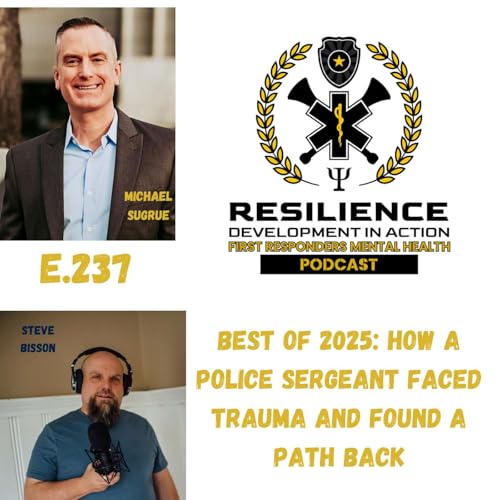
  • E.237 Best of 2025: How A Police Sergeant Faced Trauma And Found A Path Back
    Dec 31 2025

    Send us a text

    The most downloaded conversation of the year returns for a reason: it’s the raw, practical guide first responders and their families keep asking for. We sit with Sgt. Michael Sugrue—Air Force security forces veteran, Walnut Creek Police sergeant, and author of Relentless Courage—to talk about the weight of hundreds of traumatic calls, how a 2012 shooting upended his life, and the exact steps that pulled him back from the edge.

    Michael breaks down why suicide remains the top threat for police, fire, EMS, and dispatch: a culture that prizes invincibility, training that skips mental readiness, and an identity so fused to the job that retirement can feel like free fall. He explains how “silent” suicides hide in line‑of‑duty risks, why official counts underreport the crisis, and what leadership must do to turn the tide. We go deep on solutions: culturally competent therapy, confidential peer lines, retreats like West Coast Post‑Trauma Retreat and Save A Warrior, and daily practices—meditation, gratitude, strength work, honest conversations—that sustain real resilience.

    We also challenge common myths. Therapy doesn’t take your gun; it gives you your life back. EMDR helps many but not all; the real power is a personalized toolkit. Early intervention keeps stress acute and treatable; waiting turns injuries into entrenched patterns that cost careers and families. Michael’s book, co‑authored with Dr. Shauna Springer, bridges the gap between gut‑level storytelling and clear psychology, giving responders and loved ones a shared language to start hard conversations and map a path forward.

    If you serve—or love someone who does—this is a roadmap to stay in the fight without losing yourself. Hit play, share it with a partner or teammate, and let’s normalize help as a standard of care. If the episode resonates, subscribe, leave a quick review, and pass it to one person who needs to hear it today.

    You can reach Michael on LinkedIn at: https://www.linkedin.com/in/sgtmichaelsugrue?utm_source=share&utm_campaign=share_via&utm_content=profile&utm_medium=ios_app

    Support the show


    YouTube Channel For The Podcast


    Más Menos
    40 m
Todavía no hay opiniones