Episodios

  • Why Your Store P&L Is Lying to You
    Apr 17 2026
    If your digital team and your store team are arguing over attribution, you don't have a measurement problem. You have a customer problem. Most retailers still treat stores like isolated P&Ls—judged on what happens inside four walls. But something else happens the moment a store opens: Search spikes. Traffic shifts. Conversion improves—everywhere. On the ground with Courtney Hawkins of Mejuri, we got into why the real metric isn't store revenue. It’s market-level impact. HERE'S THE SHIFT: 💡 Stores aren't just sales channels—they're demand engines: A physical presence lifts digital performance across an entire metro. 🚀 Attribution models are fighting the wrong battle: When teams protect "their" numbers, they miss what’s actually driving growth. 📈 The store is your most underpriced asset: Marketing, fulfillment, brand—wrapped into one. THE BIGGER IDEA: • Customers don't think in channels. • So why do our org charts and P&Ls?
    Más Menos
    18 m
  • Stress-Testing (Retail?) Vendors in the AI Era with Levain Bakery
    Apr 16 2026
    Most retail AI isn’t solving problems; it’s hiding them. The industry is currently addicted to "overlays" - cheap, automated layers that promise instant compliance - but building on a mask is just waiting for the legal or operational consequences to catch up. At Shoptalk, Gustavo Cardona ,VP of Technology, Levain Bakery, joined us to dismantle the "plug-and-play" fallacy. For a brand scaling from a neighborhood bakery to a national powerhouse, technology isn't a silver bullet—it’s a foundation. Cardona’s playbook rejects "set-it-and-forget-it" tools in favor of code remediation (fixing the source, not the surface) and API flexibility. By integrating eight source systems into one "cent-perfect" data warehouse, Levain Bakery transformed tech from a cost center into a strategic engine. This shift ensures that whether it's accessibility compliance or holiday logistics, the brand isn't just reacting to the market—it’s engineered to lead it. - Remediation Over Overlays: Don’t use AI band-aids for web accessibility. The Unlock: Fixing the underlying code (remediation) de-risks the business and ensures a truly equitable customer experience. - The "Cent-Perfect" Peace Treaty: Unified data ends internal friction. The Unlock: When Finance and Operations pull from the same "fountain," the organization stops debating the data and starts acting on it. - APIs are the Chariot; AI is the Cherry: Don't buy a vendor for their AI features alone. The Unlock: Prioritize API flexibility so your "chariot" (infrastructure) can handle 10x seasonal surges. - Role-Based Reporting: "Dashboard fatigue" is a personalization failure. The Unlock: If a CEO can’t make a decision based on a report that day, the report has failed. The Takeaway: Innovation isn't about having the most AI; it’s about having the most discipline. The winners of this era will be those with the cleanest code and the most integrated data.
    Más Menos
    15 m
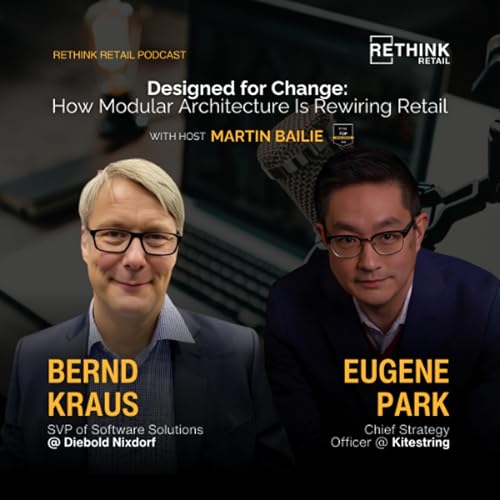
  • Designed for Change: How Modular Architecture Is Rewiring Retail
    Apr 15 2026
    The Central Nervous System: Rewiring Retail with Modular Architecture Diebold Nixdorf and Kitestring explain how modular architecture serves as the foundation for resilience. Guests Bernd Kraus and Eugene Park move beyond the "rip and replace" mentality to show how retailers can modernize while keeping the lights on. Core Insights: - By separating hardware from software, retailers gain the freedom to innovate on the storefront without waiting for a hardware refresh cycle. - Store uptime is non-negotiable. The challenge is balancing the rapid "sprint" culture of e-commerce with the enterprise-grade reliability required for brick-and-mortar operations. - From EV charging to third-party delivery, retailers are losing visibility into the customer journey. A modular backend is the only way to unify these disparate data points into a single, loyal experience. The Bottom Line: A future-proof system does not exist. What exists is an agile system that allows you to say yes to the unpredictable.
    Más Menos
    21 m
  • Crossroads of Commerce: Scaling Beyond DTC
    Apr 14 2026
    Direct-to-consumer (DTC) gave brands control over experience, data, and customer relationships. As brands grow, that model alone becomes limiting. This episode explores how brands move from subscription-based models into retail and multi-channel strategies — and what changes when products leave controlled environments and enter broader distribution. Podcast Overview Fritz Finlay is joined by Reba Hatcher, Chief Commercial Officer at ButcherBox, and Jennifer Cline, CMO of SubSummit. Together, they discuss the transition from DTC to retail, focusing on how brands scale while maintaining consistency across channels. Key Topics Covered - Why DTC alone is no longer sufficient for growth - How brands transition from subscription to retail - The trade-offs between control, scale, and visibility - What changes in product positioning, messaging, and packaging - Operational challenges of multi-channel expansion - How DTC and retail strategies can work together About SubSummit This episode is part of SubSummit (May 13–15, Kansas City), a leading event focused on subscription, commerce, and retail. SubSummit brings together brands and operators working through multi-channel growth, including the shift from DTC to retail environments.
    Más Menos
    30 m
  • How to Sell When Bots are Your Primary Customer with Hanna Andersson
    Apr 13 2026
    Most retailers are still optimizing for a world where a human types a keyword into a bar. But at Hanna Andersson, Matt Ezyk is architecting for a reality where AI agents browse and filter on behalf of the consumer. In this episode, we discuss the architectural survival of brand identity in a decentralized world. - The Bilingual Storefront: LLMs crave data density (fit, texture, origin) that ruins human UX. Use "Accordion" Architecture to hide technical metadata from the human "dopamine hit" while keeping it readable for the bots that control discovery. - LLMO (Large Language Model Optimization): Your brand identity is being reconstructed by AI using Reddit and training data. To stay relevant, return to the basics of structured data to ensure the machine treats your quality as a fact, not a slogan. - The Intuition Guardrail: AI is a rearview mirror. It fails at "newness." Human merchandising "hunches" are the only way to signal relevance for new collections that lack historical data. The Bottom Line: In 2026, building for the click is a legacy strategy. To survive the Agent Era, you must build for the conversation. If your site doesn't speak "bot," your human customers will never find your story.
    Más Menos
    9 m
  • How Boot Barn Turns AI Into a Store Associate, Not a Chatbot
    Apr 9 2026
    What if the real problem with AI in retail isn’t intelligence—but expertise? Recorded live at Shoptalk Spring in Las Vegas, this conversation breaks down how Boot Barn is tackling one of retail’s hardest challenges: scaling deep, technical product knowledge across 500+ stores—without losing credibility on the floor. Instead of relying on generic chatbots, Boot Barn built a custom AI “associate” designed to know the difference between looking right and being right—especially when safety, compliance, and performance matter. Key Insights: - AI is only as good as what it knows. Boot Barn uses Retrieval-Augmented Generation (RAG) to ground AI in real product specs, safety standards, and brand knowledge—reducing hallucinations and increasing trust where it matters most. - The real unlock isn’t AI—it’s humans training it. Professional copywriters aren’t being replaced—they’re evolving into AI trainers, shaping how the system communicates and ensuring the brand voice stays authentic to the Western and workwear customer. Expertise, on demand. In a high-turnover retail environment, AI becomes a “digital co-worker”—giving store associates instant access to complex product knowledge they might otherwise take years to learn. Search is no longer the battleground. As discovery shifts toward AI-driven answers, Boot Barn is preparing for a world where visibility depends on how well your knowledge is structured for machines—not just humans. Listen to the full conversation to see what retail AI actually looks like when it works.
    Más Menos
    11 m
  • Unified Commerce: Bridging the Execution Gap
    Apr 9 2026
    Moving Beyond the Buzzwords Unified Commerce isn't a new term, but true execution remains the "Holy Grail" for enterprise retailers. In this episode, Steven Bailey, Partner at EY and Jonathan Aitken, SVP at RADAR, discuss why the gap between vision and reality is still so wide, and how to close it. The Foundation of Real-Time Retail From the friction of in-store returns to the high cost of order cancellations, the duo explores how fragmented data ruins the customer experience. They break down why "throwing AI at the problem" isn't a fix for a broken architectural foundation. Key Insights include: - Journey vs. Channel: Why structural alignment matters more than technology. - The Smart Store: Transitioning physical locations from "sales points" to "intelligence hubs." - Inventory Truth: Why 99%+ accuracy is the non-negotiable starting point for 2026.
    Más Menos
    30 m
  • Turning 'Silent Boxes' into Living Stores: The Blueprint for In-Store Edge Intelligence
    Apr 7 2026
    The “Connected Store” has moved from concept to operational priority. In this episode, Pauline Monin (Vusion) breaks down how digital shelf technology is transforming physical stores into responsive, data-driven environments. Operational Excellence & Local E-Commerce Automated pricing removes manual processes and reduces errors at scale, allowing store teams to focus on higher-value tasks. At the same time, stores become more effective local fulfilment hubs. With “Flash-to-Pick” LED guidance, associates can follow optimized picking routes, improving speed and consistency for online order fulfilment. The AI & Retail Media Opportunity Through EdgeSense, fragmented in-store data is unified into a single intelligence layer. This enables AI-driven recommendations across pricing and assortment, while also opening the door to in-store Retail Media. Digital displays can measure engagement such as dwell time, giving brands clearer visibility into performance at the shelf.
    Más Menos
    20 m