Episodios

  • Snowboarding, Nano-Fertilizer, and Geopolitics: A Conversation with Clark Bell
    Feb 19 2026

    Send a text

    What do snowboarding, nano-fertilizer, and geopolitics have to do with modern agriculture?

    In this episode of the Patio Pondering Podcast, Jim talks with Clark Bell, CEO of NanoYield and former TEDx speaker, about his journey from working on his family’s sod farm to leading one of ag’s most intriguing nanotechnology companies.

    Clark explains how nano-fertilizer and nanoparticle delivery systems help farmers improve nutrient uptake, optimize crop inputs, and rethink fertilizer strategies under mounting economic and environmental pressures.

    The conversation explores:

    • How nanotechnology works in crop production
    • Fertilizer use, nutrient uptake, and ROI in corn & soybeans
    • Specialty crops vs. commodity agriculture
    • Input cost pressures, global supply chains & geopolitics
    • Risk, resilience, and lessons from snowboarding
    • The importance of advisory teams for modern producers
    • Local innovation’s role in a global ag economy

    This wide-ranging episode connects science, strategy, and real-world decision making — offering practical insight into technologies scaling across millions of acres.

    Connect with Clark Bell:
    🔗 LinkedIn: https://www.linkedin.com/in/clarktbell/

    🔗 NanoYield site: https://www.nano-yield.com/

    🔗 NanoYield LinkedIn: https://www.linkedin.com/company/nanoyield/

    Más Menos
    48 m
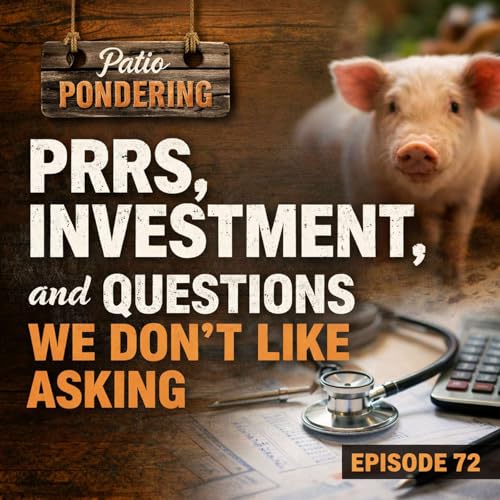
  • Eipsode 72: PRRS, Investment, and the Questions We Don’t Like Asking
    Feb 12 2026

    Send a text

    Porcine Reproductive and Respiratory Syndrome (PRRS) remains one of the most costly and frustrating diseases in modern swine production. Despite decades of research, new technologies, and substantial industry investment, PRRS continues to disrupt herds and challenge producers.

    In this reflective solo episode, Jim Smith explores the tension between producer frustration, the adaptive nature of the PRRS virus, and the scale of research funding dedicated to combating it. This thought piece examines difficult questions about expectations, investment levels, systemic consequences, and whether the pork industry is asking the right questions about PRRS.

    This episode does not argue against PRRS control or pig health initiatives. Instead, it invites listeners to think more deeply about progress, economics, incentives, and the uncomfortable realities surrounding one of the swine industry’s most persistent challenges.

    Más Menos
    8 m
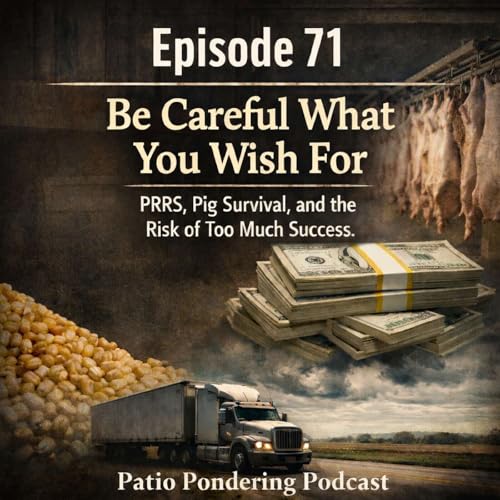
  • Episode 71: Be Careful What You Wish For — PRRS, Pig Survival, and the Risk of Too Much Success
    Feb 10 2026

    Send a text

    In this solo episode of the Patio Pondering Podcast, Jim Smith explores an uncomfortable but necessary question facing the U.S. pork industry: are we actually prepared for success if PRRS were eliminated?

    Drawing on decades of experience in swine nutrition and production, Jim reflects on the long arc of PRRS—from its early emergence in the Midwest to today’s massive investments in disease control and eradication. While improving pig health and reducing mortality is unquestionably the right goal at the farm level, this episode examines what happens when those gains occur across the entire system at once.

    Using the 1998 hog market collapse as a cautionary parallel, Jim walks through the physical and economic constraints that still exist today: packing capacity, labor availability, market absorption, and demand response. What happens if millions more pigs survive to market weight—but the infrastructure and markets aren’t ready?

    This episode is not an argument against animal health, veterinary innovation, or disease research. It is a systems-level conversation about unintended consequences, second-order effects, and why solving one constraint without planning for what comes next can shift pressure elsewhere.

    If you’re involved in pork production, animal agriculture, agribusiness, or agricultural economics—and especially if you lived through 1998—this episode invites you to slow down and think about a question the industry rarely asks out loud:

    What happens after we catch the car?

    Más Menos
    14 m
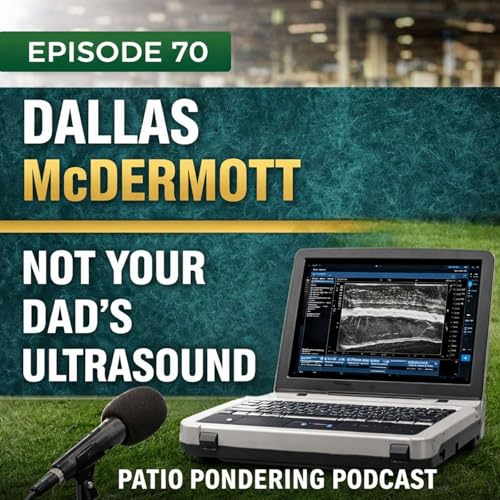
  • Episode 70: Dallas McDermott – Not Your Dad’s Ultrasound
    Feb 3 2026

    Send us a text

    In Episode 70 of the Patio Pondering Podcast, Jim Smith sits down with longtime friend and swine ultrasound innovator Dallas McDermott on the floor of the 2026 Iowa Pork Congress to talk about how ultrasound technology has quietly evolved—and why it matters more now than ever.

    Ultrasound in the swine industry used to be about backfat, muscle depth, and seedstock selection. Today, it is something entirely different. Dallas, one of the last remaining certified swine ultrasound technicians in the U.S., explains how modern systems—paired with machine learning and AI—are now being used inside packing plants to measure intramuscular fat (IMF) at line speed.

    That matters because pork loins, once a premium cut, have lost value due to inconsistent eating quality. Using ultrasound to measure IMF on carcasses—at 600 to 1,200 head per hour—allows packers to sort premium product in real time, improve consistency, and capture value that has been left on the table for years.

    This conversation explores:

    • Why pork loins lost their premium status and how eating quality drives demand
    • How ultrasound and AI are reshaping carcass evaluation inside packing plants
    • USDA-funded innovation aimed at helping small and mid-sized packers compete through quality, not scale
    • What pork can learn from beef’s focus on marbling and consumer satisfaction
    • The implications for genetics, niche programs, and future pork demand

    As pork works to move beyond “the other white meat” and reposition itself as a premium protein, this episode highlights a quiet but important paradigm shift. If pork is going to compete for space on the consumer’s plate, it has to taste good—and this conversation explains how technology may help get us there.

    This is not your dad’s ultrasound.

    Más Menos
    10 m
  • Episode 69: An Industry That Changed — and Events That Haven’t
    Jan 22 2026

    Send us a text

    In this solo episode of the Patio Pondering Podcast, recorded on the road in Des Moines after the first day of the Iowa Pork Congress, I share an observation that kept coming up in conversations across the trade show floor.

    I didn’t hear much discussion about hog margins or markets — even with profitability where it is today. Instead, I kept hearing the same questions: Where are the farmers? Where are the decision makers? Is this still worth the investment?

    Drawing on my first Iowa Pork Congress in 1999 and earlier experiences in the pork industry, I reflect on how much the structure of our industry has changed — larger operations, fewer decision makers, faster information flow, and tighter time constraints — while many of our events are still designed for an industry that no longer exists.

    This episode isn’t about blame or nostalgia. It’s about alignment.

    When purchasing decisions have consolidated and time has become one of the most valuable resources in agriculture, we owe it to the industry to ask hard questions about the return on investment of our trade shows, events, and gatherings.

    The question isn’t whether these events still matter.

    The question is whether we’re willing to evolve them.

    Más Menos
    5 m
  • Episode 68: Tight Margins and Tough Questions at the Fort Wayne Farm Show
    Jan 20 2026

    Send us a text

    This episode is my raw take from the Fort Wayne Farm Show. I intended to record more interviews, but the show floor was packed — so instead, I’m sharing what I saw, heard, and felt over three days.

    We talk about the WASDE bombshell that set the tone for the week, how farmers are thinking about tightening belts in 2025, what suppliers are saying (and not saying), and whether biologicals have a place in a year of tight margins. I also dig into the gap between precision tech and real-world ROI, the growing skepticism toward USDA reporting, and why the pork industry currently looks a whole lot more optimistic than the crop side.

    If you're trying to farm smart in a year of cautious spending and uncertain markets, this one’s worth a listen.

    Más Menos
    14 m
  • Episode 67: Diversification & Direct-to-Consumer with Mary Marsh Heigele
    Jan 20 2026

    Send us a text

    Join Jim at the Fort Wayne Farm Show for an energizing conversation with Mary Marsh Heigele from New Ag Supply in North Central Kansas. Mary brings a unique perspective on agriculture, having grown up in California's almond country and now farming wheat, corn, and cattle in Kansas with her husband Hayden.

    In this episode, we explore:

    • How New Ag Supply ships replacement planter parts nationwide (yes, even to Alaska and Hawaii!)
    • Staying optimistic during challenging commodity prices
    • Direct-to-consumer beef marketing as farm diversification
    • Using your own corn to feed cattle as a value-added opportunity
    • Cover crops as a gateway to thinking outside the traditional row crop box
    • Off-farm income through photography and videography
    • Real-world examples of farm diversification beyond the traditional corn-soy-wheat rotation

    Mary shares honest insights about the current agricultural climate across the country and encourages farmers to explore diversification opportunities - whether that's different crops, livestock, or even leveraging skills like photography to support the farm operation.

    Contact New Ag Supply:

    • Website: newagsupply.com
    • Phone: 620-938-7009
    • Find them on Facebook, Twitter, and TikTok

    Whether you're looking for quality replacement planter parts or inspiration to diversify your operation, this episode delivers practical ideas and genuine conversation about agriculture today.

    #Agriculture #FarmDiversification #DirectToConsumer #CoverCrops #FarmBusiness #PatroPondering

    Más Menos
    10 m
  • Episode 66: “Don’t Be Asleep at the Wheel”: Corn Marketing Advice for 2026 with Aaron Kuhn
    Jan 20 2026

    Send us a text

    In this episode, Jim talks with Aaron Kuhn, Regional Manager with Poet Biorefining in Portland, Indiana, about market realities facing farmers as they head into the 2026 crop year. Coming off a sharp USDA report and entering the spring crop insurance pricing window, corn marketing decisions are getting tight — especially in the Eastern Corn Belt.

    Aaron breaks down what he’s seeing in the countryside on old crop vs. new crop movement, why January–February brings forced sales due to cash flow, and how basis is behaving across Ohio and Indiana after a year of mixed yields. They also dig into how exports, the Brazil safrinha crop, and southeast feed demand influence local basis strength.

    Jim and Aaron also tackle one of the biggest points of confusion in the market right now — the 45Z biofuel credit. Aaron explains why 45Z currently benefits biofuel plants but isn’t yet flowing value back to farmers, what’s holding up climate-smart scoring, and why sustainability incentives are still worth tracking.

    Aaron closes with pragmatic advice for 2026: know your true cost of production, don’t fall asleep during potential rallies, and use target orders rather than emotional marketing.

    Más Menos
    10 m