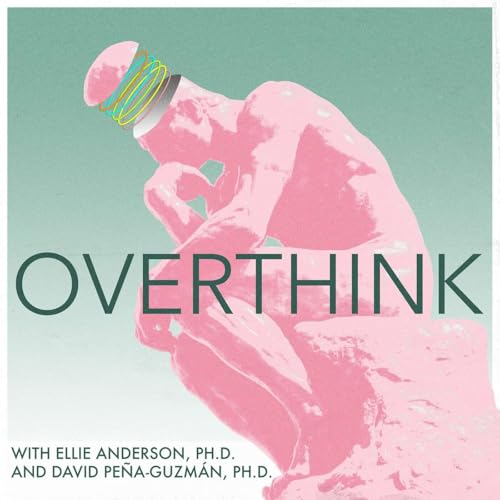
Overthink Podcast Por Ellie Anderson Ph.D. and David Peña-Guzmán Ph.D. arte de portada

Overthink

The buy box is not available to display at this moment. We apologize for the inconvenience
To purchase this book, please visit this page again later. For help with any other issue, please call our 24/7 customer service

The best of all possible podcasts, Leibniz would say. Putting big ideas in dialogue with the everyday, Overthink offers accessible and fresh takes on philosophy from enthusiastic experts.

Hosted by professors Ellie Anderson (Pomona College) and David M. Peña-Guzmán (San Francisco State University).

© © 2025 Overthink 149604
Ciencias Sociales Filosofía
Episodios
  • Addiction with Hanna Pickard
    Feb 24 2026

    To what extent is drug addiction voluntary? In episode 162 of Overthink, Ellie and David chat with philosopher Hanna Pickard about her book, What Would You Do Alone in a Cage with Nothing but Cocaine? A Philosophy of Addiction. They discuss how the “broken brain model” of addiction emerged to combat the moral model of addiction and explore the consequences of both of these models. What drives some people into addiction? What does it mean to say that addiction is a brain disease? How should responsibility and blame fit into our understanding of this condition? And how do we identify when somebody’s patterns of drug use have crossed the threshold into addiction? In the Substack bonus segment, your hosts think about the temporality of addiction and what it means to hold an “addict identity.”

    Works Discussed:

    Alan Leshner, “Addiction Is a Brain Disease, and It Matters”

    Gabor Maté, In the Realm of Hungry Ghosts: Close Encounters with Addiction

    Hanna Pickard, What Would You Do Alone in a Cage with Nothing but Cocaine? A Philosophy of Addiction


    Enjoy our work? Support Overthink via tax-deductible donation: https://www.givecampus.com/fj0w3v

    Join our Substack for ad-free versions of both audio and video episodes, extended episodes, exclusive live chats, and more: https://overthinkpod.substack.com/

    See Privacy Policy at https://art19.com/privacy and California Privacy Notice at https://art19.com/privacy#do-not-sell-my-info.

    Más Menos
    50 m
  • Spontaneity
    Feb 17 2026

    What does it mean to be spontaneous? In episode 161 of Overthink, Ellie and David get spontaneous. They look at Aristotle’s theory of spontaneous generation, at spontaneity’s role in politics, and at the dark side of spontaneity. How do different cultures and physical spaces enable or inhibit spontaneity? What is the relationship between spontaneity and human freedom? And is Lenin correct in arguing that leftists need to resist spontaneity in political organizing? In the Substack bonus segment, your hosts think through the relationship between spontaneity and habit, how spontaneity plays into the recording of Overthink episodes, and the habitual spontaneity of those with Tourette’s Syndrome.

    Works Discussed:

    Aristotle, Physics

    Lucy Cooke, The Truth About Animals

    Jonathan Gingerich, “Spontaneous Freedom”

    Immanuel Kant, Critique of Pure Reason

    Vladimir Lenin, What is to Be Done?


    Enjoy our work? Support Overthink via tax-deductible donation: https://www.givecampus.com/fj0w3v

    Join our Substack for ad-free versions of both audio and video episodes, extended episodes, exclusive live chats, and more: https://overthinkpod.substack.com/

    See Privacy Policy at https://art19.com/privacy and California Privacy Notice at https://art19.com/privacy#do-not-sell-my-info.

    Más Menos
    55 m
  • Closer Look: Epicurus Reader
    Feb 10 2026

    What does it mean to say that the good life is a life of pleasure? Although you might think of champagne and caviar, Hellenistic philosopher Epicurus actually considered the good life to be more about appreciating the simple things in life and letting go of the things that bring us only temporary pleasure but lead to pain in the long run. Why has Epicureanism so often been misrepresented, and what did Epicurus really say? In episode 160 of Overthink, Ellie and David investigate the teachings of Epicurus in The Epicurus Reader. They explain his four-part cure on how to life a better life, including why we shouldn't be worried about death. They also offer critiques on his view of justice and its lack of application to political life. How can attaining ataraxia lead us to achieving eudaimonia and living the good life? In the Substack bonus segment, your hosts elaborate on whether or not Epicurus’s argument that we should not fear death is convincing.

    Works Discussed:

    Brad Inwood and Lloyd P. Gerson, The Epicurus Reader: Selected Writings and Testimonia


    Enjoy our work? Support Overthink via tax-deductible donation: https://www.givecampus.com/fj0w3v

    Join our Substack for ad-free versions of both audio and video episodes, extended episodes, exclusive live chats, and more: https://overthinkpod.substack.com/

    See Privacy Policy at https://art19.com/privacy and California Privacy Notice at https://art19.com/privacy#do-not-sell-my-info.

    Más Menos
    58 m
Todas las estrellas
Más relevante
fun and interesting podcast. They move from everyday social issues to philosophical analyses. The don't dumb down the philosophy too much, but also make it possible for non-specialsts.

fun and clever podcast

Se ha producido un error. Vuelve a intentarlo dentro de unos minutos.