Episodios

  • Faberge Egg stolen from Dog and Duck.
    Apr 14 2026

    A stolen bag. Nothing remarkable about that, you’d think. The sort of petty, forgettable crime that barely troubles the police blotter. And yet, tucked inside, almost absurdly, was something else entirely: a Fabergé piece. Not costume jewellery, not a trinket from a seaside shop, but a genuine object from the world of imperial Russia, the kind of thing once handled by tsars and now quietly commanding five or six figures at auction.


    It’s the contrast that does it. A Tesco-bag sort of crime colliding with the rarefied air of priceless craftsmanship. Fabergé, after all, produced only around fifty imperial eggs, of which fewer than that still survive. Even the smaller pieces, pendants and miniatures, carry a weight of history far beyond their size. Gold, enamel, gemstones, yes, but more than that, a sense that this object was made to matter. And yet here it is, misplaced, mishandled, almost laughed at by circumstance.


    Which, if we’re honest, feels uncomfortably familiar. Human beings have a peculiar talent for missing the point of things. We insure the trivial, misplace the significant, and occasionally carry something extraordinary without the faintest idea of what it is. The story lands not because of the crime, but because of the recognition. Value is often hidden in plain sight, and we are not always the sharpest judges of it.


    There is a line in Matthew’s Gospel about a merchant who finds a pearl of great price and, recognising it, sells everything to obtain it. No hesitation, no confusion. Just clarity. One suspects that if such a pearl turned up today, it might spend a week in a gym bag before anyone noticed. And that, really, is the story.

    Más Menos
    7 m
  • Orkney Supermarket goes Bananas.
    Apr 12 2026

    In this episode of Mark and Pete, we turn to a story that is, on the face of it, faintly ridiculous and yet, like most such things, not without its lessons.


    Somewhere in Orkney, a small supermarket placed an order. Not an unusual event. Not a dramatic one. Just a routine bit of stock management, the sort of quiet background activity that keeps the modern world humming along. And then, somehow whether by slip of the finger, misplaced decimal, or simple human error that order became something else entirely.


    Bananas. Far too many bananas.


    Crates upon crates, far beyond what a small island population could reasonably absorb before nature began to take its course. And that is the quiet tension here, because bananas do not wait. They ripen, they soften, they insist upon being dealt with. Abundance, suddenly, becomes a problem.


    There is something almost biblical in that. Not abundance itself Scripture is not shy about blessing but abundance without proportion, without wisdom, without timing. The kind that turns from provision into pressure before you’ve quite had time to notice.


    We reflect on Proverbs 21:5, where the plans of the diligent lead somewhere steady and sure, while haste has a way of multiplying consequences.


    This is not a story about failure, exactly. Nor even incompetence. It is something more familiar than that. A small mistake, scaled up by systems, until it becomes visible enough for everyone to see.


    And perhaps that is the thing. Most of life is lived in the small decisions no one notices.


    Until suddenly, they do.

    Más Menos
    5 m
  • Poor Peppa Pig got Hacked.
    Apr 10 2026

    In this episode of Mark and Pete, we turn to a rather surreal development: the hacking of one of the most trusted names in children’s entertainment.

    Peppa Pig, owned by Hasbro, has reportedly faced a breach involving internal production content. While details remain limited, the implications are not. This is a global brand broadcast in over 180 countries, translated into dozens of languages, and worth billions in licensing, merchandising, and media revenue. It is also, crucially, trusted by parents.

    We explore what it means when even something as seemingly harmless as a children’s cartoon becomes a target. This isn’t just about leaked episodes or intellectual property. It raises questions about digital vulnerability, cultural influence, and the systems quietly shaping the next generation.

    In a world where everything is connected, nothing is too small to matter.

    Drawing on Luke 16:10, we consider the principle that faithfulness in small things reflects something deeper. Culture is not only shaped in parliaments or universities—it is formed in living rooms, in habits, and in the stories children absorb without question.

    There is a tendency to dismiss these things as trivial. But the “little foxes” still spoil the vineyard.

    This episode reflects on security, innocence, and the unseen layers of modern life where influence operates quietly but effectively.

    Because if even Peppa Pig requires cybersecurity, then perhaps we are not dealing with a simple entertainment problem at all.

    We are dealing with formation.

    And formation, once lost, is not easily recovered.

    Más Menos
    11 m
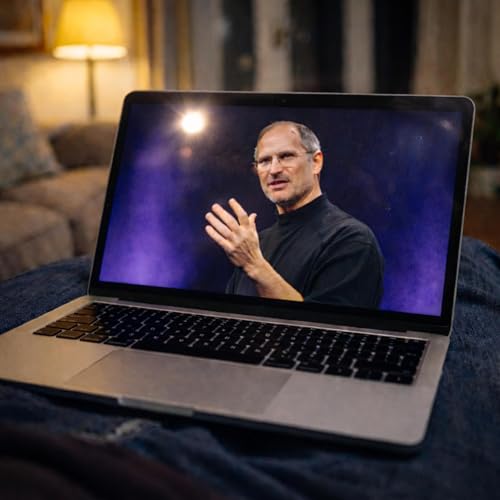
  • Apple Computers is 50 Years Old. Hurrah!
    Apr 6 2026

    In this episode of Mark and Pete, we look at the astonishing story behind Apple’s 50th anniversary—and the man who walked away from one of the greatest opportunities in modern history.

    When Steve Jobs, Steve Wozniak, and Ronald Wayne founded Apple in 1976, it looked like a modest garage project. Within days, Wayne—older, cautious, and understandably wary of financial risk—sold his 10% stake for around $800. Today, that decision would be worth roughly $300–370 billion, making it perhaps the most expensive “better safe than sorry” moment in business history.

    We explore the founding of Apple, the early dynamics between Jobs and Wozniak, and the deeper reasons behind Apple’s extraordinary success: design simplicity, product integration, cultural vision, and timing. Apple didn’t just build computers—it reshaped how ordinary people relate to technology.

    But beneath the business story lies a sharper question. Was Wayne foolish or simply prudent? And where is the line between wisdom and fear?

    Drawing on Ecclesiastes 11:4, we reflect on the danger of waiting for perfect conditions before acting. There is a kind of caution that protects—and another that quietly closes the door on what might have been.

    This episode considers risk, opportunity, and the cost of hesitation in a world where outcomes are rarely obvious at the start.

    Sometimes the difference between history-makers and spectators is not intelligence, but action.

    And sometimes, the greatest losses are not the ones we suffer but the ones we carefully avoid.

    Más Menos
    11 m
  • Amazon Echo - Smarter or More Irritating?
    Apr 4 2026

    As AI upgrades roll out, these devices are beginning to hold longer conversations, remember context, and respond in ways that feel less robotic and more personal. It’s convenient, impressive, and slightly unsettling. When your smart speaker starts to sound like it understands you, it raises an obvious question: what exactly are we inviting into our homes?

    We unpack the practical concerns, including privacy, data collection, and the subtle shift from passive listening to active engagement. If a device is always on, always listening, and now increasingly capable of understanding nuance, where does that leave personal boundaries? And how much trust are we placing in systems we don’t fully see or control?

    There’s also a cultural angle. As technology becomes more conversational, it begins to blur the line between tool and companion. For children, the elderly, or anyone living alone, these devices may start to fill a relational space that was once occupied by real human interaction.

    With their usual mix of dry humour and thoughtful reflection, Mark and Pete consider whether this is simply progress or whether we are quietly reshaping everyday life in ways we don’t yet fully grasp. A sharp, engaging look at AI, voice technology, and the changing nature of conversation in the modern home.

    Más Menos
    7 m
  • Trump Autographs US Currency
    Apr 2 2026

    Should a president’s name be stamped onto the very money people spend every day? In this episode of Mark and Pete, we dive into the debate surrounding Donald Trump and the idea of making his signature more prominent on US banknotes. It’s a story that might sound like a minor design tweak, but it opens up a much bigger conversation about power, symbolism, and how authority presents itself in public life.

    Money has never been just about economics. From ancient empires to modern states, currency has always carried meaning beyond its monetary value. Faces, symbols, and signatures on coins and notes are not accidental—they communicate legitimacy, identity, and control. So what happens when a political figure leans into that symbolism more deliberately?

    We explore whether this is a clever political move, a branding exercise, or something more historically rooted. Is it simply playing the game better than others, or does it signal a shift toward a more personalised form of political identity? And why does it matter to people at all?

    There’s also the psychological angle. When a name or image appears on money, it subtly reinforces authority every time it’s used. Every transaction becomes, in a sense, a quiet interaction with that symbol. It’s a small thing—but repeated millions of times, it adds up.

    With their usual mix of wit and thoughtful analysis, Mark and Pete unpack the historical parallels, the political instincts behind the move, and the broader cultural implications. From Roman coins to modern currency design, this episode asks a simple but surprisingly deep question: who—or what—do we really trust when we trust money?

    A sharp, engaging conversation about politics, perception, and the quiet power of symbols in everyday life.

    Más Menos
    7 m
  • Luke Littler Trademarks His Face.
    Mar 30 2026

    Luke Littler, the teenage darts phenomenon who has taken the sport by storm, is now making headlines off the oche by moving to trademark his own image. In this episode of Mark and Pete, we unpack what that actually means in a world where artificial intelligence can generate faces, voices, and entire personalities in seconds. Is this a smart and necessary step to protect personal identity, or a slightly futile attempt to hold back a technological tide that has already come in?

    We explore how image rights are evolving in the age of AI, where the old concerns about paparazzi and press intrusion have been replaced by something far stranger. Today, anyone with basic tools can recreate a public figure’s likeness, raising serious questions about ownership, consent, and the future of celebrity. Littler’s move may well be the first of many as athletes, actors, and public figures begin to realise that their “image” is no longer just something captured by a camera, but something endlessly reproducible.

    There is also a deeper cultural and philosophical layer here. What does it mean to “own” your face? Why do we instinctively feel that our likeness should not be used without permission? And what happens when technology makes that boundary almost impossible to enforce?

    With their usual blend of wit, cultural commentary, and understated humour, Mark and Pete dig into the legal realities, the technological challenges, and the slightly absurd implications of trying to trademark something as personal as your own face. It’s a conversation about identity, control, and the strange new world we are quietly building around ourselves.

    Más Menos
    9 m
  • At last! Unbreakable Encryption.
    Mar 27 2026

    In this episode of Mark and Pete, things take a distinctly futuristic turn as the conversation lands on the rise of quantum computing and the claim that it may soon deliver something close to unbreakable encryption. It sounds reassuring at first — data that cannot be hacked, messages that cannot be intercepted — but as ever, the reality is rather more complicated.

    At the centre of it all is Quantum encryption, a developing technology that uses the strange properties of quantum mechanics to secure information in ways that would have seemed impossible just a few years ago. In theory, any attempt to spy on the data changes it, making secrecy absolute and intrusion instantly detectable.

    Mark approaches the topic with a poet’s instinct, reflecting on secrecy, knowledge, and the curious human desire to hide and to know at the same time. Pete, meanwhile, begins to prod at the deeper implications. What happens when power is tied to systems that cannot be broken? Who controls the unbreakable? And perhaps more importantly, what does it say about us that we are so determined to conceal?

    Because while technology may be moving toward perfect secrecy, the Christian worldview moves in precisely the opposite direction.

    Grounded in Hebrews 4:13, the discussion turns to a truth that no algorithm can bypass: that nothing is ultimately hidden. Not motives, not actions, not the quiet things we assume will never be seen.

    Blending technology, philosophy, and theology, this episode offers a thoughtful and slightly unsettling reflection on security, truth, and the limits of human control.

    Más Menos
    8 m