Episodios

  • APEX Express – 4.9.26 – Library Joy
    Apr 9 2026
    A weekly magazine-style radio show featuring the voices and stories of Asians and Pacific Islanders from all corners of our community. The show is produced by a collective of media makers, deejays, and activists. Tonight on APEX Express, join the Powerleegirls Host Miko Lee speaks with children’s book authors Lorraine Nam, Uma Krishnaswami and Maggie Tokuda-Hall about Library Joy in honor of National School Library Month! To Learn More Lorrraine Nam, illustrator and author Michael Threet’s book: I’m So Happy You’re Here: A Celebration of Library Joy Uma Krishnaswami Her books: Book Uncle Triology Maggie Tokuda-Hall Her book: Love in the Library Every Library Authors Against Book Bans Show Transcript [00:00:00] Opening: Apex Express Asian Pacific expression. Community and cultural coverage, music and calendar, new visions and voices, coming to you with an Asian Pacific Islander point of view. It’s time to get on board the Apex Express. [00:00:35] Ayame Keane-Lee: Welcome to tonight’s episode of Apex Express Celebrating Library Joy. I’m Ayame Keane-Lee the editor of tonight’s show, and part of the PowerLeeGirls bringing you the introduction to tonight’s show. Did you know that April is National School Library Month and in just 10 days from April 19th to 25th is National Library Week? The theme for this year’s National Library Week is Find Your Joy with Honorary Chair Mychal Threets. The first of three interviews you’ll hear my mom, Miko Lee have tonight is with Lorraine Nam the illustrator for the newly released children’s book written by that very Mychal Threets called, “I’m So Happy You’re Here”. You will then hear Miko speak with Uma Krishnaswami about her children’s book “Book Uncle and Me,” and lastly with Maggie Tokuda-Hall about her children’s book, “Love in the Library,” and the important work of Authors Against Book Bans. As a library kid and current library worker, I have experienced firsthand the transformative power of library access and the importance of inclusive and diverse storytelling. In and out of schools, libraries are vital to nurturing and uplifting the autonomy and sovereignty of children, which always has and continues to be a liberatory practice. We hope tonight’s show will inspire you right into your local library to check out some of the great books mentioned here or to put them on hold. Let’s listen in. [00:02:06] Miko Lee: Welcome, Lorraine Nam, illustrator of amazing children’s books. Welcome to Apex Express. [00:02:13] Lorraine Nam: I’m excited to be here. [00:02:16] Miko Lee: I wanna start with a question I ask all of my guests, which is, who are your people and what legacy do you carry with you? [00:02:24] Lorraine Nam: Who are my people? I would say creative people. People who are interested in having an open mind, and looking at the bright side of things, the beautiful things, people who are curious. The type of legacy that I bring I think is just my parents who are creative and then bringing that, to this new generation. [00:02:57] Miko Lee: Thank you for sharing. I am, I’m looking at your beautiful face, and behind you is this, find your joy and, and it’s in lots of colors on this pink banner and in at the top we see opening up of a library door with Mychal Threets, who’s the author of this book, “I’m So Happy You’re Here: A Celebration of Library Joy.” I’m wondering if you can talk about your collaborative process with Mychal Threets. [00:03:25] Lorraine Nam: The first impression that you have of writer and illustrator for a picture book is that they work really closely together, and that’s actually not the case. We work pretty separately, but I was very excited. Mychal wrote the words to this book and they were looking for an illustrator and my agent called me and she asked me if I was interested. I was very excited about the project. I signed up for it and we worked pretty separately. We connected on Instagram, but he pretty much had no art notes, everything was pretty much whatever I was open to. Then we met for the first time and we got our very first copy of the book and we met in New York. [00:04:10] Miko Lee: And what was that like? [00:04:12] Lorraine Nam: Um, amazing. He is exactly who he is in his videos. [00:04:18] Miko Lee: Can you share for our audience who he is and a little bit more about him, just in case folks don’t know. [00:04:24] Lorraine Nam: The book calls him a librarian ambassador. He describes himself as a reader, a lover of librarians or the number one fan of libraries. This is his first book and he’s also the host of Reading Rainbow on PBS. We met at the New York Library, public Library for the first time, and he’s just so nice, very kind. Honestly, it felt like we already knew each other just because we had been talking through the publisher about the book. [00:05:02] Miko Lee: Thank you for ...
    Más Menos
    1 h
  • APEX Express – 4.2.26 – Surviving Through Solidarity.
    Apr 2 2026
    A weekly magazine-style radio show featuring the voices and stories of Asians and Pacific Islanders from all corners of our community. The show is produced by a collective of media makers, deejays, and activists. Annie Lee moderates a panel with African and Asian Americans about the impacts of Birthright Citizenship and the need for Surviving Through Solidarity. Guests include: Lisa Holder, Ming Hsu Chen, Don Tamaki and Michael Harris. Link to an APEX Episode on Wong Kim Ark from March 20, 2025 Show Transcript [00:00:00] Opening Music: Apex Express Asian Pacific expression. Community and cultural coverage, music and calendar, new visions and voices, coming to you with an Asian Pacific Islander point of view. It’s time to get on board the Apex Express. [00:00:40] Miko Lee: Welcome to Apex Express. I’m your host, Miko Lee, and tonight we will listen to a recent event, Birthright Citizenship, Surviving Through Solidarity that took place at Chinese for Affirmative Action. Just yesterday, on April 1st, the Supreme Court heard the case around birthright citizenship. This event that you’re gonna listen to was highlighting Asian and African American solidarity. As you might know, the cases of dread Scott in 1857 and Wong Kim Ark in 1898 are linked as landmark Supreme Court cases that directly defined and redefined American citizenship specifically about race and birthright. While Dred Scott denied citizenship to people of African descent, Wong Kim Ark’s case utilized the subsequent 14th Amendment to solidify birthright citizenship for children born to foreign nationals. I’m just noting that in this conversation, because it was a panel discussion that was live, there was some irregular use of microphones, so sometimes the audio can be a bit spotty. Please bear with us, and if you want to review the transcript, check out our website, kpfa.org, apex Express. And last year we also covered the story of Wong Kim Ark and have included this past show in our show notes. Now let’s listen in to moderator Annie Lee, Lawyers Michael Harris and Don Tamaki, Lisa Holder of Equal Justice Society and Ming Chen of UC Law. [00:02:20] Annie Lee: Everyone. My name is Annie Lee and I am the managing director of policy at Chinese for Affirmative Action. Welcome to CAA’s office here in San Francisco, Chinatown. And thank you all for being here today for our discussion: Birthright Citizenship Surviving through Solidarity. CAA and Stop AAPI Hate are proud to co-sponsor this event because it matters to us. CAA has been around since 1969 and we are a community based organization that provides direct services to lingual working class Chinese immigrants. And we also try to improve their lives through policy and advocacy. And in 2020, we co-founded Stop AAPI Hate, which is the national leading aggregator of anti-Asian hate incidents. And we know at Stop AAPI Hate that anti-immigrant policies are anti-Asian hate. So why are we here right now? March marks two anniversaries of two Supreme Court cases. One is Dred Scott and the other is Wong Kim Ark. These are two seminal cases in US history. And next week on April 1st, the Supreme Court will hear oral arguments in the lawsuits challenging Trump’s birthright citizenship executive order. So we are here to talk about birthright citizenship because it’s an issue that is near and dear to both the Black and Asian communities. [00:03:46] Without further ado, I am so thrilled to welcome this panel of amazing folks. Let’s start with Michael Harris. Michael Harris here on my right is a retired attorney. He, for many, many years led the juvenile justice division at the National Center for Youth Law, an incredible litigator and advocates, and I’m so proud that he’s here. He’s also on the Equal Justice Society Board. Next to Michael is Don Tamaki. Don is a lawyer at the firm Minami Tamaki, and you might know him because he was part of the legal team that successfully got reparations for Japanese Americans after decades of fighting that injustice. So thank you Don. Don and Lisa, actually, spend time together on the California Reparations Task Force. And so this is Lisa Holder next to Don. Lisa is the president of the Equal Justice Society, which is based in Oakland, an incredible legal organization that has been in many, many fights, including, they filed an amicus brief in support of birthright citizenship, and that brief discusses why this is an issue for the Black community. And last but not least, we have Professor Ming Chen, who is a law professor at UC Law, and she’s also the faculty director of the RICE Program, which is Race, Immigration, Citizenship, and Equality. So thank you so much to my panel and let’s dive in. So some of you know, but I am a former US history teacher, so I often worry that people don’t adequately understand American history and I fear that people don’t understand reconstruction and the 14th Amendment. So let’s start with the ...
    Más Menos
    1 h
  • APEX Express – 3.26.26 – A Conversation with Lavender Phoenix: The Next Chapter
    Mar 26 2026
    APEX Express is a weekly magazine-style radio show featuring the voices and stories of Asians and Pacific Islanders from all corners of our community. The show is produced by a collective of media makers, deejays, and activists. APEX Express and Lavender Phoenix are both members of Asian Americans for Civil Rights and Equality (AACRE). AACRE focuses on long-term movement building, capacity infrastructure, and leadership support for Asian Americans and Pacific Islanders committed to social justice. Important Links: Lavender Phoenix Dragon Fruit Project – Podcast Series Transcript: Miata Tan: ​[00:00:00] Hello and welcome. You are tuning into Apex Express, a weekly radio show, uplifting the voices and stories of Asian Americans and Pacific Islanders. I’m your host Miata Tan. Tonight we have two incredible guests. From Lavender Phoenix. They’re a Bay area based organization supporting queer and transgender Asian American and Pacific Islander [00:01:00] youth. I really enjoyed my conversations with both of these folks, and I’m sure you will as well. This episode is a rerun from December, 2025 when Lavender Phoenix was at a transitional moment in their leadership. Tonight, you’ll hear from the outgoing executive director as she passes the torch along to the new director stepping into the role, uh, we’re bringing this episode back in honor of the transgender day of visibility. That’s just around the corner Tuesday, March 31st. It felt like the perfect time to revisit these conversations. A quick note throughout both interviews, you’ll hear us refer to the organization as both Lavender Phoenix and its very cute nickname. LavNix. Without further ado, here’s my conversation with Yuan Wang, the outgoing executive director of Lavender Phoenix. Miata Tan: Yuan, thank you so much for joining us today. , Would you be able to share a little bit about yourself with [00:02:00] our listeners to get started? Yuan Wang: Yeah. I’m so excited to be here. , My name is Huan. My pronouns are she, and they, and I’m actually the outgoing executive director of Lavender Phoenix. You’re catching me on my second to last week in this role after about four years as the executive director, and more years on our staff team as an organizer and also as a part of our youth summer organizer program. So this is a really exciting and special time and I’m really excited to reflect about it with you. Miata Tan: Yay. I’m so excited. I’d love for you to give us an overview of Lavender Phoenix and the work that y’all do, what communities you support, Yuan Wang: Lavender Phoenix was founded about 21 years ago, and we are based in the Bay Area. We’re a grassroots organization that builds the power of transgender non-binary and queer Asian and Pacific Islander communities right here in the Bay. Right now our work focuses on three major [00:03:00] Areas. The first is around fighting for true community safety. There are so, so many ways that queer, trans, and more broadly, uh, working class communities in the San Francisco Bay Area. Are needing ways to keep ourselves and each other safe, that don’t rely on things like policing, that don’t rely on things like incarceration that are actually taking people out of our communities and making us less safe. The second big pillar of our work is around healing justice. We know that a lot of folks in our community. Struggle with violence, struggle with trauma, struggle with isolation, and that a lot of the systems that exist aren’t actually really designed for queer and trans API people, to thrive and feel connected. And so, we’ve been leading programs and campaigns around healing justice. And the last thing is we’re trying to build a really principled, high integrity leaderful movement. So we do a ton of base building work, which just [00:04:00] means that, everyday queer and trans API people in our community can come to Lavender Phoenix, who want to be involved in organizing and political work. And we train folks to become organizers. Miata Tan: And you yourself came into Lavender Phoenix through one of those programs, is that right? Yuan Wang: Yeah. Um, that is so true. I came into Lavender Phoenix about seven or eight years ago through the Summer organizer program, which is kind of our flagship youth organizing fellowship. And I was super lucky to be a part of that. Miata Tan: How has that felt coming into Lavender Phoenix? Like as a participant of one of those programs? Yeah. And now, uh, over the past few years, being able to lead the organization? Yuan Wang: Yeah. It feels like the most incredible gift. I share this a lot, but you know, when I had come into Lavender Phoenix through the summer organizer program, I had already had some experience, doing [00:05:00] organizing work, you know, doing door knocking, working on campaigns. but I really wanted to be in a space where I felt like I could be all of myself, and that included being trans, ...
    Más Menos
    1 h
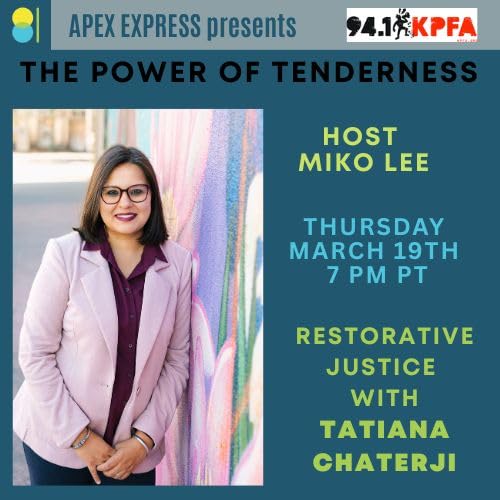
  • APEX Express – 3.19.26- The Power of Tenderness
    Mar 19 2026
    A weekly magazine-style radio show featuring the voices and stories of Asians and Pacific Islanders from all corners of our community. The show is produced by a collective of media makers, deejays, and activists. Tonight on APEX Express Host Miko Lee speaks with Restorative Justice Educator and Author Tatiana Chaterji about her work on the power of tenderness. Tune in! Tatiana Chaterji’s website Show Transcript [00:00:00] Opening Music: Apex Express Asian Pacific expression. Community and cultural coverage, music and calendar, new visions and voices, coming to you with an Asian Pacific Islander point of view. It’s time to get on board the Apex Express. [00:00:44] Miko Lee: Good evening. I’m your host Miko Lee, and tonight we are speaking with Tatiana Chaterji about Restorative Justice. Restorative justice is a movement and a set of practices that stands as an alternative to our current punitive justice system. It focuses on people and repairing harm by engaging all the impacted folks working together to repair that harm. RJ is built off of ancient indigenous practices from cultures around the globe, including Native American, African, first Nation, Canadian, and many others. So join us with Tatiana Chaterji. [00:01:23] Tati, who are your people and what legacy do you carry with you? [00:01:28] Tatiana Chaterji: Thank you for the question, Miko. The first thing that comes to mind, my people are the people we’re, we’re, we’re coming up on the cusp of a possible teacher strike, and I’m thinking about workers and the labor, movement and comrades in my life from doing, work as a classified school worker for about a decade. [00:01:49] Then my people are also from my homelands. The two that I feel very close to me are in Finland, from my mom’s side, and then in Bengal, both India, west Bengal, and Bangladesh. And my people are also those who are facing facing the worst moments of their life, either from causing harm or experiencing harm as a survivor of violence. [00:02:11] I think about this a lot and I think about also the smaller conflicts and tensions and issues that bubble up all the time. So my people are those that are not afraid to make it better, you know, to make it right. And I carry, oh gosh, what legacy do I. I wanna say first kind of the legacy of the Oakland RJ movement that really nurtured me and the youth that I’ve encountered in schools and in detention on the streets in the community. [00:02:41] Youth who are young adults and becoming bigger, older adults and, and, and also elders. To me. So sort of that’s whose legacy I carry in shaping the. Society that we all deserve. [00:02:55] Miko Lee: Thank you for answering with such a rich, well thought out response that’s very expansive and worldly. I appreciate that. Can you share what brought you to this work personally? [00:03:07] Tatiana Chaterji: Sure. As a young activist involved in Insight Women of Color against Violence and aware of the work of Critical Resistance, and I had a pretty clear politics of abolition, but I didn’t. Really think that it impacted me as personally as it did when I was in my early twenties and I suffered a brain injury from a vehicular assault, a hit and run that may have been gang affiliated or, a case of mistaken identity. My recovery is, is, is complicated. My journey through various kinds of disabilities has shaped me. But I think the way that I was treated by the police and by the justice quote unquote justice system, which I now call the criminal legal system, it because there was no justice. [00:03:52] I sort of don’t believe that justice is served in the ways that survivors need. yeah, I really, I got very close to the heart of what an RJ process can do and what RJ really is. I got introduced to Sonya Shah and the work of Suha bga and I was able to do a surrogate victim offender dialogue and then later to facilitate these processes where people are kind of meeting at the, at the hardest point of their lives and connecting across immense suffering and layers of systemic and interpersonal internalized oppression. [00:04:26] Just so much stuff and what happens when you can cross over into a shared humanity and recognition. It’s just, it’s just so profound and and from that space of healing and, and, and compassion, I’ve been able to think about. Other ways that RJ can look and have sort of been an advan, what is it evangelical for it? [00:04:51] You know, I think that because we don’t see these options, I, I, because I knew people, I was able to connect in this way and I would just shout out David uim, who’s the one who told me that even if I didn’t know the person who harmed me, that this was possible. People so often give up, they’re just like, well, I have to feel this way. [00:05:10] I have to just deal with it. Swallow the injustice and the lack of recognition. Just sort of keep going. Grit your teeth. I think we don’t have...
    Más Menos
    1 h
  • APEX Express – 3.12.26- Feed Your Heart
    Mar 12 2026
    A weekly magazine-style radio show featuring the voices and stories of Asians and Pacific Islanders from all corners of our community. The show is produced by a collective of media makers, deejays, and activists. Tonight our show is called Feed Your Heart. Host Miko Lee speaks with the collaborators and creators of the Asian American Pacific Islander Restorative Justice Network: Elli Nagai-Rothe & Tatiana Chaterji. Restorative Justice is a movement and a set of practices that stands as an alternative to our current punitive justice system. It focuses on people and repairing harm by engaging all the impacted people working together to repair the harm. RJ is built off of ancient indigenous practices from cultures around the globe, including Native American, African, First Nation Canadian, and so many others. To find out more about Restorative Justice and the work of our guests check out Info about the AAPI RJ Network on the Ripple website: www.ripplecollective.org/aapirjnetwork NACRJ conference in New Orleans: www.nacrj.org/2026-conference Show Transcript [00:00:00] Opening Music: Apex Express Asian Pacific expression. Community and cultural coverage, music and calendar, new visions and voices, coming to you with an Asian Pacific Islander point of view. It’s time to get on board the Apex Express. [00:00:44] Miko Lee: Good evening. I’m your host Miko Lee, and tonight our show is called Feed Your Heart. And we are speaking about the collaborators and creators of the Asian American Pacific Islander Restorative Justice Network with the collaborators, Elli Nagai-Rothe and Tatiana Chaterji. [00:01:03] Restorative justice is a movement and a set of practices that stands as an alternative to our current punitive justice system. It focuses on people and repairing harm by engaging all the impacted folks working together to repair that harm. RJ is built off of ancient indigenous practices from cultures around the globe, including Native American, African, first Nation Canadian, and many others. So join us as we feed your heart. [00:02:01] Welcome to Apex Express. My lovely colleagues, Elli Nagai-Rothe, and Tatiana Chaterji. I’m so happy to speak with you both today. I wanna start off with a question I ask all of my guests, and Ellie, I’m gonna start with you and then we’ll go with to you, Tati. And the question is who are your people and what legacy do you carry with you? [00:02:24] Elli Nagai-Rothe: Hmm. I love that question. Thank you. My people come from Japan and Korea and China and Germany. My people are community builders and entrepreneurs survivors, people who have caused harm, people who have experienced harm people who’ve worked towards repair dreamers, artists and people who like really good food. [00:02:51] And I carry their legacy of resilience and of gaman, which is a Japanese word that’s a little hard to translate, but basically means something like moving through moving through the unbearable with dignity and grace. , And I carry a legacy to continue healing the trauma from my ancestral line the trauma and justice. And that’s informs a lot of the work that I do around conflict transformation and restorative justice. [00:03:19] Miko Lee: Thank you so much. And Tati, what about you? Who are your people and what legacy do you carry with you? [00:03:25] Tatiana Chaterji: Thank you for the question, Miko. The first thing that comes to mind, my people are the people we’re, we’re, we’re coming up on the cusp of a possible teacher strike, and I’m thinking about workers and the labor, movement and comrades in my life from doing work as a classified school worker for about a decade. [00:03:46] Then my people are also from, my homelands. The two that I feel very close to me are in Finland, from my mom’s side, and then in Bengal, both India, west Bengal, and Bangladesh. And my people are also those who are facing facing the worst moments of their life, either from causing harm or experiencing harm as a survivor of violence. [00:04:08] I think about this a lot and I think about also the smaller conflicts and tensions and issues that bubble up all the time. So my people are those that are not afraid to make it better, you know, to make it right. And I carry, oh gosh, what legacy do I. I wanna say first kind of the legacy of the Oakland RJ movement that really nurtured me and the youth that I’ve encountered in schools and in detention on the streets in the community. [00:04:39] Youth who are young adults and becoming bigger, older adults and, and, and also elders. To me. So sort of that’s whose legacy I carry in shaping the. Society that we all deserve. [00:04:52] Miko Lee: Thank you both for answering with such a rich, well thought out response that’s very expansive and worldly. I appreciate that. Ellie, I think it was two years ago that you reached out to me and said, I’m thinking about doing this thing with Asian American Pacific ...
    Más Menos
    1 h
  • APEX Express – 2.12.26 – Anti-Pacific Islander Hate Amid Ongoing Injustice
    Feb 12 2026
    APEX Express is a weekly magazine-style radio show featuring the voices and stories of Asians and Pacific Islanders from all corners of our community. The show is produced by a collective of media makers, deejays, and activists. On this episode, the Stop AAPI Hate Pacific Islander Advisory Council discuss a new report on anti–Pacific Islander hate. They examine the documented impacts of hate, structural barriers Pacific Islander communities face in reporting and accessing support, and the long-standing traditions of resistance and community care within PI communities. Important Links: Stop AAPI Hate Stop AAPI Hate Anti-Pacific Islander Hate Report If you have questions related to the report, please feel free to contact Stop AAPI Hate Research Manager Connie Tan at ctan@stopaapihate.org Community Calendar: Upcoming Lunar New Year Events Saturday, February 14 – Sunday, February 15 – Chinatown Flower Market Fair, Grant Avenue (fresh flowers, arts activities, cultural performances) Tuesday, February 24 – Drumbeats, Heartbeats: Community as One, San Francisco Public Library (Lunar New Year and Black History Month celebration) Saturday, February 28 – Oakland Lunar New Year Parade, Jackson Street Saturday, March 7 – Year of the Horse Parade, San Francisco Throughout the season – Additional Lunar New Year events, including parades, night markets, and museum programs across the Bay Area and beyond. Transcript: [00:00:00] Miata Tan: Hello and welcome. You are tuning in to Apex Express, a weekly radio show uplifting the voices and stories of Asian Americans and Pacific Islanders. I’m your host, Miata Tan and tonight we’re examining community realities that often go under reported. The term A API, meaning Asian Americans and Pacific Islanders is an [00:01:00] acronym we like to use a lot, but Pacific Islander peoples, their histories and their challenges are sometimes mischaracterized or not spoken about at all. Stop A API Hate is a national coalition that tracks and responds to the hate experience by A API communities through reporting, research and advocacy. They’ve released a new report showing that nearly half of Pacific Islander adults experienced an act of hate in 2024 because of their race, ethnicity, or nationality. Tonight we’ll share conversations from a recent virtual community briefing about the report and dive into its findings and the legacy of discrimination experienced by Pacific Islanders. Isa Kelawili Whalen: I think it doesn’t really help that our history of violence between Pacific Islander Land and Sea and the United States, it already leaves a sour taste in your mouth. When we Pacifica. Think [00:02:00] about participating in American society and then to top it off, there’s little to no representation of Pacific Islanders. Miata Tan: That was the voice of Isa Kelawili Whalen, Executive Director at API Advocates and a member of Stop, A API hates Pacific Islander Advisory Council. You’ll hear more from Isa and the other members of the advisory council soon. But first up is Cynthia Choi, the co-founder of Stop, A API, Hate and co-Executive Director of Chinese for affirmative action. Cynthia will help to ground us in the history of the organization and their hopes for this new report about Pacific Islander communities. Cynthia Choi: As many of you know, Stop API Hate was launched nearly six years ago in response to anti-Asian hate during COVID-19 pandemic. And since then we’ve operated as the [00:03:00] nation’s largest reporting center tracking anti A. PI Hate Acts while working to advance justice and equity for our communities. In addition to policy advocacy, community care and narrative work, research has really been Central to our mission because data, when grounded in community experience helps tell a fuller and more honest story about the harms our communities face. Over the years, through listening sessions and necessary and hard conversations with our PI community members and leaders, we’ve heard a consistent. An important message. Pacific Islander experiences are often rendered invisible when grouped under the broader A API umbrella and the forms of hate they experience are shaped by distinct histories, ongoing injustice, and unique cultural and political [00:04:00] context. This report is in response to this truth and to the trust Pacific Islander communities have placed in sharing their experience. Conducted in partnership with NORC at the University of Chicago, along with stories from our reporting center. we believe these findings shed light on the prevalence of hate, the multifaceted impact of hate and how often harm goes unreported. Our hope is that this report sparks deeper dialogue and more meaningful actions to address anti pi hate. We are especially grateful to the Pacific Islander leaders who have guided this work from the beginning. Earlier this year, uh, Stop API hate convened Pacific Islander Advisory Council made up of four ...
    Más Menos
    1 h
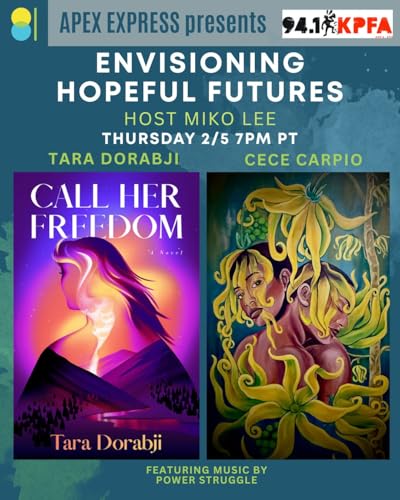
  • APEX Express – 2.5.26-Envisioning Hopeful Futures
    Feb 5 2026
    A weekly magazine-style radio show featuring the voices and stories of Asians and Pacific Islanders from all corners of our community. The show is produced by a collective of media makers, deejays, and activists. Envisioning Hopeful Futures Host Miko Lee speaks with two Bay Area artists, activists, and social change makers: Tara Dorabji and Cece Carpio. Both of these powerful people have been kicking it up in the bay for a minute. They worked in arts administration as community organizers and as artist activists. LINKS TO OUR GUESTS WORK Tara Dorabji Author’s website New book Call Her Freedom Find more information about what is happening in Kashmir Stand With Kashmir Cece Carpio Tabi Tabi Po running at Somarts SHOW Transcript Opening Music: Apex Express Asian Pacific expression. Community and cultural coverage, music and calendar, new visions and voices, coming to you with an Asian Pacific Islander point of view. It’s time to get on board the Apex Express. Miko Lee: Good evening. I’m your host Miko Lee, and tonight I have the pleasure of speaking with two Bay Area local artists, activists, and social change makers, Tara Dorabji and Cece Carpio. Both of these powerful people have been kicking it up in the bay for a minute. They worked in arts administration as community organizers and as artist activists. I so love aligning with these multi hyphenated women whose works you can catch right now. First up, I talk with my longtime colleague, Tara Dorabji Tara is an award-winning writer whose first book Call Her Freedom just came out in paperback. And I just wanna give a little background that over a decade ago I met Tara at a workshop with the Great Marshall Gantz, and we were both asked to share our stories with the crowd. During a break, Tara came up to me and said, Hey, are you interested in joining our radio show, Apex Express? And that began my time with Apex and the broader Asian Americans for Civil Rights and Equality community. So if you hear a tinge of familiarity and warmth in the interview, that’s because it’s real and the book is so great. Please check it out and go to a local bookstore and listen next to my chat with Tara. Welcome Tara Dorabji to Apex Express. Tara Dorabji: Thank you so much for having me. It’s wonderful to be with you, Miko. Miko Lee: And you’re actually the person who pulled me into Apex Express many a moon ago, and so now times have changed and I’m here interviewing you about your book Call Her Freedom, which just was released in paperback, right? Tara Dorabji: Yep. It’s the one year book-anniversary. Miko Lee: Happy book anniversary. Let’s go back and start with a little bit for our audience. They may have heard you, if they’ve been a long time Apex listener, but you as an artist, as a creator, as a change maker tell me who are your people and what legacy do you carry with you? Tara Dorabji: Who are my people? My people I would say are those who really align with truth. Truth in the heart. That’s like at the very core of it. And I’m from the Bay Area. I’ve been organizing in the Bay a long time. I started out organizing around contaminated sites from nuclear weapons. I’ve moved into organizing with young people and supporting storytelling. So arts and culture has been a huge part of it. Of course, KPFA has been a big part of my journey, amplifying stories that have been silenced, and I think in terms of legacy, I’ve been thinking about this more and more. I think it goes into two categories for me. One are the relationships and who remembers you and and those deep heart connections. So that’s one part. And then for my artistry, it’s the artists that come and can create. On the work that I’ve done and from that create things that I couldn’t even imagine. And so I really think that’s the deepest gift is not the art that you’re able to make, but what you create so that others can continue to create. Miko Lee: Thank you so much for sharing the deep kind of legacy and sense of collaboration that you’ve had with all these different artists that you’ve worked with and it’s, your work is very powerful. I read it a year ago when it first came out, and I love that it’s out in paper back now. Can you tell our audience what inspired Call her Freedom. Tara Dorabji: Call Her Freedom is very much inspired by the independence movement in Indian occupied Kashmir. And for me it was during the summer uprisings when, and this was way back in, In 2010-2009, after the Arab Spring and for the entire summer, Kashmir would be striking. It would shut down from mothers, grandmothers, women, children in the street. This huge nonviolent uprising, and I was really drawn to how it’s both one of the most militarized zones on earth. And how there was this huge nonviolent uprising happening and questions about what it could look like, even like liberation beyond the nation state. And so I was really drawn to that. My dad’s from Bombay, from...
    Más Menos
    1 h
  • APEX Express – 1.29.26 – White Switch
    Jan 29 2026
    A weekly magazine-style radio show featuring the voices and stories of Asians and Pacific Islanders from all corners of our community. The show is produced by a collective of media makers, deejays, and activists. Guest host Jovelyn Richards presents White Switch WHITE SWITCH Show Transcript Opening: [00:00:00] Apex Express Asian Pacific expression. Community and cultural coverage, music and calendar, new visions and voices, coming to you with an Asian Pacific Islander point of view. It’s time to get on board the Apex Express. Jovelyn Richards: [00:01:07] Hi, this is Jovelyn Richards and I’m happy to be here on Apex. Some of you may know me from Cover to Cover, which is every Tuesday at two o’clock, which I, um, spend time with artists, filmmakers, uh, writers, play writers, poets, to bring that to my audience. And on every third Monday you would hear me on Women’s Magazine and my colleagues. We all take one Monday and Tuesday on different topics from a feminist perspective, from a global perspective. And my specific way of approaching that is to look at writings and, um, that’s either from fiction or either it is nonfiction, but at the core of it, because my interest really is getting to the story of what it’s like to be human. Jovelyn Richards: [00:02:05] Those reflect characters topics that really dig inside of that written by women who was in search of, in their research, their lives of highlighting either known people or ordinary people who are. Living in ways in which moves humanity forward. So that’s where you’ll find me. And so why am I here? I’m here because I did a project, uh, over a year ago, and this, this, uh, tape is, uh, this program is a long time coming. I partnered with this particular project with, so when you would be familiar with, and that’s Preeti Shekar last name is spelled S-H-E-K-A-R. And we began this story, uh, of looking at anti-blackness in the South Asian community together. So what I’m going to do is let you listen to a clip, not from Preeti or myself. But from someone else’s doing this anti-blackness work in South Asian communities with Ritu Bhasin, and the last spelling of her name is B-H-A-S-I-N. So we’ll take a listen to that and then I will be right back and have that discussion. CLIP PLAYS Jovelyn Richards: [00:04:46] All right, so here we go. And so one of the things I appreciated seeing and listening to her video when I first was introduced to her, that aligned with the work that myself and Preeti was doing in our project curriculum called The White Switch, and we’ll dig into that. What is the White Switch? What is the curriculum of the White Switch and how it came about? And so what I appreciate, the continuous work, you may wanna Google, if you don’t already know, you probably do with Ritu Bhasin, uh, because she speaks directly about anti-black, uh, racism within South Asian communities, especially among professionals and leaders. And as you’ve heard in the video, she shares what that experience has been. And I was so happy to be able to offer that in the beginning of this. Uh, broadcast so that it, uh, to break the sense of isolation just in myself. Speaking of it as a black woman, I was hoping that Preeti would be here, but she’s, um, back in India and I’ll talk a little bit about what that’s like for me, uh, that my co-create, um, my partner on this here. Jovelyn Richards: [00:05:59] So the white switch and the history of it for years. Uh. Probably like close to 15 years now. We were part of the beginning of white, uh, women’s magazine and we had wanted to do something together. We knew that we wanted to work together without knowing the why, but every time we were in conversation in the building, uh, women’s magazine and the way I approach the topics, uh, as a collective. And where the resistance was, where the fun of it was at. Uh, and then her way she approached it, there was place the, the connected dots. So example would be for any of our lives, when you’re in very difficult conversations, you pay attention to the other, uh, uh, collaborators or whatever the, what the team is made of. And even if it’s to people and you see whether or not they’re coming from a place of inclusiveness, you’re seeing how, how hard they are holding on to their opinion, whether it’s negotiable, whether they’re really deeply listening. And what was really interesting to where we connect the is that we found that both of us and we were relatively new to each other. Jovelyn Richards: [00:07:20] What we both found is that the humor. That in the heat of it all, or the conflict of it all, there was, we relied on this part of humor to not, to deflate and deflect from the situation, not to deflate it, like take off the, the, the fullness of the topic, but to give us all a moment to breathe in humor. Right? And, and that’s, that is part of my go-to as a standup comedian. So that’s real for me. So. Let’s ...
    Más Menos
    1 h