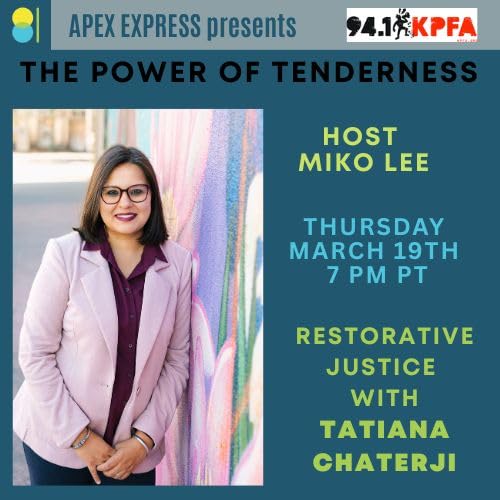
APEX Express – 3.19.26- The Power of Tenderness Podcast Por  arte de portada

APEX Express – 3.19.26- The Power of Tenderness

APEX Express – 3.19.26- The Power of Tenderness

Escúchala gratis

Ver detalles del espectáculo
A weekly magazine-style radio show featuring the voices and stories of Asians and Pacific Islanders from all corners of our community. The show is produced by a collective of media makers, deejays, and activists. Tonight on APEX Express Host Miko Lee speaks with Restorative Justice Educator and Author Tatiana Chaterji about her work on the power of tenderness. Tune in! Tatiana Chaterji’s website Show Transcript [00:00:00] Opening Music: Apex Express Asian Pacific expression. Community and cultural coverage, music and calendar, new visions and voices, coming to you with an Asian Pacific Islander point of view. It’s time to get on board the Apex Express. [00:00:44] Miko Lee: Good evening. I’m your host Miko Lee, and tonight we are speaking with Tatiana Chaterji about Restorative Justice. Restorative justice is a movement and a set of practices that stands as an alternative to our current punitive justice system. It focuses on people and repairing harm by engaging all the impacted folks working together to repair that harm. RJ is built off of ancient indigenous practices from cultures around the globe, including Native American, African, first Nation, Canadian, and many others. So join us with Tatiana Chaterji. [00:01:23] Tati, who are your people and what legacy do you carry with you? [00:01:28] Tatiana Chaterji: Thank you for the question, Miko. The first thing that comes to mind, my people are the people we’re, we’re, we’re coming up on the cusp of a possible teacher strike, and I’m thinking about workers and the labor, movement and comrades in my life from doing, work as a classified school worker for about a decade. [00:01:49] Then my people are also from my homelands. The two that I feel very close to me are in Finland, from my mom’s side, and then in Bengal, both India, west Bengal, and Bangladesh. And my people are also those who are facing facing the worst moments of their life, either from causing harm or experiencing harm as a survivor of violence. [00:02:11] I think about this a lot and I think about also the smaller conflicts and tensions and issues that bubble up all the time. So my people are those that are not afraid to make it better, you know, to make it right. And I carry, oh gosh, what legacy do I. I wanna say first kind of the legacy of the Oakland RJ movement that really nurtured me and the youth that I’ve encountered in schools and in detention on the streets in the community. [00:02:41] Youth who are young adults and becoming bigger, older adults and, and, and also elders. To me. So sort of that’s whose legacy I carry in shaping the. Society that we all deserve. [00:02:55] Miko Lee: Thank you for answering with such a rich, well thought out response that’s very expansive and worldly. I appreciate that. Can you share what brought you to this work personally? [00:03:07] Tatiana Chaterji: Sure. As a young activist involved in Insight Women of Color against Violence and aware of the work of Critical Resistance, and I had a pretty clear politics of abolition, but I didn’t. Really think that it impacted me as personally as it did when I was in my early twenties and I suffered a brain injury from a vehicular assault, a hit and run that may have been gang affiliated or, a case of mistaken identity. My recovery is, is, is complicated. My journey through various kinds of disabilities has shaped me. But I think the way that I was treated by the police and by the justice quote unquote justice system, which I now call the criminal legal system, it because there was no justice. [00:03:52] I sort of don’t believe that justice is served in the ways that survivors need. yeah, I really, I got very close to the heart of what an RJ process can do and what RJ really is. I got introduced to Sonya Shah and the work of Suha bga and I was able to do a surrogate victim offender dialogue and then later to facilitate these processes where people are kind of meeting at the, at the hardest point of their lives and connecting across immense suffering and layers of systemic and interpersonal internalized oppression. [00:04:26] Just so much stuff and what happens when you can cross over into a shared humanity and recognition. It’s just, it’s just so profound and and from that space of healing and, and, and compassion, I’ve been able to think about. Other ways that RJ can look and have sort of been an advan, what is it evangelical for it? [00:04:51] You know, I think that because we don’t see these options, I, I, because I knew people, I was able to connect in this way and I would just shout out David uim, who’s the one who told me that even if I didn’t know the person who harmed me, that this was possible. People so often give up, they’re just like, well, I have to feel this way. [00:05:10] I have to just deal with it. Swallow the injustice and the lack of recognition. Just sort of keep going. Grit your teeth. I think we don’t have...
Todavía no hay opiniones