Episodios

  • Episode 71, Andrea Kingsbury,RID, CHID, LEED AP ID+C, 
Creative Director of Interior Design, e4h, Environments for Health Architecture
    Dec 9 2025
    "If I can make a terrifying experience a little calmer and a nurse's 12-hour shift less exhausting—that's my why." –Andrea Kingsbury on HID2.0. Today on the pod, Cheryl sits down—virtually—with Andrea Kingsbury, RID, CHID, LEED AP ID+C, Creative Director of Interior Design at e4h | Environments for Health Architecture.With 18+ years in healthcare interiors, Andrea shares how she elevates design across a multi-office practice. She co-creates with clinicians so operations don't get value-engineered out. And on the Roper St. Francis Replacement Hospital, e4h is partnered with SOM (Skidmore, Owings & Merrill)—SOM leads the exterior and first-impression spaces while e4h leads the clinical environments. Together, they're translating a modern Low Country sense of place into calming, resilient settings from curb to bedside. What We Cover Origin story & staying power: finding purpose where "every decision has a human consequence" Creative Director lens: mentorship, cross-pollination, and guiding principles that anchor projects over time Digital collaboration: whiteboards as living libraries (and bringing sketching energy back across offices) Clinician-led, patient-centered: turning design ideas into performance metrics (steps saved, time gained, errors reduced) so they survive VE Roper St. Francis with SOM: a curb-to-bedside thread; visioning early, system finish master plan, and "modern Low Country" as a unifying concept Arrival sequence by landscape: Tidelands → Dunes → Marshes (lobby, promenade, café) for orientation, calm, and nourishment Community over cliché: avoiding "postcard Charleston," engaging North Charleston's distinct neighborhoods and local artists Standardization vs. soul: prefabricated pods and modular systems without losing local materiality and identity Flexibility & resilience: designing for future unknowns (pandemics, hurricanes, seismic), right-sizing and pre-planning utilities Pathways for emerging designers: timing CHID/EDAC, why to test early, and the portfolio experiences that matter now Key Takeaways Guide, don't dictate. A Creative Director cultivates mindsets and methods more than a single "house style." Metrics protect design. When choices map to operational outcomes (steps/time/errors), they're harder to cut. Place > postcard. Authenticity comes from community engagement, not clichés. Prefab ≠ generic. Standardization can speed delivery while finishes and details keep local soul. Design for tomorrow. Flexibility and resilience are now baseline program requirements. Invest early in credentials. CHID/EDAC/LEED are great signalers—easier to earn closer to school—and experience remains the difference-makers Memorable Quotes from Andrea Kingsbury "We're designing the backdrop of some of our most vulnerable moments—birth, death, recovery, crisis. Every decision has a human consequence." "If I can make a terrifying experience a little calmer and a nurse's 12-hour shift less exhausting—that's my why." "Our role isn't to impose a singular style; it's to cultivate a mindset that leads to successful projects." "Guiding principles set early become the anchor when projects evolve—they hold the vision together." "When design choices map to time saved, steps reduced, and errors prevented, it's almost impossible to value-engineer them out." "We used the Low Country landscape—tidelands → dunes → marshes—to cue orientation, calm, and nourishment." "Prefab doesn't have to look generic. We keep the speed and quality without losing local soul." "The next phase is flexibility and resilience—designing for tomorrow when we can't predict it." Resources & Links e4h | Environments for Health Architecture — Andrea's firm (Charlotte studio; healthcare-focused). https://www.e4harchitecture.com/ Roper St. Francis Healthcare — Replacement Hospital updates, community newsletters, and media (including VR/renderings when available). https://www.rsfh.com/ S.O.M. — Skidmore, Owings & Merrill — Design partner on exterior and first-impression spaces. https://www.som.com/ CHID Certification (AAHID) — Certified Healthcare Interior Designer credential referenced in the episode. https://www.aahid.org/certification/ EDAC (The Center for Health Design) — Evidence-Based Design Accreditation & Certification. https://www.healthdesign.org/certification-outreach/edac/ Biophilic Design (Primer) — Background on nature-connected strategies that inform "tidelands → dunes → marshes" concepts. https://www.healthdesign.org/insights-solutions/biophilic-design Connect with Andrea Kingsbury Email: andrea.kingsbury@e4harchitecture.com LinkedIn: https://www.linkedin.com/in/andreahkingsbury/ Our Industry Partners The world is changing quickly. The Center for Health Design is committed to providing the healthcare design and senior living design industries with the latest research, best practices and innovations. The Center can help you solve today's ...
    Más Menos
    51 m
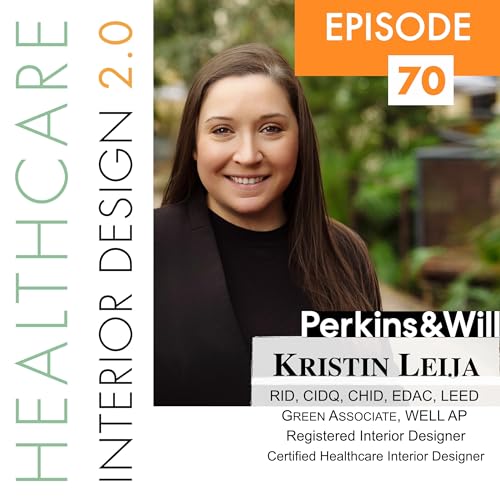
  • Episode 70: Kristin Leija, RID, CIDQ, CHID, EDAC, LEED Green Associate, WELL AP — Registered Interior Designer & Certified Healthcare Interior Designer at Perkins&Will (San Antonio, TX)
    Nov 12 2025
    "When one of us rises, all of us rise." –Kristin Leija on the Healthcare Interior Design 2.0 podcast Today on the pod, Cheryl sits down—virtually—with Kristin Leija, RID, CIDQ, CHID, EDAC, LEED Green Associate, WELL AP — Registered Interior Designer & Certified Healthcare Interior Designer at Perkins&Will in San Antonio, TX. Kristin brings big-firm reach with a startup spirit—supporting teams across Texas while anchoring in San Antonio's historic Pearl District. As a post-COVID entrant to healthcare design, she pairs digital fluency with CHID/EDAC rigor and a community-first mindset. We talk building credibility without 20 years on the clock, designing for a multicultural city, caregiver realities (including her own), and the rising focus on behavioral health and "living design" sustainability. What We Cover Post-COVID vantage point: translating six-foot spacing, touch reduction, and one-way flows into healthcare planning Earning trust early: leading with research, active listening, and co-authoring solutions with clients Community + culture → design: how San Antonio's "smallest big city" vibe shows up in wayfinding, lobbies, and public spaces Caregiver lens: where do you take sensitive calls, decompress, or bring a child while visiting? Behavioral health everywhere: why BH thinking is showing up across non-BH projects Futurism in practice: scanning signals, staying curious, and shaping what's next Living design: Perkins&Will's holistic take on health, wellness, sustainability, and poetics Key Takeaways Curiosity beats tenure. Showing up with relevant research and good questions builds credibility fast. Design the whole journey. Spaces that respect caregivers' needs (privacy, quiet, nooks) change the experience. Culture isn't décor. Authentic place-based cues support wayfinding, belonging, and ease. Behavioral health is universal. Small, thoughtful interventions can lower stress across all settings. Be a futurist. Track signals, share knowledge, and help clients prepare—not just react. Connect with Kristin Leija Email: kristin.leija@perkinswill.com LinkedIn: https://www.linkedin.com/in/kristin-leija/ Resources & Shout-outs Perkins&Will — San Antonio Studio — Kristin's team; community-rooted healthcare design. https://perkinswill.com/studio/san-antonio/ Perkins&Will Pearl District (San Antonio) — Historic brewery reimagined as a cultural hub where Kristin's studio is based. https://atpearl.com/ Pearl Culinary Institute of America — San Antonio (at Pearl) — Daily energy and inspiration right outside the studio. https://www.ciachef.edu/cia-texas/ Culinary Institute of America Fiesta San Antonio — The city's "party with a purpose," celebrating culture and community each April. https://fiestasanantonio.org/ Fiesta San Antonio UTSA — The University of Texas at San Antonio — Local research partner ecosystem Kristin references. https://www.utsa.edu/ UT San Antonio Wilford Hall Medical Center — Former USAF medical hub meaningful in Kristin's family story. https://www.army.mil/article/273984/wilford_hall_preserving_a_legacy_brick_by_brick Army Design frameworks & focus areas Perkins&Will — Living Design — Holistic health, sustainability, and poetics in practice. https://perkinswill.com/living-design/ Perkins&Will Behavioral Health Design — Kristin's recent work; principles that translate across care settings. (Overview article you can cite as needed.) https://healthcaredesignmagazine.com/news/perkinswill-opens-new-design-studio-in-san-antonio/64570/ HCD Magazine Foresight / Futurism in Design — Signal-scanning mindset to prepare clients for what's next. (Visitor guide to Pearl as a culture/innovation anchor.) https://www.visitsanantonio.com/plan-your-trip/neighborhood-guide/pearl-district/ Visit San Antonio Credentials & organizations CHID — Certified Healthcare Interior Designer (AAHID) https://aahid.org/certification/ AAHID EDAC — The Center for Health Design https://www.healthdesign.org/certification-outreach/edac/ Health Design LEED Green Associate — USGBC https://www.usgbc.org/credentials/leed-green-associate U.S. Green Building Council WELL AP — IWBI https://www.wellcertified.com/well-ap wellcertified.com NCIDQ / CIDQ https://www.cidq.org/ CIDQ Our Industry Partners The world is changing quickly. The Center for Health Design is committed to providing the healthcare design and senior living design industries with the latest research, best practices and innovations. The Center can help you solve today's biggest healthcare challenges and make a difference in care, safety, medical outcomes, and the bottom line. Find out more at healthdesign.org. Additional support for this podcast comes from our industry partners: The American Academy of Healthcare Interior Designers The Nursing Institute for Healthcare Design Learn more about how to become a Certified Healthcare Interior Designer® by visiting the American ...
    Más Menos
    37 m
  • Episode 69: Corinn Soro, Interior Designer, CID, NCIDQ, CHID, EDAC, Senior Planner, Roswell Park Comprehensive Cancer Center
    Oct 21 2025
    "Another sign is not the answer—it dilutes the message." - Corinn Soro Today on the pod, Cheryl sits down—virtually—with Senior Planner and Interior Designer Corinn Soro of Roswell Park Comprehensive Cancer Center in Buffalo, NY for a deep dive into wayfinding that actually works: why "visual pollution" erodes attention, how de-crapification clarifies intent, and where evidence-based choices can transform the patient journey from disorientation to ease. Expect real examples—subway-style maps that set expectations at a glance, pictograms that land when words won't, and donor walls designed to evolve rather than date out—plus the small, cumulative tweaks that lower stress for visitors and staff alike. Today's conversation is about design as reassurance, translating research into decisions that cut through noise and hand back control the moment someone walks through the door. What We Cover A 17-year-old's spark: geriatric care, neuroplasticity, and the built environment London roots: learning research methods alongside OTs and PTs; universal design for all bodies Evidence-Based Design in action: NICU decisions (sound, circadian light, infection control) backed by research "Visual pollution" vs. visual cues: the case for ruthless editing ("de-crapification") before adding signs Wayfinding that works under stress: step-by-step instructions, few decision points, and reassurance cues Designing for low literacy: a color-and-letter "subway" system, line-of-travel markers, and proximity intuition Pictograms that actually communicate: testing, swapping out abstractions, and kid-friendly icons Measuring ROI: missed appointments, staff disruptions, and the real cost of poor wayfinding In-house rhythm at a research hospital: tight feedback loops, quick iterations, and process fixes Donor walls that age well: digital storytelling, magnetic plaques, and durable substrates Advocacy and pipeline: AMFP Upstate NY, craft labor realities, and manufacturing shifts ahead Big wish list: self-cleaning floors (for hospitals…and home) Why post-occupancy evaluations could prevent future design disasters (and why they rarely happen) Key Takeaways Edit before you add. Wayfinding succeeds when clutter is removed and destinations are made legible through architecture, lighting, and contrast—not just more signs. Design for the stressed brain. Fewer decision points + stepwise reassurance beat complex directions every time. Evidence accelerates approvals. EBD turns subjective taste debates into science-backed decisions leadership can green-light. Symbols > sentences. Tested pictograms improve comprehension across languages, ages, and literacy levels. Iterate in the wild. Being embedded with clinicians and patients surfaces quick wins you'll never catch from afar. Memorable Quotes from Corinn Soro "Another sign isn't the answer—it dilutes the message." "Wayfinding is about giving choice back to patients when so much else is out of their control." "If a space is 'too quiet' for the engineer, it's probably just right for the neonates." "Healthcare design is a team sport." Resources & Links Roswell Park Comprehensive Cancer Center — https://www.roswellpark.org/ AMFP Upstate New York Chapter — https://amfp.org/upstate-new-york Fiona Finer, the Interior Designer (ages 3–8) — https://www.amazon.com/Fiona-Finer-Interior-Designer-Corinn/dp/1720664889 EDAC Certification (Evidence-Based Design) — https://www.healthdesign.org/certification-outreach/edac Hablamos Juntos pictograms — https://www.theicod.org/resources/news-archive/segd-and-hablamos-juntos-introduce-new-universal-symbols-in-health-care Sisters of Charity Hospital (Buffalo, NY) — NICU project mentioned — https://www.chsbuffalo.org/sisters-of-charity-hospital/ Past HID2.0 episode featuring Tama Duffy Day — Episode 20 https://healthcareidpodcast.libsyn.com/2019/09 Connect with Corinn Soro Email: corinn.soro@roswellpark.org LinkedIn: https://www.linkedin.com/in/corinn-soro-14859ab/ Our Industry Partners The world is changing quickly. The Center for Health Design is committed to providing the healthcare design and senior living design industries with the latest research, best practices and innovations. The Center can help you solve today's biggest healthcare challenges and make a difference in care, safety, medical outcomes, and the bottom line. Find out more at healthdesign.org. Additional support for this podcast comes from our industry partners: The American Academy of Healthcare Interior Designers The Nursing Institute for Healthcare Design Learn more about how to become a Certified Healthcare Interior Designer® by visiting the American Academy of Healthcare Interior Designers at: https://aahid.org/. Connect to a community interested in supporting clinician involvement in design and construction of the built environment by visiting The Nursing Institute for Healthcare Design at https://...
    Más Menos
    1 h y 1 m
  • Episode 68: Kelly Guzman, MN, RN, FAAN, President/CEO at Yellow Brick Consulting and Kevin Meek, RN-BSN, BA, MHI, EDAC, LSSBB, CCHM, FACHE, Vice President – Advisory Services at Haskell
    Jun 9 2025
    "I wanted to be a dolphin trainer... But here I am." - Kelly Guzman What happens when emergency nurses become healthcare design consultants? In this fascinating episode of Healthcare Interior Design 2.0, host Cheryl Janis sits down with two remarkable guests who made the leap from bedside care to transforming how healthcare spaces are designed. Meet Kelly Guzman, who traded her childhood dreams of training dolphins for a nursing career that began during the 1987 nursing shortage. After years managing emergency departments and clinical services at UCLA Health, Kelly discovered her true calling when tasked with moving entire hospitals into new buildings. Now CEO of Yellow Brick Consulting, she orchestrates complex healthcare facility transitions with military precision - including dress rehearsals with up to 900 staff members testing new spaces before they open. Meet Kevin Meek, whose journey started at age 13 as a hospital candy striper, inspired by the TV show Emergency 51. His design awakening came in 2014 when he walked through a micro hospital under construction and immediately knew it would be an operational nightmare. One complaint to his boss led to a game-changing meeting with architects in Texas, launching his transition from trauma nurse to design consultant. Both Kelly and Kevin have served on the board of the Nursing Institute for Healthcare Design (NIHD), our podcast industry partners. They found their tribe in this organization that connects clinical "unicorns" who felt alone in the design space. The NIHD's mission is to engage and integrate clinical expertise into healthcare facility planning through leadership, education, and advocacy - ensuring that the voices of those who actually work in these spaces are heard in the design process. Together, they've pioneered the concept of "clinically informed design" - and the stories they share will make you question everything you thought you knew about healthcare facility planning. From door handles placed in impossible locations to the eternal struggle of finding space for critical patient information at the bedside, this episode reveals the often hilarious (and sometimes heartbreaking) disconnect between beautiful design and functional reality. In this eye-opening conversation, you'll discover: How two emergency nurses found their calling as healthcare design "unicorns" and why the industry desperately needs more clinical voices The game-changing difference between evidence-based design and clinically informed design (hint: one involves research, the other involves asking the right questions) Why a door paddle eight feet from the door could be a matter of life and death - and other design details that seem obvious once you know them The fascinating world of hospital transition planning, where entire facilities rehearse their opening like a Broadway production How the Nursing Institute for Healthcare Design is connecting clinical expertise with architectural brilliance Real-world horror stories of beautiful spaces that staff absolutely hate to work in Practical strategies for nurses thrust into design meetings and architects wanting to truly engage clinical teams Why post-occupancy evaluations could prevent future design disasters (and why they rarely happen) Discover why nurses are the ultimate design unicorns, learn about the organization connecting clinical voices to design teams nationwide, and find out what happens when a nurse tells a prospective client that they "hate" their gorgeous new facility - with the architect standing right there. Learn more about Kevin Meek: https://www.haskell.com/ Learn more about Kelly Guzman: https://consultyellowbrick.com/ Learn more about The Nursing Institute for Healthcare Design: https://nursingihd.com/. Industry Partners The world is changing quickly. The Center for Health Design is committed to providing the healthcare design and senior living design industries with the latest research, best practices and innovations. The Center can help you solve today's biggest healthcare challenges and make a difference in care, safety, medical outcomes, and the bottom line. Find out more at healthdesign.org. Additional support for this podcast comes from our industry partners: The American Academy of Healthcare Interior Designers The Nursing Institute for Healthcare Design Learn more about how to become a Certified Healthcare Interior Designer® by visiting the American Academy of Healthcare Interior Designers at: https://aahid.org/. Connect to a community interested in supporting clinician involvement in design and construction of the built environment by visiting The Nursing Institute for Healthcare Design at https://www.nursingihd.com/ FEATURED PRODUCT The prevention of nosocomial infections is of paramount importance. Did you know that bathrooms and showers – particularly in shared spaces – are a veritable breeding ground for pathogen, some of which we see in the form of mold and the ...
    Más Menos
    51 m
  • Episode 67, Megan McNally, CHID, CID, IIDA, EDAC, NCIDQ, Director of Interior Design at RYAN Companies and Stephanie Fallon​​​​, M.S., CHID, IIDA, Director of Interiors at PhiloWilke Partnership.
    Mar 3 2025
    "Certification enhances your credibility and your expertise in healthcare interior design. It distinguishes you from non-certified healthcare interior designers that are practicing in the healthcare design space and illustrates the amount of knowledge to deliver these types of environments." —Megan McNally on The Healthcare Interior Design 2.0 podcast Step into the world of healthcare design certification, where interior designers develop specialized expertise to create healing environments that protect patients and improve outcomes. In this informative episode, host Cheryl Janis sits down with Stephanie Fallon, President-Elect, and Megan McNally, President of the American Academy of Healthcare Interior Designers (AAHID), who share insights about the path to becoming a Certified Healthcare Interior Designer (CHID). From understanding the rigorous examination process to exploring the unique challenges of healthcare environments, Stephanie and Megan reveal why specialized certification has become increasingly critical in an industry where design directly impacts patient safety, infection control, and healing. Their combined 30+ years of experience creating award-winning healthcare spaces illuminates why certified designers are essential members of any healthcare project team. Discover how AAHID's certification process is elevating the standard of healthcare design nationwide and creating a community of professionals dedicated to advancing evidence-based design practices. This conversation will give you a comprehensive understanding of how specialized certification is transforming healthcare environments and improving outcomes for patients and staff alike. Learn more about the American Academy of Healthcare Interior Designers at: https://aahid.org/ Stephanie Fallon serves as Director of Interiors and Associate Partner at PhiloWilke Partnership, with 15 years specializing in Healthcare and Health Science Interiors. Megan McNally is the Director of Interior Design at RYAN Companies, where she leads their National Healthcare Interior Design Practice. She was recently recognized as Healthcare Design's HCD10 in the Interior Design category. In this enlightening conversation, Cheryl, Stephanie, and Megan explore: The mission and 20-year history of the American Academy of Healthcare Interior Designers (AAHID) and its role in certifying healthcare design professionals The comprehensive CHID examination process that tests designers' knowledge of critical healthcare environments, from acute care to ambulatory and residential settings The two distinct pathways to CHID certification, accommodating both experienced designers and those newer to the healthcare specialty How certified designers understand and address unique healthcare challenges related to infection control, patient safety, staff functionality, and code compliance The professional benefits of certification, including leadership opportunities, networking with passionate CHIDs, and volunteer positions within committees The important impact CHIDs have on planning healthcare environments that promote healing through access to natural light, cleanable materials, and thoughtful design Emerging trends in healthcare design, including design for neurodiversity, increased focus on staff retention through supportive amenities, and community integration How sustainability, wellness, and technology integration are shaping the future of healthcare design, from robot pathways to AI integration A call for healthcare systems to require certified healthcare interior designers on project teams to ensure specialized expertise The personal stories of meaningful projects, including a dementia-friendly heart center designed with acoustic controls, intuitive wayfinding, and supportive aids Whether you're a healthcare professional, interior designer considering healthcare specialization, or someone interested in how design impacts healing environments, this episode offers valuable insights into the specialized world of healthcare interior design certification. Join us for an informative discussion about how certified designers are transforming healthcare spaces and improving outcomes through thoughtful, evidence-based design. Listen to the episode now! Shout Outs Past Episode Mentions: [30:43] "For anyone who's listening out there, Episode 64 was" (about the Durable Codings Fabric Task Force)[36:53] "Episode 65, " (featuring Dr. Katie Padito about neurodiversity) Individual Shoutouts: [29:10] "on the committee as well and represented our group, Jane Rohde." https://www.jsrassociates.net/jane Industry Partners The world is changing quickly. The Center for Health Design is committed to providing the healthcare design and senior living design industries with the latest research, best practices and innovations. The Center can help you solve today's biggest healthcare challenges and make a difference in care, safety, medical outcomes, and the bottom line. Find out ...
    Más Menos
    54 m
  • Episode 66, Anthony Treu AIA, ACHA, LEED AP, Principal and Healthcare Practice Leader at Skidmore, Owings & Merrill (SOM)
    Jan 21 2025
    "When somebody shows you who they truly are, believe them the first time. From the very beginning, we took Emory at their word when they said they wanted to design and build a cancer center never before seen or imagined." —Anthony Treu on The Healthcare Interior Design 2.0 podcast Step into a world where healthcare spaces nurture healing, empower caregivers, and transform the patient experience. In this inspiring episode, host Cheryl Janis sits down with visionary healthcare architect Anthony Treu, AIA, ACHA, LEED AP, Principal and Healthcare Practice Leader at Skidmore Owings and Merrill (SOM), who is revolutionizing how we think about healthcare design. From a fourth-grader sketching houses to the one of the architects behind award-winning cancer centers at SOM, Anthony shares the remarkable journey of creating spaces that combine cutting-edge innovation with profound human comfort. He and his teams' work on the groundbreaking Emory Winship Cancer Center in Atlanta, Georgia shows us what's possible when we dare to reimagine healthcare delivery from the ground up. Discover how Anthony and his team are creating healthcare environments that feel less like institutions and more like sanctuaries of healing, where high-tech innovation meets human-centered design. This conversation will leave you believing in the power of architecture to transform the healthcare experience. Learn more about Anthony Treu and SOM's pioneering healthcare architecture projects at: https://www.som.com/. SOM partnered with May Architecture, https://www.mayarchitecture.com/ on the Emory Winship Cancer Center project. Anthony credits this collaboration as a cornerstone of the project's success, combining SOM's innovative approach with May Architecture's specialized clinical design expertise. In this enlightening conversation, Cheryl and Anthony explore: The revolutionary spirit behind Emory Winship Cancer Center, where traditional cancer care was completely reimagined to put patients first How rethinking the basic layout of cancer care reduced treatment planning from weeks to a single day The stunning results of patient-centered design: registration times cut in half, satisfaction scores soaring into the 90th percentile, and staff retention improving by 10% The beautiful balance of creating spaces that feel both technologically advanced and warmly inviting How questioning core assumptions – like "Do we really need waiting rooms?" – can lead to breakthrough innovations The future of healthcare spaces, where rooms might quietly monitor vital signs without patients even knowing Anthony's philosophy of approaching each project with fresh eyes, free from the weight of convention Stories from some of SOM's global projects in Egypt and Kazakhstan that reveal universal truths about human-centered healthcare design The exciting frontier of healthcare design, where ambient technology and passive monitoring could transform the patient experience How collaboration and trust between architects, engineers, and visionary clients can turn seemingly impossible dreams into reality The power of asking better questions rather than just designing better solutions Whether you're a healthcare professional, designer, architect, or someone who cares about improving the healthcare experience, this conversation will inspire you to think differently about what's possible in healthcare design. Join us for a masterclass in how thoughtful design can transform not just buildings, but the entire experience of giving and receiving care. Listen to the episode now! Shout Outs May Architecture (00:24:11) Described as cornerstone partner for Emory project CBR Healthcare (00:25:19) Program manager for Emory project Batson Cook (00:25:24) Contractor for Emory project Newcombe and Boyd (00:25:24) Engineering partners Featured Projects: Emory Winship Cancer Center - Atlanta, Georgia (00:00:48)Egypt's National Cancer Institute (00:44:23)Almaty's International Medical Center (00:44:27)Roper St. Francis Healthcare - Charleston, South Carolina (00:48:55) Industry Partners The world is changing quickly. The Center for Health Design is committed to providing the healthcare design and senior living design industries with the latest research, best practices and innovations. The Center can help you solve today's biggest healthcare challenges and make a difference in care, safety, medical outcomes, and the bottom line. Find out more at healthdesign.org. Additional support for this podcast comes from our industry partners: The American Academy of Healthcare Interior Designers The Nursing Institute for Healthcare Design Learn more about how to become a Certified Healthcare Interior Designer® by visiting the American Academy of Healthcare Interior Designers at: https://aahid.org/. Connect to a community interested in supporting clinician involvement in design and construction of the built environment by visiting The Nursing Institute for Healthcare Design ...
    Más Menos
    1 h y 8 m
  • Episode 65, Dr. Kati Peditto, PhD, Senior Design Researcher at DLR Group, Design Psychologist | Keynote Speaker | AuDHD | Designing Spaces for Neurodiversity and Mental Health
    Dec 3 2024
    "There's a great saying among the neurodivergent community. If you've met one person with autism, you've met one person with autism." -Kati Peditto on The Healthcare Interior Design 2.0 Meet Dr. Kati Peditto, an environmental psychologist and Senior Design Researcher at DLR Group who's transforming how we think about neurodivergent design. Featured in The Washington Post, The Atlantic, and The BBC, Kati brings both professional expertise and personal experience as someone with AuDHD to this vital conversation about creating truly inclusive spaces. Join host Cheryl Janis for an illuminating discussion that will challenge everything you thought you knew about healthcare design. Get ready to discover why designing for neurodivergence goes far beyond quiet rooms and sensory spaces, the surprising ways our environments affect behavior - from ICU alarms to office kitchen smells, and how a 49-day cross-country run shaped her revolutionary approach to healthcare spaces. Whether you're a designer, healthcare professional, or someone passionate about creating more inclusive spaces, this conversation will open your eyes to the profound impact of thoughtful, evidence-based design. Join us for an unforgettable journey into what's new in healthcare design with Dr. Kati Peditto! Want to Learn More? Learn more about Dr. Kati Peditto and DLR by visiting this link: https://www.dlrgroup.com/ Connect with Kati: LinkedIn: https://www.linkedin.com/in/katipeditto/ Instagram: https://www.instagram.com/pedittophd/ Ready to have your perspective transformed? In this episode, Cheryl and Kati explore: The eye-opening truth about neurodivergence: Why it's so much more than today's "hot topic" The surprising differences between male and female presentations How neurodivergent minds process environments differently What designers often miss when creating "inclusive" spaces Game-changing design insights: The unexpected reason office kitchen locations matter more than acoustics Why traditional "quiet rooms" aren't enough How hospital alarm systems are failing our healthcare workers The missing pieces in current universal design approaches Personal revelations and powerful experiences: Kati's fascinating journey to discovering her own neurodivergence The life-changing 49-day cross-country run that shaped her research What it's really like navigating the design world as a neurodivergent professional Why some environments exhaust neurodivergent individuals The future of inclusive design: Moving beyond one-size-fits-all solutions Revolutionary approaches to stakeholder engagement Why evidence-based design is crucial for neurodivergent spaces How to create truly adaptable environments Shout Outs 4:03 - Cornell University - PhD in human behavior and design 4:08 - The Washington Post, The Atlantic, BBC 4:12 - Center for Health Design - 2018 new investigator award 4:26 - St. Mary's College of Maryland - 2017 scholarship award 21:39 - Johns Hopkins Hospital - ICU research experience 30:20 - Ulman Cancer Fund (now Ulman Foundation) - cross-country fundraiser 47.42 - DLR Group - current role Industry Partners The world is changing quickly. The Center for Health Design is committed to providing the healthcare design and senior living design industries with the latest research, best practices and innovations. The Center can help you solve today's biggest healthcare challenges and make a difference in care, safety, medical outcomes, and the bottom line. Find out more at healthdesign.org. Additional support for this podcast comes from our industry partners: The American Academy of Healthcare Interior Designers The Nursing Institute for Healthcare Design Learn more about how to become a Certified Healthcare Interior Designer® by visiting the American Academy of Healthcare Interior Designers at: https://aahid.org/. Connect to a community interested in supporting clinician involvement in design and construction of the built environment by visiting The Nursing Institute for Healthcare Design at https://www.nursingihd.com/ FEATURED PRODUCT The prevention of nosocomial infections is of paramount importance. Did you know that bathrooms and showers – particularly in shared spaces – are a veritable breeding ground for pathogen, some of which we see in the form of mold and the build-up of toxic bio films on surfaces. Body fats and soap scums provide a rich food sauce for micro-organisms such as airborne bacteria Serratia Marcescens, which thrive in humid conditions. We know that people with weakened immune systems are so much more vulnerable to the illnesses associated with infection and let's face it, none of us go into the shower with an expectation that we might get sick. So how do we keep those shower walls clean? Well let's think big – BIG TILES. Porcelanosa have developed XXL Hygienic Ceramic Tiles that are 5 feet long - which means just one piece fits the wall of a shower or tub surround....
    Más Menos
    48 m
  • Episode 64, Donna Deckard, BSN, MPA, EDAC, Barbara Dellinger, MA, FIIDA, CHID, EDAC, and Teri Lura Bennett, BSN, RN, CHID, EDAC
    Oct 1 2024
    "I decided I should go back to school for interior design because someone should be designing these spaces who knew what it was like to work in them. And I decided it would be me." —Teri Lura-Bennett Step into the world of evidence-based healthcare design with host Cheryl Janis and an all-star lineup of experts: Donna Deckard, Director of the EDAC program at the Center for Health Design; Barbara Dellinger, a veteran healthcare interior designer with over 40 years of experience and Teri Lura-Bennett, a unique blend of registered nurse and acclaimed healthcare interior designer. Our guests dive deep into the often-overlooked yet critical world of hospital flooring and surfaces, sharing eye-opening stories of trials, failures, and triumphs. Learn how a single flooring decision can impact patient safety, staff efficiency, and maintenance costs for years to come. Discover the power of evidence-based design as our experts reveal how meticulous research and real-world testing are revolutionizing healthcare environments. From navigating the complexities of material selection to accessing reliable, up-to-date information, this episode equips you with the knowledge to make informed decisions that go beyond aesthetics. Whether you're a seasoned healthcare designer or new to the field, you'll gain invaluable insights to elevate your next project and create spaces that are not just beautiful, but safer and more effective. Learn more about The Swiss Cheese Model that Teri mentions here: https://thedecisionlab.com/reference-guide/management/swiss-cheese-model Learn more about the EBD process of Finding and Conducting Research that Donna shares by viewing and downloading this .PDF: https://drive.google.com/file/d/1QhBFnumvnfe16CwkOhkpWqM6KYikZ5MU/view?usp=sharing Learn more about The Center for Health Design and the EDAC Certification by visiting: https://www.healthdesign.org/. LinkedIn Contact Info for Guests: Barbara Delinger: https://www.linkedin.com/in/barbara-dellinger-9697b613/ Teri Lura Bennett: https://www.linkedin.com/in/teri-bennett-61306925/ Donna Deckard: https://www.linkedin.com/in/donna-deckard-6b38318/ In today's episode, Cheryl and her guests discuss the following: Barbara shares a riveting story about helping to save the healing gardens in a billion-dollar military hospital project. Picture a tense value engineering meeting where millions were at stake, and an architect's impassioned defense of evidence-based design saved the day! Thank you Barbara! Journey through time with Donna as she traces the roots of evidence-based design back to the 1970s. Learn how a groundbreaking study on hospital window views revolutionized the field and sparked a design revolution. Teri reveals her unique path from ICU nurse to interior designer. Her story of redesigning a coronary care unit while still a nurse manager will inspire anyone looking to make a career pivot. Uncover the mysteries of the "Swiss Cheese Model" as Teri explains how a series of small oversights can lead to major design failures - and how to prevent them. Get the inside scoop on a real-world flooring study at Johns Hopkins, where 12 different materials battled it out in a high-traffic corridor. The results might surprise you! Barbara and Teri dish on the drama of failing fabrics in healthcare settings. Their tale of the "Durable Coated Fabrics Task Group" reads like a design detective story, complete with millions of dollars at stake and a race against time to find a solution. Laugh (and cringe) at Teri's anecdotes about well-meaning cleaning staff inadvertently causing more problems - and learn valuable lessons about the importance of whole-team education in healthcare design. Discover the unexpected link between evidence-based medicine and design as Donna explains how three pioneering doctors in the 70's laid the groundwork for today's healthcare environments. Get fired up about the power of research as the guests share how they've used evidence to defend design choices, influence product development, and create safer, more effective healing spaces. Walk away with a treasure trove of resources, including the Center for Health Design's knowledge repository (with over 6,000 articles!) and tips for earning your EDAC certification. Shout Outs: - Center for Health Design - American Academy of Healthcare Interior Designers - Facility Guidelines Institute (FGI) Industry Partners: The world is changing quickly. The Center for Health Design is committed to providing the healthcare design and senior living design industries with the latest research, best practices and innovations. The Center can help you solve today's biggest healthcare challenges and make a difference in care, safety, medical outcomes, and the bottom line. Find out more at healthdesign.org. Additional support for this podcast comes from our industry partners: The American Academy of Healthcare Interior Designers The Nursing Institute for Healthcare Design ...
    Más Menos
    1 h y 6 m