Healthcare Interior Design 2.0 Podcast Por Porcelanosa arte de portada

Healthcare Interior Design 2.0

Healthcare Interior Design 2.0

De: Porcelanosa
Escúchala gratis

Healthcare design is undergoing a revolutionary transformation. How can we create healing environments that embrace innovation, celebrate human diversity, and serve everyone in our communities? From reimagining cancer care delivery to integrating infection-resistant materials and sustainable product solutions, how can thoughtful design enhance the experience of patients, families, caregivers and clinical staff? With compassion and curiosity, host Cheryl Janis interviews the world's top wellness leaders and healthcare design professionals who are challenging conventional thinking and creating spaces that heal, nurture, and welcome all. Join us as we explore groundbreaking innovations and human-centered approaches that are reshaping the future of healthcare design. Tune in and be part of the conversation that's transforming how we experience healthcare. #DesignHeals #InclusiveHealthcare Arte Enfermedades Físicas Higiene y Vida Saludable
Episodios
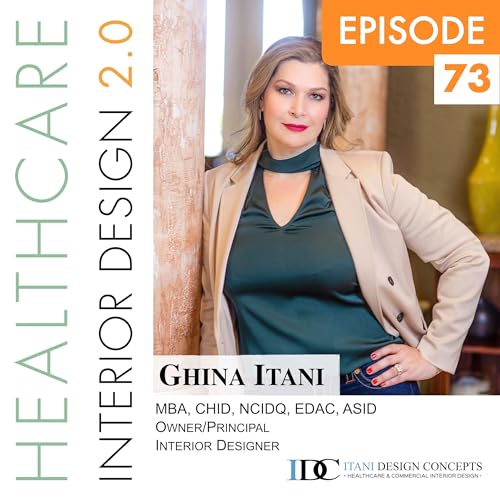
  • Episode 73, Ghina Itani, MBA, CHID, NCIDQ, EDAC, ASID, Owner/Principal Interior Designer of Itani Design Concepts (IDC)
    Feb 17 2026
    "Art is underutilized as a tool. We should ask: what's the intent behind this piece? Why this piece… and what is this going to do for patients?" —Ghina Itani on HID2.0 What if "beautiful" isn't just a nice-to-have — but a clinical tool? In this episode, Cheryl sits down with Ghina Itani, MBA, CHID, NCIDQ, ASID, EDAC — founder and principal designer of Itani Design Concepts (woman-owned, founded in 2007). Together they unpack how healthcare design decisions ripple outward: influencing everything from patient stress to staff retention, wayfinding, and even workplace culture. You'll hear Ghina's origin story — including the moment she rediscovered her portfolio in a box during her "little ones" season and realized her career was still waiting — and how one early hospital project helped raise expectations for what healthcare spaces could feel like. Then we will dive deep into neuroaesthetics (the brain's response to beauty and environment), why designers must avoid "paint-by-numbers" claims, and how color research can be shared without overpromising. Along the way, Ghina breaks down the famous Baker–Miller Pink story and what it teaches us about context, demographics, and why no single color is a universal prescription. Finally, you'll explore art as care — including the idea of museum prescriptions — and why art is often underutilized as a real tool for healing and connection (not just decoration.) What you'll hear in this episode A powerful origin story about timing, identity, and returning to ambition Why healthcare design is never just aesthetic — it's operational Neuroaesthetics: what it is, why it matters, and what it isn't Color guidelines: where they help… and where they fall apart The "pink prison" story — and what it teaches about context over clichés How designers can present research logically (especially with clinical leaders) Art as a care intervention, not an accessory — including museum prescription programs Why instinct still belongs in evidence-based work Key Takeaways Design has reach. A chair choice can affect not just comfort — but operations, loyalty, and even patient flow. Color isn't a magic button. It's about dose, placement, scale, lighting, and culture — not "blue = calm." Neuroaesthetics is a lens, not a guarantee. Designers can use research to guide decisions without promising outcomes. Inclusion builds trust. Bringing staff and stakeholders into the design process reduces resistance and improves buy-in. Art can be therapeutic. When chosen with intent, it can open conversation, reduce stress, and support care experiences. Memorable Quotes from Ghina Itani "I kind of realized that… my career is waiting. It's right here." "I took chances and I was gutsy." "Even if I didn't have an idea what I'm doing at the time, I always think: I'm going to figure it out." "When an opportunity comes, you have to seize it." "If I think too much about something, I probably won't do it." "Owning a business and being a designer are two different things." "Now we're affecting operation." "We cannot just say, this color gives you this outcome." "Neuroaesthetics is misunderstood… it's not a prescription that you put it and solve the problem." "Art is underutilized as a tool." "We still think of it as pretty and not pretty… but we shouldn't think that way." "We should think: what's the intent behind this piece? Why this piece… and what is this going to do for patients?" "We are the product of our environment." "We cannot make it ever robotic… it will always need the human." "At the end of the day… I would trust what I think of it and what my instincts tell me as well." Resources & Links ITANIA DESIGN CONCEPTS - Itani Design Concepts (website): https://itanidc.com/ - About Ghina Itani: https://itanidc.com/index.php/about/ - Contact page: https://itanidc.com/index.php/contact/ - Portfolio: https://itanidc.com/index.php/portfolio/ - ASID Design Finder listing (Ghina Itani): https://designfinder.asid.org/listing/ghina-itani CREDENTIALS & ORGANIZATIONS MENTIONED - AAHID (American Academy of Healthcare Interior Designers): https://aahid.org/ - CHID credential info (AAHID): https://aahid.org/certification/ - EDAC (The Center for Health Design): https://www.healthdesign.org/certification-outreach/edac/ - The Center for Health Design (home): https://www.healthdesign.org/ - CIDQ / NCIDQ Certification: https://www.cidq.org/ TOPICS FROM THE EPISODE - Neuroesthetics (overview): https://en.wikipedia.org/wiki/Neuroesthetics - Baker–Miller pink (overview): https://en.wikipedia.org/wiki/Baker%E2%80%93Miller_pink - Museum prescriptions (Montreal Museum of Fine Arts): https://www.mbam.qc.ca/en/news/museum-prescriptions/ - Penn Center for Neuroaesthetics: https://neuroaesthetics.med.upenn.edu/ Connect with Ghina Itani Email: gina@itanidc.com Phone: 661-549-5886 LinkedIn: https://www.linkedin.com/in/ghina-itani/ Our Industry Partners The ...
    Más Menos
    55 m
  • Episode 74, Susan Suhar, NCIDQ, IIDA, LEED AP, WELL AP, Fitwel Amb, Design Principal – Interiors, Associate Vice President at HDR Architecture
    Mar 3 2026
    "The best way to think of it is like a do not use ingredient list, similar to checking a food label — but for buildings." — Susan Suhar on HID2.0 Today on the podcast, Cheryl sits down with Susan Suhar — Design Principal- Interiors and Associate Vice President at HDR Architecture in Los Angeles — to talk about what's changing (and what's timeless) in healthcare design. With 25+ years designing award-winning environments across healthcare, workplace, and life science, Susan brings a rare mix of creative vision and real-world rigor — designing for the whole ecosystem: patients and families, yes, but also the staff doing the caring every single day. Susan helps lead the vision and growth of HDR's LA interiors practice, and she's been deeply involved in major healthcare work including Cedars-Sinai's Marina del Rey Hospital and the UCSF Helen Diller Hospital project in San Francisco (part of a collaborative design team). In this conversation, Susan and Cheryl dig into the shifts shaping healthcare interiors right now — from behavioral health and outpatient growth, to sustainability, staff respite spaces, and why empathy still belongs at the center of every healing environment. WHAT WE COVER Why healthcare interiors serve "one of the broadest ranges of humans in human emotion" — all at onceSusan's origin story: how universal design shaped her purpose as a designerWhat's unique about designing healthcare in California (and specifically Los Angeles)Key shifts shaping healthcare design today: -behavioral health -the evolving patient + staff experience -outpatient growth and the rise of same-day proceduresHow shorter schedules are changing design + documentation — and where AI fits (supporting, not replacing)Cedars-Sinai Marina del Rey Hospital: designing a community hospital that feels sophisticated, elegant, and not like a hospitalThe "sea change for healing" concept: waves, journey, light-on-water (and an unforgettable chapel + meditation patio)UCSF Helen Diller Hospital: iconic architecture, fog-response interiors, and major investments in respite, sustainability, and health"Red list free" in plain language — and why it matters in a hospitalWhy staff spaces are not optional: sleep rooms, respite, and protecting caregiver wellbeingSusan's guiding principle: empathy, and the questions that make design better KEY TAKEAWAYS Design empathy isn't a vibe — it's a practice. It shows up in how we listen, what we prioritize, and what we protect in the program.Staff experience is patient experience. If we don't design for caregiver wellbeing, we quietly erode care quality.Sustainability + health transparency are converging. Materials aren't just about durability and aesthetics anymore — they're about human impact, too.The pace is changing. Faster schedules are pressuring teams to get more efficient without losing the design story or the details. RESOURCED MENTIONED PROJECTS + IMAGES • HDR – Cedars-Sinai Marina del Rey Hospital (project page) https://www.hdrinc.com/portfolio/cedars-sinai-marina-del-rey-hospital • HDR – UCSF Health Helen Diller Hospital (project page) https://www.hdrinc.com/portfolio/ucsf-health-helen-diller-hospital • UCSF Real Estate – Helen Diller Hospital project overview https://realestate.ucsf.edu/projects/ucsf-health-helen-diller-hospital-hdh • Herzog & de Meuron – UCSF Health Helen Diller Hospital (project page) https://www.herzogdemeuron.com/projects/547-ucsf-helen-diller-medical-center-2/ CEDARS-SINAI UPDATES • Cedars-Sinai Newsroom – "New Cedars-Sinai Marina del Rey Hospital Rises" (includes video/update) https://www.cedars-sinai.org/newsroom/new-cedars-sinai-marina-del-rey-hospital-rises/ • Cedars-Sinai Newsroom – "Construction Begins for New Cedars-Sinai Marina del Rey Hospital" https://www.cedars-sinai.org/newsroom/construction-begins-for-new-cedars-sinai-marina-del-rey-hospital/ • Cedars-Sinai – "An Upgrade to Medicine in the Marina" (construction progress story) https://www.cedars-sinai.org/stories-and-insights/advancing-our-mission/an-upgrade-to-medicine-in-the-marina HDR SITE / PORTFOLIO SEARCH (as mentioned on the episode) • HDR homepage https://www.hdrinc.com/ • HDR portfolio (search/browse) https://go.hdrinc.com/portfolio SUSTAINABILITY + MATERIAL HEALTH TERMS (RED LIST / EPD / HPD) • ILFI – Red List (Living Building Challenge) https://living-future.org/red-list/ • ILFI – Living Building Challenge overview https://living-future.org/lbc/ • EPD International – International EPD System (what an EPD is / program info) https://www.environdec.com/about-us/international-epd-system • HPD Collaborative (what an HPD is / material health disclosure) https://www.hpd-collaborative.org/ CALIFORNIA HEALTHCARE FACILITY OVERSIGHT (OSHPD / now HCAI) • HCAI – OSHPD became HCAI (official announcement) https://hcai.ca.gov/oshpd-becomes-the-department-of-health-care-access-and-information/ • HCAI – Building Safety (...
    Más Menos
    44 m
  • Episode 72, Elizabeth Johnson, PhD, MS-CRM, RN, Assistant Professor, Montana State University Mark and Robyn Jones College of Nursing, Incoming President of the Nursing Institute for Healthcare Design
    Jan 13 2026
    "As a system scientist and a nurse, my patient is now the hospital." –Elizabeth Johnson on HID2.0 On today's podcast episode, Cheryl sits down with Dr. Elizabeth Johnson (PhD, MS-CRM, RN)—Assistant Professor at Montana State University's Mark & Robyn Jones College of Nursing, host of Designing Care On-Air, and incoming President of the Nursing Institute for Healthcare Design (NIHD). Elizabeth lives at the intersection of nursing, technology, and design, with a passion for designing healthcare systems—especially for rural, frontier, remote, and tribal communities where distance and infrastructure shape what care can look and feel like. In this conversation, Elizabeth shares the "permission" moment that changed her path into healthcare design, her research using mobile and wearable technology to support clinical trial participant safety, and the powerful insights coming from The Kind Room Project—where children use art to show what a healthcare space looks like when it helps them feel calm, safe, and brave. Along the way, she offers a reframe you won't forget: "My patient is now the hospital." In this episode, we cover The moment that changed everything: being asked (for the first time) what she thought—as a nurse—during a design challenge. The Kind Room Project: using art-based prompts so kids can show what "healthcare that feels kind" looks like. A surprising insight from children's drawings: many prefer softer, muted tones over the stereotypical "primary colors." Why rural hospitals are a "living, breathing apparatus" of community life—and what designers miss if they only visit during business hours. Wearables + clinical trials: how technology can help rural/remote participants stay safe and supported closer to home. "Day two design" (after the ribbon cutting): where latent errors show up—and how to ask great questions, not just good ones. The mindset shift she wants to normalize: making friends with the unknown. Memorable quotes "My patient is now the hospital." "Advocacy through vision and visibility." "Permission is granted. It's a yes—you belong." "Make friends with the unknown." Links & ways to connect Elizabeth Johnson's email: elizabeth.johnson37@montana.edu Elizabeth LinkedIn: https://www.linkedin.com/in/elizabeth-johnson-phd-ms-crm-rn-833590167/ Montana State University Nursing directory (Elizabeth): https://www.montana.edu/nursing/directory/bozeman/2344665/elizabeth-johnson MSU CAIRHE "Johnson Project" page: https://www.montana.edu/cairhe/other-investigators/johnson/ NIHD (Nursing Institute for Healthcare Design): https://nursingihd.com/ Elizabeth's NIHD bio: https://nursingihd.com/elizabeth-johnson-bio Join NIHD: https://nursingihd.com/join Designing Care On-Air (Apple Podcasts): https://podcasts.apple.com/us/podcast/designing-care-on-air/id1696746547 Kind Room / design tool site (as mentioned): https://designkind.art If you liked this episode… Share it with a nurse, designer, architect, engineer, or administrator who cares about building healthcare environments that feel more human—and more kind. Our Industry Partners The world is changing quickly. The Center for Health Design is committed to providing the healthcare design and senior living design industries with the latest research, best practices and innovations. The Center can help you solve today's biggest healthcare challenges and make a difference in care, safety, medical outcomes, and the bottom line. Find out more at healthdesign.org. Additional support for this podcast comes from our industry partners: The American Academy of Healthcare Interior Designers The Nursing Institute for Healthcare Design Learn more about how to become a Certified Healthcare Interior Designer® by visiting the American Academy of Healthcare Interior Designers at: https://aahid.org/. Connect to a community interested in supporting clinician involvement in design and construction of the built environment by visiting The Nursing Institute for Healthcare Design at https://www.nursingihd.com/ ------------ The world is changing quickly. The Center for Health Design is committed to providing the healthcare design and senior living design industries with the latest research, best practices and innovations. The Center can help you solve today's biggest healthcare challenges and make a difference in care, safety, medical outcomes, and the bottom line. Find out more at healthdesign.org. Additional support for this podcast comes from our industry partners: The American Academy of Healthcare Interior Designers The Nursing Institute for Healthcare Design Learn more about how to become a Certified Healthcare Interior Designer® by visiting the American Academy of Healthcare Interior Designers at: https://aahid.org/. Connect to a community interested in supporting clinician involvement in design and construction of the built environment by visiting The Nursing Institute for Healthcare Design at https://...
    Más Menos
    56 m
Todavía no hay opiniones