Episodios

  • NCDs, AMR, and Policy Crossroads
    Sep 22 2025

    What insights and lessons learned from the UN High Level Meeting on antimicrobial resistence last September can inform preparations for the upcoming UN High Level Meeting on non-communicable diseases?

    In this second episode of Intersections in Health, a podcast mini-series, we delve into #NCDs and #AMR common policy benefits and challenges with

    • Professor Dame Sally Davies, UK Special Envoy on AMR, former Chief Medical Officer for England and former member of the WHO Executive Board 2014-2016, and
    • Danilo Lo-Fo-Wong, WHO/Europe Regional Adviser and Programme Manager on the Control of Antimicrobial Resistance.

    We discuss the deathly threat of AMR for people with non-communicable diseases such as cancer, health diplomacy, the critical roles of civil society organisations in policy, health and the arts and the value of stepping outside our disciplinary bubbles.

    Tune in and share your feedback on the issues discussed.

    Please listen back to our previous episode exploring the intersections of NCDs and the triple planetary crisis and stay tuned for our final episode on NCDs and population ageing.

    This short series is part of WHO/Europe’s count-down to the UN High Level Meeting on NCDs in September 2025.

    Hosted and produced by Maebh Ní Fhallúin

    Sound design and editing by David Barrett

    Más Menos
    36 m
  • NCDs and the triple planetary crisis
    Jun 5 2025

    How can we address the intersecting challenges of climate change and non-communicable diseases at once?

    In this first episode of the Intersections in Health, a new short podcast mini series, we delve into NCDs and the triple planetary crisis of climate change, biodiversity loss and toxic pollution with

    • Hans Bruyninckx , Commissioner on the Pan-European Commission on Climate and Health #PECCH, Professor of Environmental Governance at the University of Antwerp, former Executive Director of the European Environment Agency and
    • Sinaia Netanyahu , Programme Manager at WHO/Europe’s Centre for Environment and Health.

    We discuss attacks on science and #misinformation, the art of knowledge translation, communicating complexity and uncertainty, super wicked problems and system transformation. Crucially, we explore what this moment asks of each one of us and collectively.

    Tune in and give us your feedback on the issues discussed.

    ----------

    Our next episodes will explore the intersections of NCDs and anti-microbial resistance and NCDs and population ageing.

    This short series is part of WHO/Europe’s count-down to the UN High Level Meeting on NCDs in September 2025.

    Más Menos
    34 m
  • Medevac
    Mar 17 2025

    Crisis and conflict dominate the headlines. The ongoing war in Ukraine and the conflict between Israel and the occupied Palestinian territory have brought death, destruction and displacement. But among the major disasters and conflicts. It's important to look for the stories of the people who are helping.

    As we mark over 5,000 medical evacuations from Ukraine, in this episode of Health in Europe, we'll share stories about some of the sick and injured people who have been transported away from war zones and other emergencies, and of their welcome, medical treatment, recovery and eventual repatriation.

    We'll also explore the Region's Emergency Medical Teams to learn about people who, with sometimes only hours notice, drop everything to travel to emergency zones. Who are they and what motivates them?

    Más Menos
    31 m
  • Celebrating Women in Science
    Mar 6 2025

    Stories of strength and dedication to mark International Women’s Day

    For International Women’s Day, we celebrate the achievements of three remarkable women working at the forefront of global health. Margaux Mesle, Ana Paula Coutinho Rehse and Harsh Lata work for the WHO Regional Office for Europe’s World Health Emergency programme (WHE) which sits at the centre of global coordination, preparation and response to disease outbreaks and emergencies. Their journeys into science, their challenges, and their advice for future generations are both inspiring and enlightening.

    Más Menos
    27 m
  • How To Talk to Children About Suicide
    Feb 26 2025

    When we hear the word suicide, many of us instinctively recoil. The word is taboo in everyday life. For family members who have lost somebody to suicide, this stigma can make grieving even more complex. People may struggle to explain the loss and how they feel about it to friends, colleagues, and other family members.

    But how do you explain suicide to a young child? What words should you use? How do you support them?

    In June 2024, Ireland's National Office for Suicide Prevention published an illustrated children's book called Safe Harbour, to help parents and carers talk to children bereaved by suicide.

    The book, written by Patricia Ford and illustrated by Bronna Lee, encapsulates much of what suicide bereavement is about, navigating a world that is both completely new and oddly normal. For this episode of Health in Europe, we are looking at suicide bereavement with Safe Harbour as our compass.

    DOWNLOAD SAFE HARBOUR:
    You can download the book and its resources at https://www.childhoodbereavement.ie/safeharbour

    PLEASE NOTE:

    This episode of Health in Europe covers the theme of suicide and contains an account of suicide bereavement. If you are thinking of ending your life, please reach out to family and friends or to a local suicide helpline. If you are unsure of helplines in your area, please visit: https://findahelpline.com

    Más Menos
    23 m
  • Learning lessons from the last pandemic
    Sep 9 2024

    In this turbulent world, it’s tempting to move on and forget the difficult days of COVID-19. Although the impact of the COVID pandemic is far-reaching, and for many, ongoing, as priorities shift, people are thinking less about the last pandemic or the possibility of another one. We risk falling into yet another cycle of panic and neglect.

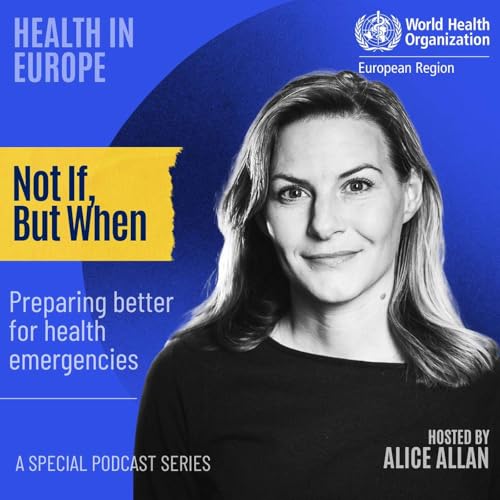
    In episode 6 of Not If, But When, we ask, what are the challenges for the public health experts trying to apply the lessons of the last pandemic, and working to strengthen the global systems for preventing future ones?

    We speak to Catherine Smallwood, former WHO Regional Office for Europe’s Senior Emergency Officer and Programme Manager (Emergency Operations), about the systems in place that guide health emergency preparedness and response.

    We hear from Mike Ryan, Executive Director of WHO's Health Emergencies Programme, about why, despite increasing and overlapping emergencies, he’s optimistic that the world will find ways to work together to combat global threats.

    Más Menos
    31 m
  • Dengue
    Aug 20 2024

    In tropical and subtropical countries, the virus causing dengue is spiking. Close to an historic high of over 6 million cases and more than 7,000 dengue-related deaths were reported in over 80 countries and territories in 2023. Most places in Europe remain too cool to favour the mosquito or the virus, but imported dengue cases have been rising in the European region and the impact of climate change appears to be shifting the picture.

    To find out more about dengue and the family of viruses it belongs to, called arboviruses, Alice Allan speaks to Marc-Alain Widdowson, high threat pathogens technical lead at the WHO Regional Office for Europe and medical entomologist Luca Facchinelli. To learn more about Italy’s work on dengue prevention and communication, she speaks to Flavia Riccardo, an epidemiologist in the Infectious Disease Department of the Italian National Institute of Health, and her colleague from the Institute’s press office, Pier David Malloni.

    Más Menos
    27 m
  • Influenza past, present and future
    Aug 2 2024

    The first of the three influenza pandemics that occurred in the 20th century is estimated to have killed over 50 million people. Based on scientific advances, what do we know about the 1918-20 pandemic? What lessons does it teach about preventing pandemics and containing outbreaks when they do occur?

    • Richard Pebody, director clinical and emerging infections of the UKs health security agency, explores the deadly 1918-20 pandemic.
    • Thorsten Wolff, head of the Division for Influenza and other Respiratory Viruses, talks us through the scientific discoveries that helped to explain the virus that caused the 1918-20 pandemic, and the ongoing work of the National Influenza centre in Berlin.
    • Nicola Lewis, Director of the Worldwide Centre for Influenza at the Francis Crick Institute, UK, explains their work to monitor seasonal flu and pick up changes in flu strains that could have pandemic potential.
    Más Menos
    28 m