Eko Radio Podcast Por Eko Square arte de portada

Eko Radio

Eko Radio

De: Eko Square
Escúchala gratis

Eko Radio is the premier platform for community-driven progress in Columbus and beyond. Join Eko Square as we dissect bold policy recommendations, creative insights, and transformative reports—from the Columbus Literacy Surge to the People’s Justice Platform. We turn strategic proposals into actionable change for equity, education, and power.Eko Square Ciencia Política Economía Gestión Gestión y Liderazgo Política y Gobierno
Episodios
  • Nigeria: A Prisoner’s Dilemma (Written 2013)
    Mar 15 2026
    https://www.ekosquare.com/wp-content/uploads/2026/03/The_Game_of_Betrayal__Deconstructing_Nigeria_s_Feudal_State.mp4 Prisoner’s Delimma: A paradox in decision analysis, in which two individuals acting in their own best interest pursue a course of action that does not result in the ideal outcome for either. Written by DiePreye Krukrubo (2013) Nigeria, the most populous Country in Africa is about twice the size of California with over 150 million people, 250 ethnic groups, and over 500 different languages. The brilliance of its people is apparent in the number of Nigerians with world renowned achievements in music, literature, banking, finance, science and engineering. According to an article published a few years ago, Nigerians are the most highly educated immigrant group in the USA. The resilience of the Nigerian people is undisputable in light of our ability to adapt, assimilate and contribute to our new residential societies, when living in diaspora. Despite the infrastructural deficiencies and shortcomings of the Nigerian state, the innovation, high levels of energy and competitive productivity of its people has resulted in a GDP growth of about 6.5% since 2005, which is truly a testament our collective determination. You’ve probably figured out by now that I draw a distinction between the Nigerian people and the state, and I limit the context of my examination to the situated instrument of the State (i.e. the institution charged with regulating, administering, and executing a “common good” for the people). I seek to explore the reasons why most Nigerians, most notably Dr. Ngozi Okonjo-Iwela- a former managing director of the World Bank, Finance Minister, and Foreign Affairs Minister of Nigeria- concludes that the Nigerian State is “…incompetent and inefficient.” I believe that an exploration and thorough understanding of the fundamental features of the ‘Nigerian’ legitimate discontent is a prerequisite for the successful reconstruction of the failing Nigerian state, and the reclamation of a creditable government by our people. I put it to you dear friends, that the failure of the state is the inevitable manifestation of the continual inter-ethnic apprehensions, and the aggressive pursuits of narrow interests. The failures that everyday Nigerians live with include but are by no means limited to: ● Little to no electricity (sometimes for days on end). Interacting with “men in uniform” AKA law enforcement, who are empowered to serve and protect them, but at whose hands they are exploited and sometimes beaten. Little access to safe drinking water. Queuing in long lines for hours to get fuel despite living in one of the world’s top oil producers. Growing Islamic fundamentalism in the North, and armed insurrection by Southerners in conflict with foreign oil companies and the government for local resource control and social justice. An atrocious state of education, a catastrophic rate of unemployment, abject poverty, armed robbers, ethnic killings, and rampant corruption! Some people, unable to recognize the plethora of failures as the tragic yet logical consequences of “democratic” activities in Nigerian politics, buy into the notion that democracy is exclusively western and intrinsically “un-African,” with generic exclamations of how united Africans were before “…the white man came and divided us with western education and democracy”. They evoke the convoluted history of the transatlantic slave trade, with oversimplified revisions of African victimization, impressing upon the role of Europeans while conveniently neglecting the most definitive role of all. I’ll start by addressing African victimization and the transatlantic slave trade. Yes, the transatlantic slave trade, driven by competition within major European empires for economic dominance through the industrial revolution (distinct from the industrial era), provided the free labor on whose backs Europe and the Americas were pushed to the forefront of modernity and scientific discovery, while creating enormous wealth and opportunity for their people and markets. Yet while much ado is made about the European utilization of African slaves to build the foundations of an industrial era, the far more significant (and least addressed issue) is the collective decision made by African men (of free will in sub-autonomous circumstances), to commoditize their richest capital, themselves, in narrow-minded calculations for the accumulation and/or preservation of wealth and territory. So much so in fact, that not only was the slave trade a domestic social and political reality, but slaves were the major export within what would be called Nigeria for over 100 years well into the 19th Century. Sure, the need for slave labor created enormous wealth and opportunity for some of the trading empires within Nigeria, by developing alliances and avenues for the acquisition of superior western...
    Más Menos
    1 h y 3 m
  • The Quicksand Of Consensus: Why Peter Obi’s Next Mandate Depends on Dismantling the Autocracy of the Ticket
    Mar 13 2026
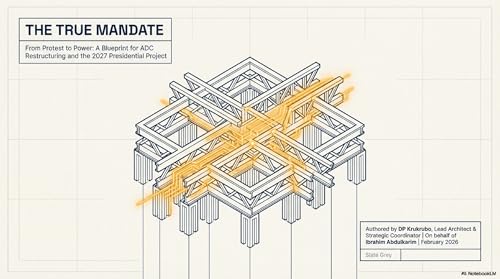
    https://www.ekosquare.com/wp-content/uploads/2026/03/the-quicksand-of-consensus.mp4 The Relatable Crisis of “Passion Without Power” The 2023 election cycle was defined by the kinetic, youth-led energy of the “Obidient” movement—a vibrant surge that promised to break the duopoly of Nigeria’s entrenched political machines. Yet, we must face a sobering reality: raw passion, no matter how righteous, is not a substitute for institutional power. The recent Abuja (FCT) area council elections served as a brutal autopsy of this structural failure. While the APC swept 5 of 6 councils, the ADC—despite high-profile defections and media dominance—delivered modest results, such as 12,109 votes in AMAC against the APC’s 40,295. This data confirms that media vibes and social media energy do not win elections; disciplined, ward-level structures do. The “Strategic Proposal for ADC Reconstruction” is not merely a political document; it is the necessary roadmap to ensure that the “Children of the Land”—the 80 percent of dormant voters who represent the soul of this nation—are never again led into a battle they are structurally unequipped to win. Key Takeaway 1: The High Price of the “Unholy Alliance” To understand the future, we must deconstruct the “Faustian bargain” of the past. The Labour Party was never a sanctuary for reform; it was a site of a compromised “unholy alliance.” To secure a ticket on short notice, a tacit agreement was struck that prioritized the candidacy over the platform’s integrity. “The terms of this agreement were clear: Obi would receive the party’s presidential ticket, but in exchange, he and the Obidient Movement would stay out of the Labour Party’s internal affairs.” By staying silent on the “broken constitution” and the centralized autocracy of the National Chairman, Julius Abure, the movement inadvertently legitimized the very undemocratic practices it claimed to oppose. Winning a ticket through such a compromise is a hollow victory. If the vessel of statecraft is built on structural rot and internal impunity, the momentum of the people will always be swallowed by the chaos of a feudal party machine. True moral authority requires a platform that mirrors the justice it seeks for the nation. Key Takeaway 2: Consensus is “Quicksand,” Not a Mandate In the theater of Nigerian politics, “consensus” is the preferred tool of the godfathers—a backroom compromise designed to bypass the will of the people in favor of elite bargains. But for a movement seeking a genuine mandate, consensus is quicksand. The ADC reconstruction rejects this model, identifying it as a “moral hazard” that creates candidates beholden to selectors rather than electors. Instead, the blueprint mandates open, rules-based primaries. These primaries are designed to be a “trial by fire” that tests the seriousness, physical stamina, and organizational reach of candidates. While consensus favors older, less resilient elite bargains, the open primary model favors younger, energetic leaders with genuine grassroots networks. A mandate born of a backroom deal is a compromise that threatens to destroy the movement’s momentum before the first ballot is cast. Key Takeaway 3: The 12-Week Masterstroke—Staggered Congresses To dismantle the old guard’s reliance on one-day conventions—which are easily hijacked by money and violence—the “Strategic Proposal” introduces a 12-week staggered congress period, beginning on April 13, 2026. This is a war of narratives designed to “own the news cycle” for an entire quarter. Operational Quality: A dedicated “Congress Task Force” will supervise each zone sequentially (April–June 2026), ensuring that lessons learned in one region improve the integrity of the next.Media Dominance: By touring the country zone-by-zone, the ADC showcases internal democracy in action, contrasting sharply with the APC’s closed, elite-driven politics.Regional Exposure: As the party moves through each geopolitical zone, it will simultaneously highlight the specific failures of the ruling party—from insecurity in the North to economic neglect in the South—tying national reform to local grievances. As the proposal asserts, this is about “returning power to the people” versus the “closed, elite-driven, court-managed internal politics” that has historically disenfranchised the Nigerian voter. Key Takeaway 4: Beyond Twitter—The Local Cooperative Model A presidential candidate without a “ground game” of down-ballot champions is a general without an army. To move beyond social media “vibes,” the ADC aims to transform party executives into Local Political Entrepreneurs.The Engine of Local Legitimacy The strategy moves beyond traditional party offices by organizing teachers, health workers, and farmers into “Local Cooperatives” or “Issue Clusters.” These groups diagnose community needs and draft ...
    Más Menos
    36 m
  • The Blueprint for a 21st-Century Nigeria: 5 Radical Reimaginations from Draft Labor Party Constitutional Proposals
    Mar 11 2026
    https://www.ekosquare.com/wp-content/uploads/2026/03/Blueprint_for_a_New_Nigeria.mp4 The Nigerian political landscape is no longer merely failing; it has devolved into what the “Children of the Land” text describes as a “feudal state” characterized by “utter ineptitude and malice.” For decades, a narrow political class—unworthy of the privilege of leading—has treated the nation’s resources as a private treasury, institutionalizing a “rent culture” that leaves the citizenry in destitution. With roughly 80% of registered voters choosing to disengage from this “culture of corruption and cronyism,” the system faces a crisis of legitimacy that cannot be solved by incrementalism.The Draft 2024 Labor Party Bylaws and Charter proposals, authored by DP Krukrubo, represent a technical rescue operation. This is not a mere campaign manifesto; it is a structural roadmap designed to dismantle the “shackles of existing political structures” and replace them with a representative system built on accountability, merit, and the “sacred duty” of serving the public good. Read Charter Read Bylaws Killing the “National Chairman” Autocracy A central cause of Nigeria’s democratic decay is the “unholy alliance” often struck between popular candidates and party leadership. As seen in recent political history, truces are frequently made where candidates receive tickets in exchange for ignoring the “unchecked authority” of a National Chairman. This consolidation of power allows a single individual to head both the National Executive Committee (NEC) and the National Working Committee (NWC), rendering internal checks and balances impotent. To end this cycle of impunity, the 2024 proposals institutionalize a three-branch party architecture designed to make such truces impossible through structural design: The NEC (Legislative/Grassroots): The highest policy-making body, responsible for resolutions and legislative oversight.The NWC (Executive/Operational): Tasked with day-to-day implementation and merit-based candidate recruitment.The Disciplinary Committee (Judiciary): An independent arbiter for disputes and constitutional interpretation. “What is happening within the Labour Party today… reflects a broader malaise affecting Nigerian politics, where constitutions are tools for consolidating power rather than empowering the people.” By strictly separating these powers, the 2024 framework ensures that no individual can dictate the party’s direction. This internal separation is a necessary precursor to ending the “rent culture” that plagues the national government. Bottom-Up Governance via Grassroots Collectives The new structure effectively removes the “middleman” of the political elite by institutionalizing grassroots collectives. According to Article Two of the Bylaws, the NEC is mandated to organize society into active collectives of farmers, teachers, artisans, and youth. Unlike traditional “wings” of a party, these collectives possess a direct policy mandate. For example, a “collective of teachers” does not just support the party; it identifies specific classroom gaps and feeds those resolutions directly into the NEC’s legislative process. This ensures that the party’s platform is not a product of elite patronage but a reflection of the realities of those who perform the nation’s labor. By making the NEC’s policy agenda dependent on these bottom-up inputs, the 2024 proposals ensure that public services are designed to tackle real-world problems rather than serve the interests of “thugs and mercenaries.” The Economic Leapfrog: 4IR and Agrarian Revolution The National Labor Party Charter shifts the national economic paradigm from “consumption to production.” This transition is powered by what the Charter calls “entrepreneurial public sector governance”—a model where the state acts as a catalyst for growth rather than a drain on resources. The economic strategy focuses on two pillars: Export-Oriented Industrialization: Leveraging Nigeria’s land and natural resources through an “agrarian revolution” to move beyond raw material exports.The 4th Industrial Revolution (4IR): Applying scientific and technological innovations to “leapfrog” traditional development stages and build a competitive digital economy. Through integrated public-private partnerships, the party intends to build world-class infrastructure in energy, rail, and healthcare. This isn’t just about building roads; it’s about creating an environment where the creative industries (film, music, fashion) and manufacturing can thrive globally through tech-driven productivity. Institutionalized Inclusivity and “Zoning” Without Quotas The 2024 proposals reject the tokenism of “mandatory quotas,” which Article Eight, Section 4 of the Charter explicitly prohibits. Instead, the framework introduces a more robust system of “zoning...
    Más Menos
    40 m
Todavía no hay opiniones