Episodios

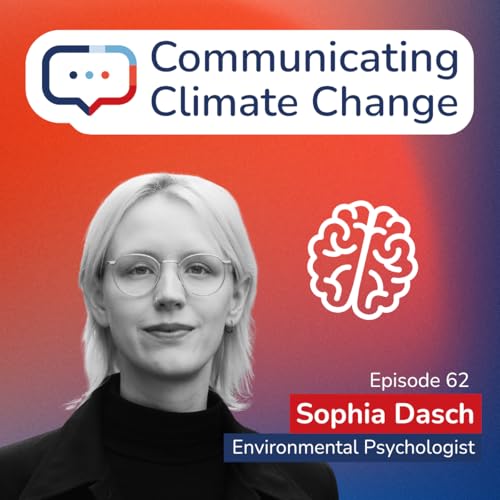
  • The Psychology of Collective Climate Action With Sophia Dasch
    Mar 30 2026

    This episode features a conversation with environmental psychologist, Sophia Dasch. It was recorded in February 2026.

    Sophia works at the intersection of psychology, policy, and climate action. She’s an expert on the psychology of social movements, and of climate action more broadly.

    I discovered Sophia through her co-authored book “The Psychology of Collective Climate Action” which she describes as a passion project of the non-profit organization, Wandelwerk.

    The members of Wandelwerk – which roughly translates as "change collective" – are psychologists by training, grounded in scientific research, and at the same time they’re active participants in the climate movement. Their collective mission is to bridge these worlds by translating psychological insights into practical tools for climate action.

    They do this through workshops, educational programs, public engagement, and their own research – as well as publications like the book “The Psychology of Collective Climate Action,” which is freely available as an open-access resource. And, for me, is one of the most important reads of recent years.

    Alongside Wandelwerk, Sophia works as a policy consultant at the research institute ConPolicy, where she brings her expertise to topics such as Action for Climate Empowerment (or ACE), risk communication, and digitalization.

    Amongst other things, Sophia and I discussed the psychology of movement building, the three non-negotiables for collective climate action, and the many ways communicators can contribute to putting them in place.

    This one instantly slides into my top 10 biggest impact episodes. So, get your notepads ready!

    Additional links

    Get the book The Psychology of Collective Climate Action

    Visit the Wandelwerk website

    Más Menos
    51 m
  • Writing Winning Climate Speeches With Rune Kier Nielsen
    Feb 23 2026

    This episode features a conversation with award-winning speechwriter and author, Rune Kier Nielsen. It was recorded in June 2025.

    Rune has worked across the public and private sectors, including within the Danish Government as well as leading Danish technology companies, and as Public Advocacy Lead on Climate Action at the UN Environment Programme, where he led campaigns such as ACT NOW: Speak Up, empowering youth and communities in developing countries to drive systemic change.

    A two-time international Cicero Speechwriting Award winner, Rune has lectured widely and authored several books on climate speechwriting. Drawing on his background in Social Anthropology, he champions human-centered climate communication, guiding others to speak effectively about the world they want to see.

    He currently works at VIA University College, Denmark’s largest and most international university college, where he develops engaging science communication strategies for the green transition.

    I discovered Rune through his most recent book, Speaking on Climate: A Guide to Speechwriting for a Better Future, which I would recommend to all climate communicators, since it offers foundational insights that are valuable not only for speechwriting, but climate communications of all kinds.

    Amongst other things, Rune and I discussed the mechanics of a powerful speech, where climate speeches have – and continue to – fall short, and the unique benefits this format offers for bringing people together and energising collective action.

    Additional links

    Visit Rune’s website

    His latest book Speaking on Climate: A Guide to Speechwriting for a Better Future

    Check out Rune’s video introduction to the book

    Read the Kirkus review of the book here.

    Find Rune’s book, Speaking on Climate, getting lots of love on We Don't Have Time

    Más Menos
    49 m
  • Drilling into Fossil Fuel Industry Influence With Amy Westervelt
    Jan 19 2026

    This episode features a conversation with award-winning investigative climate journalist, Amy Westervelt. It was recorded in June 2025.

    Amy has been on the climate beat for more than 20 years, reporting for a wide range of outlets including Inside Climate News, The Washington Post, The Guardian, The Nation, The Intercept, NPR, and many more.

    In the past 10 years, Amy has worked extensively in the audio realm, most notably with Drilled, a true crime podcast about climate denial.

    What was planned to be a single limited-run audio series was an absolute hit, and has now grown into an ongoing investigative reporting project digging into the various forces obstructing action on climate.

    Despite her successes in audio though, Amy continues to write regularly for a wide range of publications. In 2023 she was named one of Covering Climate Now’s Journalist of the Year and her work has previously received Murrow, ONA, SEJ, Rachel Carson, and Folio awards, as well as a Peabody nomination.

    Amongst other things, Amy and I discussed the structural influence the fossil fuel industry has carefully crafted over our information ecosystem; the magic that narrative injects into climate journalism; and the need for more of us to don our tin-foil hats a bit more often, because things are frequently way wackier than we’d maybe like to believe.

    Additional links

    Drilled: https://drilled.media/

    Amy’s 5 petroganda narratives: https://drilled.media/news/petroganda-narratives

    Ben Franta’s paper on weaponising economics: https://www.tandfonline.com/doi/full/10.1080/09644016.2021.1947636

    The Media Matters bubble graph: https://www.mediamatters.org/google/right-dominates-online-media-ecosystem-seeping-sports-comedy-and-other-supposedly

    The Black Thread: https://communicatingclimatechange.com/the-black-thread

    Más Menos
    49 m
  • Introducing “The Black Thread”
    Oct 13 2025

    The Black Thread is a new documentary podcast series unravelling Norway’s complex relationship with prosperity, identity, and responsibility in a warming world.

    Episodes will be dropping weekly over on Drilled Media.

    Más Menos
    2 m
  • Insights From Interventions Within the Global Majority With Diya Deb
    Jun 2 2025

    This episode features a conversation with Diya Deb, executive director of Mindworks. It was recorded in April 2025.

    Growing up as an activist in India, Diya has in-depth experience of working in harsh political and social realities.

    With a variety of leadership roles under her belt from Amnesty and Greenpeace India, and a background in campaigning and program management too, she holds a deep belief in the need to decolonise knowledge and drive systemic change in Global Majority countries.

    At the helm of Mindworks, Diya works to apply cognitive and social science insights to support organisations and changemakers, particularly in Asia, Africa and Latin America, to campaign innovatively to address climate and other systemic issues.

    Amongst other things, Diya and I discussed the ways that mindsets in places like India and Indonesia demand new strategies and emphasis from climate communicators, the fresh ways that denial emerges in such contexts, and the desperate need for more listening in developing interventions and engagement that resonates.

    Additional links:

    Visit the Mindworks website

    Dig in to the Anger & Agency Monitor

    Check out the Time to Talk insights and toolkit

    Más Menos
    43 m
  • Charting a New Course With Rupert Read
    May 12 2025

    This episode features a conversation with Rupert Read, co-director of The Climate Majority Project. It was recorded in March 2025.

    Rupert is an Emeritus Professor of Philosophy at the University of East Anglia, a former spokesperson for Extinction Rebellion, and at the Climate Majority Project, works to build a mass, moderate climate movement by supporting community-led adaptation, democratic participation, and practical climate action across the UK.

    He’s the author of several influential books on climate and society, and is a frequent commentator on the likes of the BBC, Al Jazeera, and other major platforms.

    His latest book, Transformative Adaptation: Another world is still just possible, argues that we are now beyond the safe climate threshold and must bring adaptation to the cenre of our response — not as retreat, but as an opportunity for deep change.

    Transformative Adaptation offers a framework for reimagining how we live, work, and govern in the face of climate impacts. It champions localism, community resilience, and working with nature, while challenging dominant systems that are no longer fit for purpose.

    Amongst other things, Rupert and I discussed how communicators can help audiences meet the realities of our current predicament with active hope and a sense of agency, which actions and interventions need to be taken and how we can support them, and what the concept of “thrutopia” offers for imagining what it all might look like.

    Additional links:

    Get Rupert’s book Transformative Adaptation: A new world is still just possible

    Check out Rupert’s website

    The Climate Majority Project website

    Some words from Rupert on Thrutopia

    Article with Caroline Lucas about climate populism

    Más Menos
    42 m
  • Building Climate Accountability From the Ground Up With Ingmar Rentzhog
    Apr 28 2025

    This episode features a conversation with Ingmar Rentzhog, founder and CEO of We Don’t Have Time, the world’s largest media platform dedicated to climate action. It was recorded in March 2025.

    Ingmar is a serial entrepreneur in finance and communication, as well as a climate changemaker who’s been recognized internationally for his impact. He’s a European Climate Pact Ambassador and a member of Al Gore’s Climate Reality Project, and through his work at We Don't Have Time, he’s mobilising millions to hold businesses, leaders, and governments accountable and drive genuine progress.

    With a mission to democratize knowledge about climate solutions and mobilize global action toward a prosperous and fossil-free future, We Don’t Have Time boasts a community of more than 120,000 climate professionals and influencers spanning 180 countries, as well as partnerships with more than 450 companies, governments, and civil society organizations. We Don’t Have Time reaches 200 million people each month on social media!

    Amongst other things, Ingmar and I discussed the ways that technological infrastructures like media platforms and social networks can support grassroots action, the importance of both sticks and carrots in engaging companies, governments, and other actors on climate issues, and how understanding financial flows can help us propel our much needed societal transformation forward.

    Additional links:

    Check out We Don’t Have Time and join the community!

    Find out more about the Make Science Great Again campaign

    Más Menos
    44 m
  • Visions of Tomorrow’s World With Chinelo Onwualu
    Apr 14 2025

    This episode features a conversation with writer, editor and strategic communications consultant, Chinelo Onwualu. It was recorded in March 2025.

    Chinelo is co-founder of Omenana, a magazine dedicated to African speculative fiction, and is the former chief spokesperson for the African Speculative Fiction Society. She’s also one of the reviewers of entries for Grist’s Imagine 2200 climate fiction contest.

    Her writing has been featured in several anthologies and magazines, including Uncanny magazine, Strange Horizons, The Kalahari Review, and Brittle Paper.

    It has also earned her many merits including a nomination for the British Science Fiction Awards, as well as for the Nommo Awards for African Speculative Fiction, and also the Short Story Day Africa Award.

    With a background in journalism, Chinelo previously worked as a reporter and online editor in Nigeria and the United States, including as a senior editor for Cassava Republic Press, one of the leading independent publishers in all of Africa.

    In her consultancy work, Chinelo has spent more than a decade supporting multi-national non-profits across the world with their strategic communications, including WE Charity International, ActionAid Nigeria, The BBC World Trust, and the University of Sussex's Institute for Development Studies.

    Amongst other things, Chinelo and I discussed the importance of stories in shaping our societies, how fiction can help us make changes in our real lives, and what Western storytellers might learn from those whose cultures have already faced apocalyptic scenarios.

    Additional links:

    Visit Chinelo’s website

    Grist's Imagine 2200 climate fiction contest

    Check out Omenana

    Peruse Rosarium Publishing and Flame Tree Press

    Explore Roy Okupe’s comics

    Discover Nightmare magazine and Uncanny magazine

    Read more about Chinese author Cixin Liu

    Más Menos
    41 m