Episodios

  • You Know You Love Me: A Conversation with Lindsay Denninger
    Apr 6 2026

    Gossip Girl was never just a teen soap about rich kids in absurd headbands making terrible decisions on the Upper East Side. It was also a glittery little blueprint for influencer culture, public shaming, digital surveillance, aspirational wealth, and the deeply American habit of packaging cruelty as glamour.

    In this episode of Bitchy History, I’m joined by Lindsay Denninger to talk about her book You Know You Love Me: How Gossip Girl Changed Pop Culture as We Know It, why female-centered pop culture is so often dismissed as unserious, and why that dismissal is complete nonsense. We get into the show’s feminism, its failures, its cultural afterlife, and the reason it still feels weirdly relevant in an era of curated identities, toxic men, and lives lived half for the camera.

    Because popular media matters. “Trashy” media matters. The things girls and women are told not to take seriously usually turn out to be doing a whole lot of cultural work behind the scenes.

    So yes, we’re talking about Gossip Girl. But we’re also talking about power, gender, performance, and the fact that this show walked so the modern internet could run headfirst into a wall.

    XOXO

    Buy: You Know You Love Me: How Gossip Girl Changed Pop Culture as We Know It

    (Buy local if you can, but Amazon is fine if it’s all you have at home.)

    Find Lindsay on social media!

    https://www.instagram.com/lindsaydenninger

    lindsaydenninger.substack.com


    Get full access to Bitchy History at www.bitchyhistory.com/subscribe
    Más Menos
    38 m
  • Seneca Falls and the Limits of “Universal” Womanhood
    Apr 5 2026

    We love to treat the Seneca Falls Convention as the moment feminism began.

    A group of women gathered, declared that “all men and women are created equal,” and kicked off the fight for the vote. Simple. Inspiring. Done.

    Except… not quite.

    In this episode, we take a closer look at what actually happened in 1848—and what didn’t get included in that story. Because while the Declaration of Sentiments used universal language, the reality of the movement was much more specific.

    We’ll break down:

    * how abolition and reform movements made Seneca Falls possible

    * why the demand for the vote was controversial—even in the room

    * how Frederick Douglass helped push suffrage forward

    * and how Sojourner Truth exposed the limits of who counted as a “woman”

    Along the way, we’ll bring in historians like Gerda Lerner, W. E. B. Du Bois, and Angela Davis to keep us grounded in what was actually happening—not the polished version we like to tell later.

    RECOMMENDED READING

    Primary Sources

    * Declaration of Sentiments

    * Report of the Woman’s Rights Convention

    * Ain’t I a Woman?

    Key Background

    * Gerda Lerner — The Creation of Feminist Consciousness; The Meaning of Seneca Falls

    * Angela Davis — Women, Race, & Class


    Get full access to Bitchy History at www.bitchyhistory.com/subscribe
    Más Menos
    24 m
  • Before Seneca Falls: Black Women Were Already Political
    Mar 22 2026

    The women’s rights movement didn’t begin in 1848.

    Long before the Seneca Falls Convention, Black women were already speaking publicly about freedom, citizenship, labor, and political power in a nation that denied them all four. In this episode, we move beyond the tidy origin story and look at the women who came first—Maria W. Stewart, Sojourner Truth, and Frances Ellen Watkins Harper—and how their work reshapes what we think we know about the fight for women’s rights.

    Because the question was never just whether women should vote.

    It was who counted as a full political person in the first place.

    Core Primary Sources

    * Maria W. Stewart, Productions of Mrs. Maria W. Stewart (1835)

    * Sojourner Truth, Narrative of Sojourner Truth (1850)

    * Frances Ellen Watkins Harper, Speeches, Poems, and Essays

    * Anna Julia Cooper, A Voice from the South (1892)

    Secondary Sources

    * Rosalyn Terborg-Penn, African American Women in the Struggle for the Vote, 1850–1920

    * Martha S. Jones, Vanguard: How Black Women Broke Barriers, Won the Vote, and Insisted on Equality for All

    * bell hooks, Ain’t I a Woman: Black Women and Feminism

    * Kimberlé Crenshaw, “Mapping the Margins” (1989)


    Get full access to Bitchy History at www.bitchyhistory.com/subscribe
    Más Menos
    33 m
  • Miss Mitchell’s Comet
    Mar 8 2026

    Maria Mitchell discovered a comet, but she also calculated data for the U.S. Coast Survey, built one of the first rigorous observatory programs for women in the United States, supported abolition, worked alongside suffragists, and challenged institutional pay inequality.

    In this episode, Professor Meredith steps back and lets her sister lead a conversation about a woman who refused to be professionally contained. We talk about celestial navigation, the science of comets, Quaker radicalism, and why Mitchell’s life challenges the idea that women must narrow themselves to a single identity. A story about the stars and the freedom to embody multitudes.

    Find Alexandria on SubStack (where you can also find her links to TikTok, Youtube, and Instagram).


    Get full access to Bitchy History at www.bitchyhistory.com/subscribe
    Más Menos
    51 m
  • The Vibe That Binds: Divine Feminine and the Politics of Softness
    Mar 1 2026
    For the final episode of Arc III: Pretty Cages, we’re ending where containment gets subtle.No laws.No contracts.No sermons about obedience.Just vibes.In recent years, the language of the “divine feminine” has exploded across social media and wellness culture. Women are encouraged to soften, surrender, receive, flow, and “drop into their feminine energy.” We’re told that masculine and feminine energies are natural polarities. That men and women are wired differently. That harmony depends on balance.It sounds empowering. It sounds spiritual. It sounds like healing.But when you look closely, something feels familiar.In this episode, we trace how divine feminine discourse echoes older systems of gender containment — from Victorian separate spheres ideology to 20th-century pop psychology to long-standing pseudoscientific claims about biological difference.We explore:* How “complementarity” survives by rebranding hierarchy as balance* Why “wired different” arguments never really go away* How softness becomes prescription rather than choice* The selective editing of goddess history in modern spiritual culture* And how the most effective cages relocate enforcement inside the selfThis isn’t an attack on spirituality, intuition, or softness.It’s an investigation into how power adapts.Because pretty cages don’t disappear.They evolve.And sometimes the pedestal just becomes an altar.Sources Used in This Episode (I can’t, in good conscience, necessarily recommend reading most of them…)* Holy & Human, “The Divine Masculine and Divine Feminine Long for Union”* The Good Trade, “What Is The Divine Feminine?”* Soulaia, “The Rise of the Divine Feminine”* Helena Aeberli (Substack), “the modern myth of the divine feminine”* Morgan Migliorisi, 365 Days of Divine Feminine Wisdom * Mari Silva, Divine Feminine and Masculine Energy: Unlock Inner Power and Achieve True Balance* Heather Dolson, Divine Feminine Unveiled * Deya Smith, Soft is the New Power * Anodea Judith & Isabella Price, Goddess Power: Awakening the Wisdom of the Divine Feminine in Your Life* Reemus Bailey, Healing the Feminine Energy: The Wounds of Your Inner Child* Michelle Cross, How To Connect To Your Feminine Energy * Angela Grace, Feminine Energy Awakening: Goddess Energy Secrets & How To Step Into Your Divine Power* John Gray, Men Are from Mars, Women Are from Venus * Gina Rippon, The Gendered Brain * Cordelia Fine, Delusions of Gender Get full access to Bitchy History at www.bitchyhistory.com/subscribe
    Más Menos
    34 m
  • Good Girls Don’t: The Cage of Reputation
    Feb 22 2026
    This isn’t the story you were told about girlhood in the 1950s.It’s the story about the girls who disappeared.In postwar America, Britain, and Ireland, “good girl” culture wasn’t just a moral vibe. It was infrastructure. If you got pregnant, you vanished. If you reported harm, you risked social death. If you disrupted the script, institutions activated.Between 1945 and 1973, more than 1.5 million American women surrendered babies for adoption. In England and Wales, approximately 185,000 children were adopted from unmarried mothers between 1949 and 1976. In Ireland, tens of thousands of women and children passed through mother-and-baby homes, some of which later became the subject of national investigations and redress schemes.These weren’t isolated tragedies.They were choreographed.Resources and Recommended Reading* Ann Fessler, The Girls Who Went AwayOral histories of women who surrendered children during the Baby Scoop Era.* Clair Wills, Missing Person: Or, My Grandmother’s SecretsIntergenerational reckoning with Irish mother-and-baby homes and institutional silence.* Detroit News (2006) – “Author gives a voice to unwed mothers who suffered in silence”(Marney Rich Keenan)* Christian Science Monitor (2006) – “Mothers only in secret”(Marjorie Kehe)* Chicago Tribune (2006) – “Delivering up their babies”(Maureen N. McLane)Official Reports & Inquiries* UK Parliament – Joint Committee on Human Rights* Irish Commission of Investigation into Mother and Baby Homes (2020 Final Report)* Ryan Commission to Inquire into Child Abuse (Ireland)* Magdalene Laundries Report (2013)* Title IX Pregnancy Regulations (45 C.F.R. § 86.40, 1975)Historical & Academic Context* Rickie Solinger, Wake Up Little Susie: Single Pregnancy and Race before Roe v. Wade* Barbara Melosh, Strangers and Kin: The American Way of Adoption* Rebecca Sharpless, Fertile Ground, Narrow Choices* Research on adultification bias: Georgetown Law Center on Poverty & Inequality Modern Reporting & Institutional Echoes* CNN Health (2024) – Investigation into maternity homes* Ms. Magazine (2025) – Liberty University maternity home reporting* CBC News – No apology for unwed mothers (Canada) Get full access to Bitchy History at www.bitchyhistory.com/subscribe
    Más Menos
    32 m
  • Happily Ever After (Terms and Conditions Apply)
    Feb 15 2026
    Marriage is sold to women as safety.Not just emotional safety. Structural safety. Safety from poverty. Safety from suspicion. Safety from being treated like a free-floating problem in a world that prefers women attached to something male and respectable.But historically? Marriage wasn’t just romance.It was paperwork.In this episode of Bitchy History, we break down the legal architecture underneath “happily ever after” and ask a simple question:If marriage is voluntary… why has leaving it been so dangerous?We cover:* Coverture and the legal disappearance of married women under English common law* Why Roman and Spanish law handled marriage differently* Parliamentary divorces that required Acts of Parliament* American divorce scandals and “divorce tourism”* Custody law as leverage* Why no-fault divorce changed bargaining power inside marriage* And why modern political movements are suddenly very concerned about “family stability”Because divorce wasn’t controversial because it undermined love.It was controversial because it undermined control.From Blackstone to no-fault reform to today’s policy debates, this episode traces how marriage became a governance tool, how it shaped women’s citizenship, property rights, and parental authority—and why every time exit becomes easier, backlash follows.The cage is beautiful.The door is conditional.And when the door opens even a crack, tradition gets loud.Sources Core Legal & Historical Foundations* William Blackstone, Commentaries on the Laws of England (1765–69)Primary articulation of coverture doctrine in English common law.* Nancy F. Cott, “Marriage and Women’s Citizenship in the United States, 1830–1934” (1998) Essential for understanding marriage as a civic and political status.* Chester G. Vernier, American Family Laws (early 20th c.)Foundational compilation of U.S. marriage and divorce statutes.* Lawrence M. Friedman, A History of American LawContext for how divorce law evolved administratively.* Mary Lyndon Shanley, Feminism, Marriage, and the Law in Victorian England* Rebecca Probert, Marriage Law and Practice in the Long Eighteenth Century* Roderick Phillips, Putting Asunder: A History of Divorce in Western SocietyCase Studies Mentioned* Jane Addison (1801 parliamentary divorce)* Forrest v. Forrest (1852)* Clarissa Wren litigation* Williams v. North Carolina (1942)* Alva Vanderbilt divorce (1895)* Divorce colony phenomenon (South Dakota, Nevada)Recommended ReadingStart Here * Stephanie Coontz, Marriage, a History: How Love Conquered Marriage (2005) Accessible, sweeping global history of how marriage shifted from economic contract to romantic ideal.* Roderick Phillips, Putting Asunder: A History of Divorce in Western Society Comprehensive history of divorce law and practice from antiquity through the modern West.* Nancy F. Cott, “Marriage and Women’s Citizenship in the United States, 1830–1934” (1998), The American Historical Review Essential article on how marriage shaped women’s political and civic identity in the U.S.Academic Deep Dive* Mary Lyndon Shanley, Feminism, Marriage, and the Law in Victorian England (1989) Foundational work on how marriage reform, feminism, and legal identity collided in 19th-century Britain.* Hendrik Hartog, Man and Wife in America: A History (2000) Deep dive into marriage as lived legal experience in the United States, including coverture, divorce, and everyday disputes.* Scott Coltrane, “The Social Construction of the Divorce ‘Problem’” (2003), Family Relations Examines how divorce becomes framed as moral crisis rather than structural phenomenon. Get full access to Bitchy History at www.bitchyhistory.com/subscribe
    Más Menos
    31 m
  • Bianca's Cure and Dr. Gigi Berardi
    Feb 10 2026

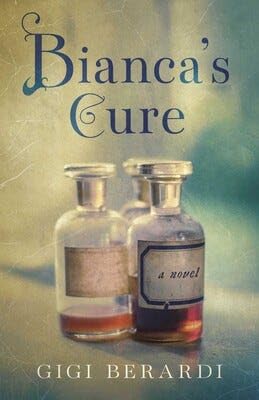
    This week on the podcast, I’m joined by Dr. Gigi Berardi — professor, journalist, and now historical novelist — to talk about her forthcoming book Bianca’s Cure, a Renaissance-set novel about women’s knowledge, early science, and what happens when a woman refuses to stay in the role history assigns her.

    The conversation fits perfectly with the arc we recently wrapped up on the podcast, which has focused on how women across history are punished for stepping out of line.

    Why Bianca Capello?

    Berardi’s entry point into the story begins not in an archive, but in Florence itself — with a local legend about an open window that must never be closed, or else a woman’s scream will echo through the piazza. That woman is often said to be Bianca Capello, a 16th-century Venetian noblewoman turned Medici consort.

    Historically, Bianca is remembered as a scandal. The record of her inner life, her work, and her intellect is thin. Her death is suspicious. Her remains were never conclusively identified.

    Bianca’s Cure asks the obvious question history never bothered to: what if she was more than the story told about her?

    Science, Alchemy, and Who Gets Taken Seriously

    One of the most interesting parts of the interview is Berardi’s discussion of Renaissance science. Alchemy, chemistry, medicine, and the occult weren’t separate worlds — they overlapped constantly. The difference wasn’t what knowledge was being produced, but who was producing it.

    In the novel, Bianca is deeply engaged with experimentation, herbal medicine, and systematic observation. Her work is serious. Her methods are deliberate. And that, more than anything, makes her dangerous.

    As Berardi notes, the road women in science travel today isn’t fundamentally different from the one Bianca navigates five centuries earlier.

    “She’s Not Nice” — and That’s the Point

    One thing that’s already coming up in reader reactions is discomfort with Bianca herself. She’s ambitious. She’s focused. She doesn’t soften herself for the people around her.

    Some readers don’t like that.

    Berardi is clear about why she leaned into this: “nice” has long been a way to discipline women’s ambition. Bianca’s Cure pushes back on the idea that female characters need to be likable in order to be worthy of attention.

    About the Book

    Bianca’s Cure

    Out February 10

    Published by She Writes Press, distributed by Simon & Schuster

    The book is available through major retailers and many independent bookstores. If your local shop doesn’t have it in stock, they can usually order it.

    Here at Bitchy History we love a good independent bookstore, but we recognize book deserts exist, so the big retailers are fine too if it’s all you’ve got.

    Where to Find Gigi Berardi

    Gigi Berardi can be found through her professional website, where she’s launching a blog focused on science, history, and storytelling. You can also download the first two chapters of Bianca’s Cure by subscribing there. Links are in the show notes.

    Listen to the Episode

    In the full episode, we talk about:

    * Writing historical fiction with thin archives

    * Women’s erased contributions to science

    * Alchemy, malaria, and Renaissance medicine

    * Why being “nice” is not the same as being good


    Get full access to Bitchy History at www.bitchyhistory.com/subscribe
    Más Menos
    53 m