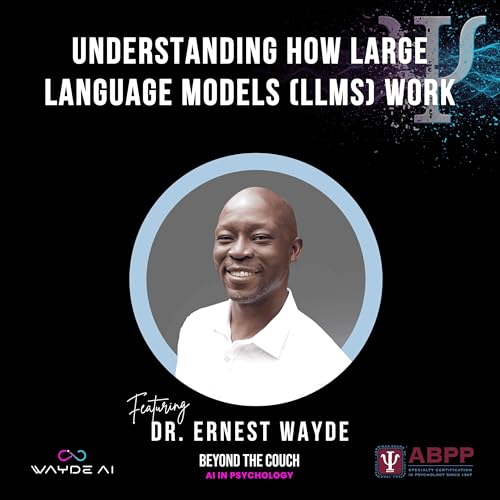
Beyond the Couch: AI in Psychology Podcast Por Ernest Wayde arte de portada

Beyond the Couch: AI in Psychology

Beyond the Couch: AI in Psychology

De: Ernest Wayde
Escúchala gratis

Beyond the Couch: AI in Psychology bridges the gap between psychology and artificial intelligence, offering psychologists across all specialties clear, actionable insights into how AI is transforming the field. Whether you're a clinician, researcher, educator, organizational psychologist, or working in any psychological specialty, this podcast delivers expert perspectives on ethical integration, practical applications, and future developments to help you confidently navigate the digital transformation of our profession. Presented by ABPP and Wayde AI, with sponsorship from the National Register of Health Service Psychologist, this collaboration brings together psychological expertise and technological innovation to explore how AI can enhance psychological work while maintaining professional standards and human connection. Subscribe now to join a growing community of forward-thinking psychologists who are shaping the future of our profession.Copyright 2025 Ernest Wayde Ciencia Ciencias Sociales Higiene y Vida Saludable Psicología Psicología y Salud Mental
Episodios
  • Dirty, Dull, and Dangerous: AI, Exposure Therapy, and the Future of Clinical Practice with Dr. Andrew Sherrill
    Oct 14 2025

    In this episode, Dr. Ernest Wayde speaks with Dr. Andrew Sherrill, an Emory psychologist specializing in anxiety, PTSD, and OCD, to explore how AI can support—not replace—clinicians. Dr. Sherrill explains how automation can take on the dirty, dull, and dangerous tasks that bog down therapists, freeing them to focus on empathy and evidence-based care.

    Drawing from exposure therapy, he offers a powerful parallel for psychologists learning to face their own “AI anxiety.” By approaching new technology the same way we help clients face fears—gradually, with curiosity and compassion—clinicians can engage with AI ethically, creatively, and confidently.

    Takeaways:

    • AI should replace tasks, not therapists.
    • Exposure therapy principles can reduce technophobia and build comfort with AI.
    • Stay in the loop: always validate and supervise AI outputs.
    • Use AI creatively for safe exposure stimuli (VR, AR, LLMs), but maintain clinical oversight.
    • Avoidance fuels anxiety—curiosity builds competence.

    Guest Links:

    Dr. Andrew M. Sherrill | evidencefirstsolutions.com

    AI studies with clinicians registry: http://bit.ly/TEAMMAIT_Study

    Más Menos
    40 m
  • Psychological Report Writing in the Age of AI: Human Judgment vs. Machine Speed with Dr. Adam Lockwood
    Sep 30 2025

    What happens when AI can write a psychological report in under two minutes — and licensed psychologists take hours? In this episode of Beyond the Couch: AI in Psychology, Dr. Ernest Wayde talks with Dr. Adam Lockwood about the disruptive role of AI in psychological report writing.

    They explore how AI compares to human-written reports, where clinicians see value and risks, and what this means for the future of psychology.

    Key Takeaways:

    • AI-generated reports can match human quality in many areas — and sometimes surpass them in recommendations.
    • Clinicians still prefer human summaries, but effect size differences were often small.
    • Automation bias and loss of clinical skills remain real risks if AI is used uncritically.
    • Bias in AI output reflects societal inequities, making vigilance essential.
    • Responsible adoption requires safeguards like HIPAA-compliant agreements and human oversight.

    For more of Dr. Lockwood’s insights and commentary on emerging AI research in psychology, visit his blog at LockwoodConsulting.net

    Más Menos
    34 m
  • Navigating AI Ethics in Psychology with Dr. Lindsay Childress-Beatty
    Sep 16 2025

    In this conversation, Dr. Ernest Wayde and Dr. Lindsay Childress Beatty explore the intersection of artificial intelligence (AI) and psychology, focusing on the ethical implications, the importance of competence, and the evolving role of psychologists in the development and application of AI technologies.

    They discuss the need for ethical guidelines, the challenges posed by rapid advancements in AI, and the necessity of integrating cultural competency into AI design. The conversation emphasizes the importance of critical thinking and ethical frameworks in preparing future psychologists for a landscape increasingly influenced by AI.

    Takeaways include:

    • AI is a growing field in psychology that requires ethical considerations.

    • The integration of AI in psychology must prioritize human involvement.

    • Competence in understanding AI tools is essential for psychologists.

    • Psychologists should be involved in AI design to address ethical issues.

    • Education must adapt to teach future psychologists about AI.

    Más Menos
    31 m
Todavía no hay opiniones