

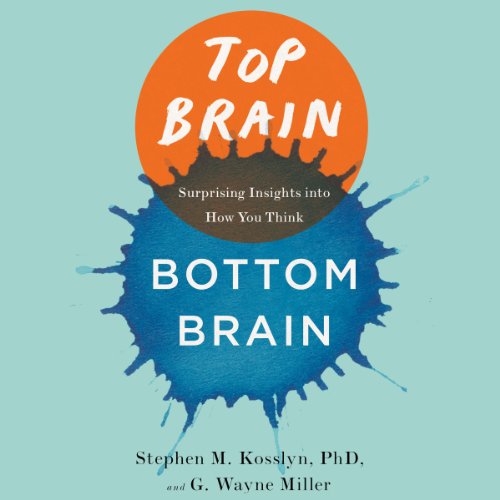
Top Brain, Bottom Brain
Surprising Insights Into How You Think
No se pudo agregar al carrito
Add to Cart failed.
Error al Agregar a Lista de Deseos.
Error al eliminar de la lista de deseos.
Error al añadir a tu biblioteca
Error al seguir el podcast
Error al dejar de seguir el podcast
Obtén 30 días de Standard gratis
Compra ahora por $15.90
-
Narrado por:
-
Christopher Hurt
In this groundbreaking contribution to the literature on human personality, a celebrated psychologist and an award-winning author offer a novel way to learn about how each of us thinks.
For the past 50 years, popular culture has led us to believe in the left brain vs. right brain theory of personality types. It would be an illuminating theory if it did not have one major drawback: It is simply not supported by science. In contrast, the Top Brain, Bottom Brain theory is based on solid research that has stayed within the confines of labs all over the world—until now.
With cowriter G. Wayne Miller, Stephen M. Kosslyn, PhD, a leader in the field of cognitive neuroscience, explains this exciting new theory for the first time. Kosslyn and Miller describe how the top and bottom parts of the brain work together, summarizing extensive research with ease and accessibility. In doing so, they introduce us to four modes of thought: Mover, Perceiver, Stimulator, and Adaptor. These ways of thinking and behaving shape your personality, and with the scientifically developed test provided in the book, you’ll quickly be able to determine which mode best defines your dominant way of thinking. Once you’ve identified your dominant cognitive mode, you can reflect on the many possible practical applications from the way you conduct business to your relationships to your voyage of personal discovery.
Download the accompanying reference guide.©2013 Stephen M. Kosslyn (P)2013 Audible, Inc.Los oyentes también disfrutaron:


Reseñas de la Crítica
Would you listen to Top Brain, Bottom Brain again? Why?
I am planning to listen again because it offers excellent perspective in hiring employees. Everyone knows about the theory of right brain versus left brain - this book adds a new dimension that will improve teamwork and hiring success.What was one of the most memorable moments of Top Brain, Bottom Brain?
The four examples of their theory in action was great. It showed the ways each type react when put in the same situations.Have you listened to any of Christopher Hurt’s other performances before? How does this one compare?
Nope - great voice and tone.If you were to make a film of this book, what would the tag line be?
Top & Bottom - the other halves of the brain.Any additional comments?
Great read! Also, I had a question about the PDF so I emailed their website. One of the authors was back in touch with me within 6 hours. Thank you for their customer service!Great Read - Will be required reading for my team
Se ha producido un error. Vuelve a intentarlo dentro de unos minutos.
If you could sum up Top Brain, Bottom Brain in three words, what would they be?
the pdf file is underneath the publisher's summary - Download the accompanying reference guide.What other book might you compare Top Brain, Bottom Brain to and why?
The tony buzan 's list of brain books as they preach on right brain, left brain theoryDid Christopher Hurt do a good job differentiating all the characters? How?
I am still in the midst of listening.Was this a book you wanted to listen to all in one sitting?
I do not have the time to listen in one sittingAny additional comments?
he pdf file is underneath the publisher's summary - Download the accompanying reference guide.pdf file
Se ha producido un error. Vuelve a intentarlo dentro de unos minutos.
Finally!!, a practical tool for behaviour analisis
Se ha producido un error. Vuelve a intentarlo dentro de unos minutos.
What disappointed you about Top Brain, Bottom Brain?
I was very interested in the topic and their hypothesis is interesting, but the prose is dreadful and dry. It lacked style, was not engaging, and was a chore from start to finish.What didn’t you like about Christopher Hurt’s performance?
He did the best he could with the material.Well intentioned, terribly written
Se ha producido un error. Vuelve a intentarlo dentro de unos minutos.
Bet you didn't know that your cerebral cortex has two parts. Well sort of. A kind of upper, frontish part and lower rearward part. Well, not exactly. I mean, some parts that you'd think were part of the upper part are really in the lower part, and like it's not always clear what's part of what, but the point is, they're different. They do different things, or differentish anyway; it's all a bit hazy- you know how the brain is. Now your upper brain part does space, like 'where' and shape and things of that sort, so it handles planning- I mean because really maybe it's better to say it does 'how' more than just 'where', according to the author. But the mostly lower brain part does something different- it does 'what'. Like such as, identifying and perhaps classifying and other related things, so it brings in a lot of emotion too. The book's not super clear on that.
Now I can already hear you thinking, how could the lower part identify what something is without analyzing it's spatial structure and relations, which is what the upper part does? And that would be an interesting and possibly profound question. So this book doesn't address that.
But guess what? It turns out that the the two parts of the brain interact. They're connected! It's true. It's all scientifically summarized by a line drawing of the brain lobes. See those swooping arrows? Dynamic, real time connectivity! (And you just know that's got to include some feedback.) I've rarely seen so much neurobiology packed so economically into to such a compact, childlike illustration. Take that, people who say the brain is constituted from functionally homogeneous disconnected domains!
So now you're thinking: distinct yet connected functional regions, upper and lower brain parts, I get that. But that has me thinking about the inevitability of cognitive modes. Well this book has got your cognitive modes right here. And not your grandpa's right and left hemisphere cognitive modes, either. No, this is much subtler and more vertical than that. Because it turns out that- and mind you this is not one thing more than pure rote speculation by the authors- some people emphasize the use of their upper brain part, and others rely more on their lower(ish) brain part, while still others- oh when will it stop?- emphasize both parts equally, and finally some people don't emphasize either part, which seems sad. If the force of the pristine combinatorial logic of this scheme doesn't convince you then... well I guess you won't be convinced, because the book provides exactly no other evidence for the existence of these cognitive modes.
Now, these cognitive modes break down into a quadripartite psychological typology consisting of Mover mode, Perceiver mode, Stimulator mode and zzzzzzzzz...
Really, it is all just so trite and totally made up. By the time I reached the last third of the book- the cognitive modes part- I felt as though I was being repeatedly hit with a new model of Taser, powered by banality rather than electricity. Remember when you and your friends would watch lousy movies just to crack up at how unbelievably bad they were? Well it got to that point for me.
In fact, I actually returned this audiobook for a refund of my credit (you knew Audible has a return policy, didn't you?) But then I un-returned it so I could write a review. So you see it is something of a sacred mission with me to prevent you from wasting your credit and your time on this book. Because I love brains, and can't bear to see this book happen to them.
Trite Brain, Banal Brain
Se ha producido un error. Vuelve a intentarlo dentro de unos minutos.