


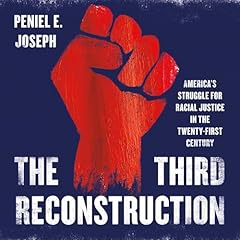
The Third Reconstruction
How a Moral Movement Is Overcoming the Politics of Division and Fear
No se pudo agregar al carrito
Solo puedes tener X títulos en el carrito para realizar el pago.
Add to Cart failed.
Por favor prueba de nuevo más tarde
Error al Agregar a Lista de Deseos.
Por favor prueba de nuevo más tarde
Error al eliminar de la lista de deseos.
Por favor prueba de nuevo más tarde
Error al añadir a tu biblioteca
Por favor intenta de nuevo
Error al seguir el podcast
Intenta nuevamente
Error al dejar de seguir el podcast
Intenta nuevamente
Prueba gratis de 30 días de Audible Standard
Selecciona 1 audiolibro al mes de nuestra colección completa de más de 1 millón de títulos.
Es tuyo mientras seas miembro.
Obtén acceso ilimitado a los podcasts con mayor demanda.
Plan Standard se renueva automáticamente por $8.99 al mes después de 30 días. Cancela en cualquier momento.

The Third Reconstruction
Narrado por:
Chase Bradley
Compra ahora por $13.50
-
Narrado por:
-
Chase Bradley
Over the summer of 2013, the Reverend Dr. William J. Barber II led more than a hundred thousand people at rallies across North Carolina to protest restrictions to voting access and an extreme makeover of state government. These protests—the largest state government–focused civil disobedience campaign in American history—came to be known as Moral Mondays and have since blossomed in states as diverse as Florida, Tennessee, Wisconsin, Ohio, and New York.
At a time when divide-and-conquer politics are exacerbating racial strife and economic inequality, Rev. Barber offers an impassioned, historically grounded argument that Moral Mondays are hard evidence of an embryonic Third Reconstruction in America.
The first Reconstruction briefly flourished after Emancipation, and the second Reconstruction ushered in meaningful progress in the civil rights era. But both were met by ferocious reactionary measures that severely curtailed, and in many cases rolled back, racial and economic progress. This Third Reconstruction is a profoundly moral awakening of justice-loving people united in a fusion coalition powerful enough to reclaim the possibility of democracy—even in the face of corporate-financed extremism.
In this memoir of how Rev. Barber and allies as diverse as progressive Christians, union members, and immigration-rights activists came together to build a coalition, he offers a trenchant analysis of race-based inequality and a hopeful message for a nation grappling with persistent racial and economic injustice. Rev. Barber writes movingly—and pragmatically—about how he laid the groundwork for a state-by-state movement that unites black, white, and brown, rich and poor, employed and unemployed, gay and straight, documented and undocumented, religious and secular. Only such a diverse fusion movement, Rev. Barber argues, can heal our nation’s wounds and produce public policy that is morally defensible, constitutionally consistent, and economically sane. The Third Reconstruction is both a blueprint for movement building and an inspiring call to action from the twenty-first century’s most effective grassroots organizer.
Los oyentes también disfrutaron:




Las personas que vieron esto también vieron:


A technical issue is preventing me from giving it a 5 star rating overall-- the text of the afterword is also randomly dropped into the middle of the last chapter, and I can't tell whether it is simply annoyingly inserted or whether it overwrites part of that chapter.
Great book, technical problem
Se ha producido un error. Vuelve a intentarlo dentro de unos minutos.
Inspiring, Awakening, Relevant!
Se ha producido un error. Vuelve a intentarlo dentro de unos minutos.
North Carolinians (the author is a well-known local so this was particularly awful)
Legislature
Septuagenarian
Immorality (come on, obviously “immortality” was wrong in context!)
Mettle
Koch
Evangelism (the author is a pastor!!)
I know mistakes happen, but this is just sloppy. What a shame. This book is important and deserved better.
Deserved better narration
Se ha producido un error. Vuelve a intentarlo dentro de unos minutos.
Great book. Indefensibly bad audio version.
Se ha producido un error. Vuelve a intentarlo dentro de unos minutos.
Must Read
Se ha producido un error. Vuelve a intentarlo dentro de unos minutos.