


The Hundred Years War, Volume 1
No se pudo agregar al carrito
Add to Cart failed.
Error al Agregar a Lista de Deseos.
Error al eliminar de la lista de deseos.
Error al añadir a tu biblioteca
Error al seguir el podcast
Error al dejar de seguir el podcast
Prueba gratis de 30 días de Audible Standard

The Hundred Years War, Volume 1
Compra ahora por $20.78
-
Narrado por:
-
Charlton Griffin
-
De:
-
Alfred H. Burne
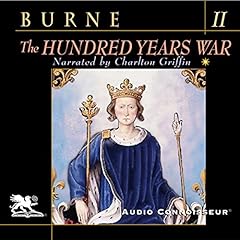
Volume One briefly traces the causes of the conflict and then plunges straight ahead into the military preparations and initial clashes, mainly naval. Under what many consider the leadership of England's greatest sovereign, Edward III, Calais is seized as a port-of-entry for English arms and supplies. With Calais secure in his rear, Edward marches into the interior of France and comes to grips with Philip's army at Crécy in 1346, an epoch changing calamity for France. After numerous sieges, marches and smaller battles, the next French King, John II, is captured by Edward's son, the Black Prince, at the battle of Poitiers in 1356. By the time of Edward III's death in 1377, England controls a good third of French territory. But the French doggedly resist, and the war drags on into a desultory second phase lasting well into the early 1400s.
The Hundred Years War is a military history, and probably the finest English chronicle of these confusing events. Drawing upon all known English and French sources, A. H. Burne has assembled a stunning narrative that sweeps you into the military camps of the English and French kings. Volume 2 carries the story to its climactic ending in 1453.
(P)2007 Audio ConnoisseurLos oyentes también disfrutaron:


Continuar la serie
Las personas que vieron esto también vieron:


Totally Anglo-centric
Se ha producido un error. Vuelve a intentarlo dentro de unos minutos.
History written fairly well.
Se ha producido un error. Vuelve a intentarlo dentro de unos minutos.
"The Hundred Year War, Volume 1" is no fantansy, but it's still a good story. It introduced me to two fascinating historical figures I was not familiar with -- King Edward III, and his son, "The Black Prince", Edward the IV.
"The Song of Ice and Fire" gives a fictional account of the horrors of medieval warfare. After reading this history, I'd say Martin got it right. It was brutal warfare, especially if you were a peasant.
For fantasy fans this is a good read. It is certainly not fantasy and reads as a history, but it provides so much back-ground material that is present in modern fantasy. Much of the warfare depicted in Robert Jordan's "Wheel of Time" series comes right out of the 100 year war. (The "Two Rivers" bow, is of course, the English longbow.)
As to the English longbow, it utterly dominated the battlefield. It was a simple, but brutally effective weapon and was the main reason why the English army was so effective in this war.
I am no fan of feudalism or Kingdoms, and would not like to live under such systems, but when the ruling classes of the medieval era decided to go to war, they were right in the thick of the battle. King Edwards or his son was present in every major battle depicted in this book. Compare that to our own effete ruling classes. Except in very rare circumstances, they and their children will be many thousands of miles from the battles of the wars they start.
100 Year War
Se ha producido un error. Vuelve a intentarlo dentro de unos minutos.
It is foolish to think that there should be one definitive book to describe historical events from all angles. Instead, if we want to really understand a period from every perspective we should try reading more than one book on the subject.
Unfortunately I am unable to rate the reading as highly as the actual text of the book being read. The best I can say about the reader is that he has a nice deep voice and he reads fairly fluently. He might be OK at reading a contemporary genre novel, a crime thriller etc., but he should stay away from reading history, or non-fiction of any kind.
His major failing is that he gives stress and emphasis to words and phrases in inappropriate places, and this gets annoying fairly quickly.
Also, his pronunciation of the French quotes is quite off.
Finally, he is obviously unfamiliar with the correct pronunciation of English names. You would think that a professional reader would take the trouble to learn the correct pronunciations for a book he was reading, wouldn't you? Salisbury is pronounced SAULS-bury, and NOT SALLIS-bury, I don't know how many times I had to endure him reading it the wrong way over and over.
Well written, poorly read
Se ha producido un error. Vuelve a intentarlo dentro de unos minutos.
Ignore the introduction, ignore everything political or social justice-related or Euro-centric that (however rightly) bothers you. TRY to ignore the eye roll inducing "well we won't be discussing how the army was mustered/fed/ etc."
There are reasons we read FOUNDATION works in our field. We read them to understand the shaping of the historiography, the shaping of HOW a story is told--and if you think that's not important in 2018, you live under a rock, congratulations.
We also read them because when a less current author retains enough common sense and enough rich detail in their exploration of the primary sources and details which are, let's face it, not going anywhere, we can still get an over-arching view of the events dealt with in a way that is useful.
I believe this may be such a foundation work in Medieval Military history, albeit not in the "top 10".
Full disclosure: I am an insomniac and I needed something I would be interested in listening to, and engaged with but would be able to fall asleep--the equivalent of a good but not dramatically heart-racing story.
For that, while I do listen longer, due to the interest factor, it works admirably and the narrator is very good for pace.
Solid, Old School Military History
Se ha producido un error. Vuelve a intentarlo dentro de unos minutos.