

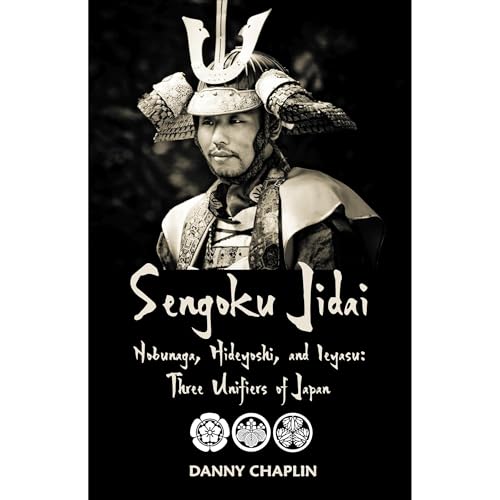
Sengoku Jidai. Nobunaga, Hideyoshi, and Ieyasu
Three Unifiers of Japan
No se pudo agregar al carrito
Add to Cart failed.
Error al Agregar a Lista de Deseos.
Error al eliminar de la lista de deseos.
Error al añadir a tu biblioteca
Error al seguir el podcast
Error al dejar de seguir el podcast
 Exclusivo para miembros Prime: ¿Nuevo en Audible? Obtén 2 audiolibros gratis con tu prueba.
Sengoku Jidai. Nobunaga, Hideyoshi, and Ieyasu
Compra ahora por $14.99
-
Narrado por:
-
Virtual Voice
-
De:
-
Danny Chaplin

Este título utiliza narración de voz virtual
Japan's Sengoku jidai, known as the 'Warring States Period,' was a time of profound crisis and upheaval, characterized by constant warfare and social unrest. During this turbulent era, the traditionally low-born rural military class of 'bushi' (samurai warriors) rose to power, overthrowing their social superiors in the court and reshaping the landscape of Japan. At the center of this tumultuous age stood three remarkable individuals: Oda Nobunaga (1534-1582), Toyotomi Hideyoshi (1537-1598), and Tokugawa Ieyasu (1543-1616). Each of these figures played a unique and pivotal role in the re-unification of Japan during the sixteenth and early seventeenth centuries.
This groundbreaking narrative history of the Sengoku era weaves together the epic tales of these three figures for the first time. It provides a comprehensive survey of the Azuchi-Momoyama Period (1568-1600), covering the reigns of both Nobunaga and Hideyoshi, as well as the foundational years of the Tokugawa shogunate (1600-1616). The book delves deep into the pivotal battles fought by each of these three hegemons, from the decisive clash at Okehazama in 1560 to the legendary Battle of Sekigahara in 1600, and the Two Sieges of Osaka Castle in 1614-15.
Moreover, the book examines the political and administrative structures of their rule, shedding light on the role played by western foreigners ('nanban') and the Christian religion in early modern Japanese society. With its broad scope, the story of Japan's three unifiers – dubbed 'the Fool,' 'the Monkey,' and 'the Old Badger' – unfolds as a sweeping saga, encompassing acts of unimaginable cruelty alongside tales of great samurai heroism that continue to resonate through the peaceful Edo/Tokugawa period and beyond.
Los oyentes también disfrutaron:



Las personas que vieron esto también vieron:




Unfortunately, the virtual voice narration is god-awful. It butchers "virtually" all Japanese proper names and places. Better yet it butchers them inconsistently. Most people/place names that appear in this book are pronounced at least two or three different ways throughout. I came across a couple names that had 4 or 5 different pronunciations within the span of a couple minutes. It gets to the point that it is hard to tell if we're talking about the same person we were earlier in the book (or even thirty seconds ago) because the names sound nothing alike.
One other grating thing that happens throughout. When any range of years is given; say 1569 to 1573. It is invariably read out loud as "Fifteen Sixty Nine to One Thousand Five Hundred Seventy Three." You end up missing the next few sentences trying to figure the span of years from the non sequitur you were just presented.
It is a shame this wasn't narrated by someone with even a passing knowledge of how Japanese syllables are pronounced. I don't want to say it ruined the experience for me. But the virtual voice narration did no favors to the material it was presenting.
Really well written. Really poorly narrated.
Se ha producido un error. Vuelve a intentarlo dentro de unos minutos.