

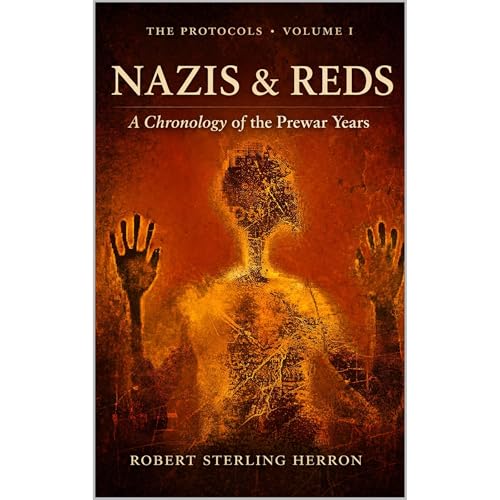
Nazis & Reds
A Chronology of the Prewar Years
No se pudo agregar al carrito
Add to Cart failed.
Error al Agregar a Lista de Deseos.
Error al eliminar de la lista de deseos.
Error al añadir a tu biblioteca
Error al seguir el podcast
Error al dejar de seguir el podcast
Prueba gratis de 30 días de Audible Standard

Nazis & Reds
Compra ahora por $3.99
-
Narrado por:
-
Virtual Voice

Este título utiliza narración de voz virtual
The Protocols series examines how the modern world was made — not in a single moment, but through a long chain of changes that began with industrialization and ended, for many, in the catastrophe of global war. Rather than offering a unifying theory, the series brings together the record left by those who experienced these transformations directly: workers and scientists, statesmen and agitators, diarists, journalists, and ordinary citizens caught between the promises of progress and the pressures it created. Their words show how new technologies, new forms of labor, new ideologies, and new modes of state power reshaped daily life. They also show how fragile societies can become when confronted with rapid change and competing visions of order.
The opening volume, Nazis & Reds: A Chronology of the Prewar Years, begins not in the 1930s but in the nineteenth century, when industrial capitalism and modern science challenged inherited beliefs. It focuses on pivotal moments, like the publication of Darwin’s theory of natural selection which offered a biological explanation for change, but which was soon simplified — and distorted — into Herbert Spencer’s phrase “the survival of the fittest,” a formula widely used to rationalize hierarchy, competition, and exploitation. This misinterpretation travelled quickly: from economic theory to imperial policy, from academic debate to political dogma. It became one of the currents that shaped the modern world, licensing both complacency and coercion under the banner of inevitability.
Against this backdrop, Nazis & Reds traces how political movements arose to harness or resist these pressures. It follows the emergence of mass parties, the spread of revolutionary ideologies, the collapse of empires, and the attempts of governments to manage social and economic instability. Through documents and eyewitness accounts, the volume shows how fear of decline, promises of renewal, and the search for simple explanations created openings for authoritarian movements on the right and left alike.
By the time the narrative reaches the familiar episodes of the 1930s — Hitler’s consolidation of power, Stalin’s purges, the Spanish Civil War, the Munich crisis — the roots of these events are already visible in the earlier record. What unfolded in those years was not sudden. It was the cumulative result of decades in which societies struggled to adapt to industrial, scientific, and political change, and too often mistook force for stability.
More than a prelude to war, Nazis & Reds is a study in how modern societies respond to disruption. It suggests that the dilemmas of that earlier era — the misuse of scientific ideas, the attraction of rigid ideologies, the erosion of civic trust — remain relevant. The forces that shaped the twentieth century did not disappear with it; they continue to test democratic life today, often in quieter but no less consequential ways.
Las personas que vieron esto también vieron:

What even is this?
Se ha producido un error. Vuelve a intentarlo dentro de unos minutos.