

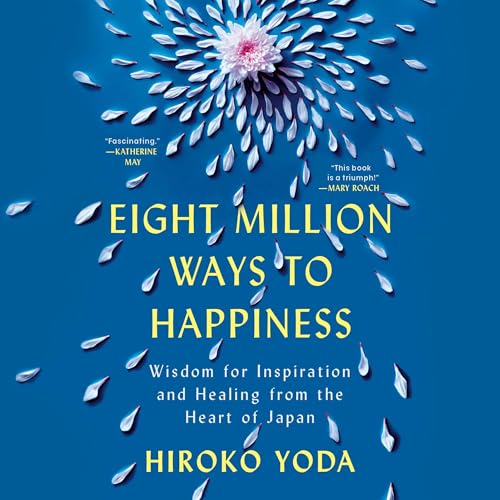
Eight Million Ways to Happiness
Wisdom for Inspiration and Healing from the Heart of Japan
No se pudo agregar al carrito
Solo puedes tener X títulos en el carrito para realizar el pago.
Add to Cart failed.
Por favor prueba de nuevo más tarde
Error al Agregar a Lista de Deseos.
Por favor prueba de nuevo más tarde
Error al eliminar de la lista de deseos.
Por favor prueba de nuevo más tarde
Error al añadir a tu biblioteca
Por favor intenta de nuevo
Error al seguir el podcast
Intenta nuevamente
Error al dejar de seguir el podcast
Intenta nuevamente
Prueba gratis de 30 días de Audible Standard
Selecciona 1 audiolibro al mes de nuestra colección completa de más de 1 millón de títulos.
Es tuyo mientras seas miembro.
Obtén acceso ilimitado a los podcasts con mayor demanda.
Plan Standard se renueva automáticamente por $8.99 al mes después de 30 días. Cancela en cualquier momento.

Eight Million Ways to Happiness
Narrado por:
Hiroko Yoda
Compra ahora por $21.60
-
Narrado por:
-
Hiroko Yoda
-
De:
-
Hiroko Yoda
Everyone’s in the pursuit of happiness, but few know how to attain it. Millions around the world have turned to Japan for advice on finding their Ikigai, or summoning The Courage to Be Disliked. Japan’s spiritual traditions hide in plain sight, forming the basis of so much of what we love about the country’s culture. Without Japan’s spiritual sustenance, Jiro wouldn’t dream of sushi; Hayao Miyazaki’s films wouldn’t spirit us away; and Marie Kondo wouldn’t spark joy.
In her book Eight Million Ways to Happiness, Hiroko Yoda offers the culmination of her decade-long odyssey into the spiritual heart of her homeland. Readers follow Hiroko as she trains as a Shinto shrine-dancer, partakes in Buddhist funeral rituals, ascends holy mountains with Shugendo ascetics, and meets one of Japan’s last living itako, a traditional mystic. Her stories—personal, cultural, and historical—offer life lessons for readers of any background.
Hiroko awakens readers to the idea of a traditional spiritual flexibility that seamlessly coexists with the modern secular world, fortifying us through life’s inevitable ups and downs. We are all subject to forces beyond our control, but we are also part of a bigger natural system that can strengthen us—if we learn how to reconnect with it.
Los oyentes también disfrutaron:

Las personas que vieron esto también vieron:








On the latter (cultural insights), I most enjoyed the material on Asobi, or spiritual play. If this piques your interest as well, I recommend “Occult Hunting and Supernatural Play” by Laura Miller as further reading. But perhaps the greatest cultural element emphasized in the book is Hanshinhangi. The following will illustrate how this sets the book apart from others in the Japanese spiritual genre.
There’s a famous story about 17th century swordsman Miyamoto Musashi visiting Hachidai Shrine before his worrisome fight with a gang of Yoshioka swordsmen. Musashi’s western translators tell the story like this: thinking he would die during the battle, he visited the shrine to ask the kami (spirits) for guidance. Suddenly he realized - what the hell am I doing, praying for help when I am the skilled Musashi! Rejecting the kami, he walked toward the battlegrounds, confident in his own abilities.
The author of Eight Million Ways to Happiness tells the same story, but with a telling gloss: Approaching the shrine, Musashi received a message from the kami - reject the kami, believe in yourself! Thus Musashi left for battle, confident in his own abilities.
The nuance is this: when westerners reject spirituality, they do so outright (like an on/off switch, according to the author); when Japanese reject spirituality, they do so temporarily and by degrees (like turning down a dial) - Hanshinhangi.
This book holds many such edifying nuances, all read by the author herself, in a charming cadence.
History and Culture from an Insightful Insider
Se ha producido un error. Vuelve a intentarlo dentro de unos minutos.