

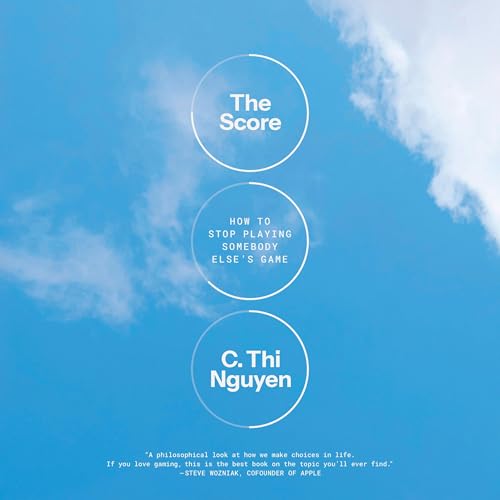
The Score
How to Stop Playing Somebody Else's Game
No se pudo agregar al carrito
Solo puedes tener X títulos en el carrito para realizar el pago.
Add to Cart failed.
Por favor prueba de nuevo más tarde
Error al Agregar a Lista de Deseos.
Por favor prueba de nuevo más tarde
Error al eliminar de la lista de deseos.
Por favor prueba de nuevo más tarde
Error al añadir a tu biblioteca
Por favor intenta de nuevo
Error al seguir el podcast
Intenta nuevamente
Error al dejar de seguir el podcast
Intenta nuevamente
Prueba gratis de 30 días de Audible Standard
Selecciona 1 audiolibro al mes de nuestra colección completa de más de 1 millón de títulos.
Es tuyo mientras seas miembro.
Obtén acceso ilimitado a los podcasts con mayor demanda.
Plan Standard se renueva automáticamente por $8.99 al mes después de 30 días. Cancela en cualquier momento.

The Score
Narrado por:
C. Thi Nguyen
Compra ahora por $19.80
-
Narrado por:
-
C. Thi Nguyen
-
De:
-
C. Thi Nguyen
“Brilliant and wildly original . . . The Score is socially attentive, historically literate and imbued with sensual glee.” —Becca Rothfeld, The Washington Post
“I give this excellent book five stars.” —Stuart Jeffries, Financial Times
A philosophy of games to help us win back control over what we value
The philosopher C. Thi Nguyen—one of the leading experts on the philosophy of games and the philosophy of data—takes us deep into the heart of games, and into the depths of bureaucracy, to see how scoring systems shape our desires.
Games are the most important art form of our era. They embody the spirit of free play. They show us the subtle beauty of action everywhere in life in video games, sports, and boardgames—but also cooking, gardening, fly-fishing, and running. They remind us that it isn’t always about outcomes, but about how glorious it feels to be doing the thing. And the scoring systems help get us there, by giving us new goals to try on.
Scoring systems are also at the center of our corporations and bureaucracies—in the form of metrics and rankings. They tell us exactly how to measure our success. They encourage us to outsource our values to an external authority. And they push on us to value simple, countable things. Metrics don’t capture what really matters; they only capture what’s easy to measure. The price of that clarity is our independence.
The Score asks us is this the game you really want to be playing?
Los oyentes también disfrutaron:




Las personas que vieron esto también vieron:







Great questions posed, light on answers
Se ha producido un error. Vuelve a intentarlo dentro de unos minutos.
Amazing
Se ha producido un error. Vuelve a intentarlo dentro de unos minutos.
Metrics vs games
Se ha producido un error. Vuelve a intentarlo dentro de unos minutos.
Also, a much more minor issue, but it did take me out of the flow, the author asserts that the printing press was a centralized technology, but neglected to mention that prior to the printing press, books were hand drawn mostly by monks. The printing press actually democratized books and printed content. In fact there were many crack downs by authorities on underground printers writing political pamphlets. The overly truncated history of centralizing/decentralizing technologies just feels lazy. Like the author was in too much of a hurry to make his point that he was ok with a bit of hand waving.
Interesting premise, but repetitive and boring
Se ha producido un error. Vuelve a intentarlo dentro de unos minutos.
The Score
Se ha producido un error. Vuelve a intentarlo dentro de unos minutos.