Note: Text was lightly edited for clarity and does not match audio exactly.
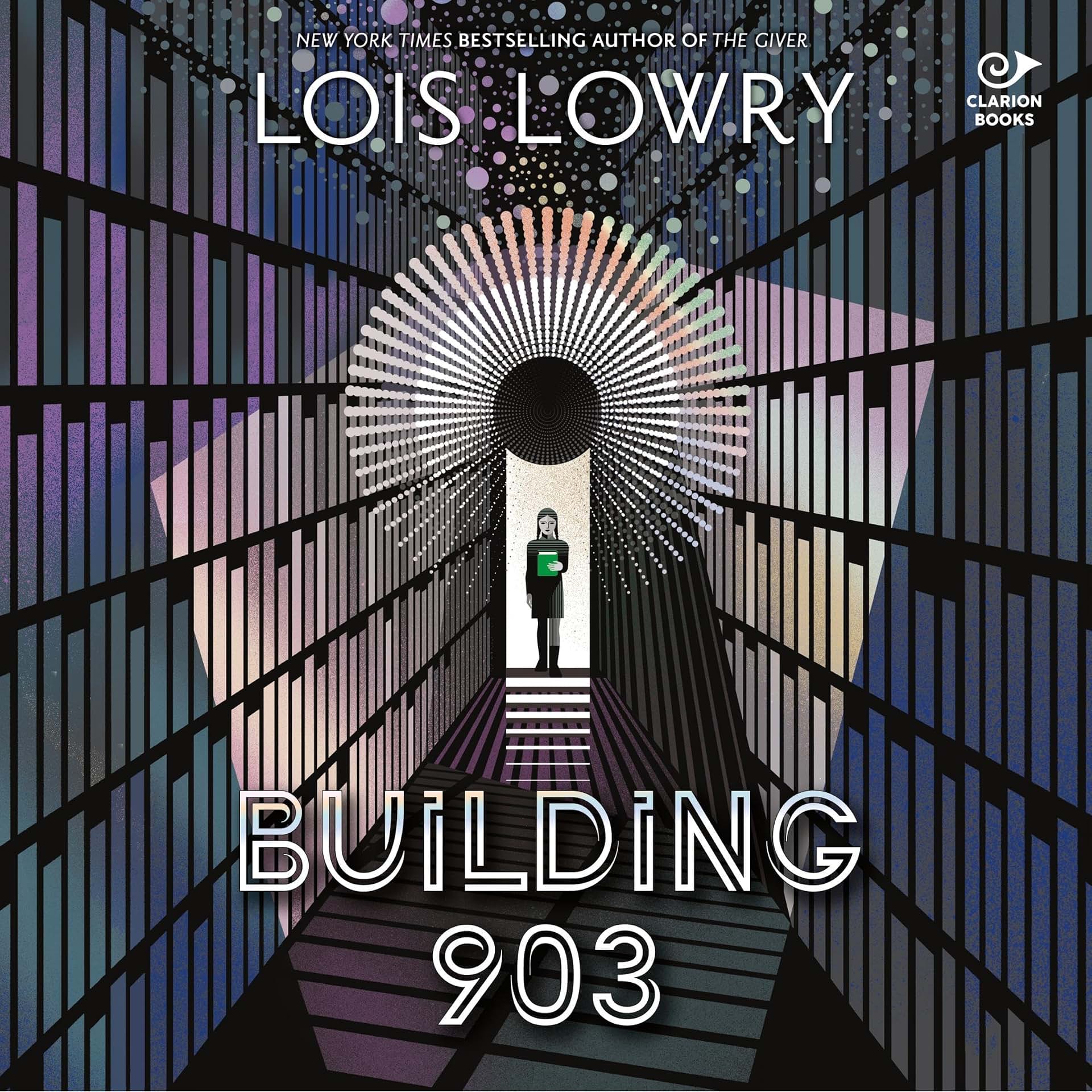
Emily Cox: Hi, listeners. This is Emily Cox. I'm an editor here at Audible. Today, I'm so incredibly thrilled to be speaking with Lois Lowry, my absolute favorite children's author, who I've been fangirling over since I was little. She is a two-time Newbery prize winner and the author of the perennially bestselling series The Giver Quartet. Today, we're going to be talking about her newest dystopian novel, Building 903. Welcome, Lois.
Lois Lowry: Thank you. It's nice to sort of be here with you.
Yeah, Zoom creates a certain sort of intimacy. So, I was thinking about, do we talk about your career first or this new title? And I think I want to jump into Building 903 because that's the exciting new release. I think it's going to be a big deal for fans of The Giver. Even though it's a different world than that dystopian series, there are some similar themes throughout, like the sort of sameness and the lack of ownership. I was just sort of wanting to talk about or get your thoughts on how you develop those strange future visions.
Of course, my answer always is that they come out of my imagination, and we can go there a little later. But in thinking about that question—and you're not the first person to have asked it—I realized that a lot of that comes out of the fact that I grew up in an Army family. My father was a career Army officer. So, I grew up most of the time on Army bases, military bases, with the exception of World War II. I'm very old, so I encompass World War II. My father was overseas in the Pacific during that time, so I was living with my grandparents in a small town in Pennsylvania. But aside from that, I was at Schofield Barracks in Honolulu; and Fort McPherson, Georgia; and Tokyo; and Fort Jay, Governors Island in New York, which is First Army Headquarters.
I don't really need to mention all of those individual places except to say that living on an Army post, as I did, is kind of, I don't want to say dystopian, but it's that kind of world where everything is managed for you. It is as comfortable and as safe as any community can be. I'm just remembering as I sift through the pictures that appear in my mind that on Governors Island, where I lived as a teenager, and that's an island in New York Harbor, out by the Statue of Liberty.
I've done a breast cancer walk out there. They now use it for events. It's not an active base anymore.
Well, actually, I've been there recently, too, and my old house is now an art gallery. Any rate, in those days, it was an Army base. I graduated from high school in 1954, so that's the time period we're talking about. At that time, there was a prison, or a military prison, on the island. The building is still there. I don't know what it's used for now, but in my day, when I was a kid, it didn't strike me as at all unusual that prisoners would tend our yard, trim our bushes, mow our grass, and they were always accompanied by a uniformed guard with a gun. So, I would come and go, casually pass the guy with the gun. Our yard would be meticulously trimmed by guys—I don't think they were in chains, but they might have been—I mean, they were prisoners, incarcerated for whatever they had done.
That was just an example of the kind of world that you become accustomed to, as the people in my books do. It's very safe and very comfortable and very nice in many ways. It's only in recent years, looking back on that, that I realized how uncomfortable it now makes me feel. And perhaps that's why I've drawn on that experience in so many books.
Wow. That's really, really interesting. I can sort of see where the colorlessness that you talk about in The Giver might come from.
Well, and the sameness. I mean, I lived in a world—not among my colleagues, my classmates, and friends—but a world of uniforms. It was so well organized. It's too late now, my parents are both long gone, but now I would like to ask my mother what it was like for her to marry into that kind of world, which is what she did. At any rate, I think that has stayed with me, as childhoods do. And it has reappeared, reimagined, in several of my books, and certainly this new one.
You mentioned The Giver along with Building 903, and the time period is never mentioned in The Giver. We assume sometime in the future, perhaps. Well, of course, it was written 30 years ago (laughs). But not too distant future. But in Building 903, I gave a date to it, and it’s 2099. I didn't want to deal with turn of the century because I remembered what it was like when it became the 2000s and we all worried that our computers would explode with that thing. So, I didn't deal with that. But any rate, we've moved far ahead in time, and that does, in my mind, connect it to The Giver in some way. It's the way things would play out if more time had passed.
I thought it was interesting that some of the characters in Building 903 were born in the 20th century, and, I guess, that health care has moved in a direction where they're still around.
Well, that was one of the things that appeared in my imagination early on. I don't believe this was true in the world of The Giver. And this, I think, really will be true 50 years from now or whatever, is that the life expectancy has extended so that there are characters who are 130 years old and more. In fact, part of the book deals with the fact that in the world where these people live, they are governed by a despot who has found a way to, in the distant past, to corrupt the electoral process that we're familiar with. So, he's been reelected again and again, and he's over 100, but he's been in power for many decades.
And everyone else is forced to retire, but he's not because he—
Because he rules the world as it were, yeah.
Many school libraries have stopped filling those shelves with books because kids have access to the information they need from other sources, and they more and more do not read for pleasure. That is something that really concerns me.
Right. I want to circle back a little bit to how your books play with real-world events. But before that, I read something around Gathering Blue where you wrote that characters arrive to you, and then you develop the story from there. Was that the case for this book as well?
I have talked about that often, and that has continued to be true for me, and I don't know how it happens. But it is true that a character will appear in my imagination, fully formed. All I have to do is give them a name, and sometimes they come with a name. Only once have I changed the name that a character has appeared with in my imagination, and that was the character of Claire in the fourth book in The Giver series. When she appeared, and I could see her and I knew what she was about and what she was going to face, her name was Mary. I realized in writing the book, partway through the book, that people, maybe not kids, but critics, teachers, professors, were all going to find religious significance in that name, and I didn't want that to be the case. So, I changed her name to Claire.
But by and large, they arrive fully formed and, frequently, named, and with some kind of situation that I don't really understand when they appear in my imagination, but they're facing something that needs to be resolved. I try always, maybe I haven't succeeded in every book—I'd have to go through 53 of them and check—but I try always to present to the reader on the first page "This character, this is gonna be who we're focusing on. And this character has something askew that we're gonna try to fix in this book."
The Giver, for example, begins with that sentence, “It was almost December, and Jonas was beginning to be frightened.” So, you know the book is going to be about a boy; that's a boy's name. Very soon, you'll know the setting in which he is living. But there will be that thing: Why is he frightened? What's going on? And so I try to do that in every book.
I went and checked on my computer before our conversation. Back in 2022 I was hired by a children's magazine to produce a short story. They had a short story by a well-known author of children's books in every issue, and I believe there were quarterly issues. I said, "Sure, I'm happy to do that." And after I agreed to do that, but hadn't yet even thought about it, the editor emailed me apologetically and she said, "I'm sorry to tell you, but each of our issues have a theme. And the fall issue is going to have the theme of the future." Well, in 2022, the future was up for grabs. We were in the middle of the pandemic, so it was going to be a challenge. And I said to her by email, "Don't worry. I can do that." And then I sat down to do it.
I wrote a very simple story, which was my assignment. I don't know how many words it was, no more than a thousand. It had a young girl as the protagonist. Her name was Avery. Forget that, because she never reappears in anything I've written since. And it's the future, because that's the theme of the magazine that month. Her next-door neighbor is 130 years old and is going placidly off to elder care, which is what people do in that story in that time. Before she goes, she gives a key to her 10-year-old neighbor.
After her neighbor is gone, the child goes in the house, finds six boxes in this place she opens with a key, and they are filled with, one, a jump rope. Two, a set of jacks. Does anybody remember jacks? And a lot of books. It has a happy ending. The child is, "What are these? Oh, cool, books." And [with] her mother, they start looking at the books, and “We haven't had these around for many years. They're all in that big building.” And so the child says, "Well, I'm gonna suggest to my teacher that we have a field trip to the Biblio Storage Building, and every child will get to pick out a book.” Yay. The end.
So, it's a kind of introduction into what became a much darker and much more complicated book, Building 903—no longer called the Biblio Storage Building. But that is the building in the book that houses the books that have now been illegal for over 50 years. So, the twins—boy and girl twins who are 14—have never in their lives seen, held, touched, smelled, opened, or read a book. Nor, interestingly, have their parents, because that much time has passed. Books have been illegal since 1945. And so not only is this intriguing, but it's also very dangerous for them to have suddenly discovered these very illegal items, and their mother is a member of the police force, so she's terrified as well. It's a very different story with a very different ending, but that was the origin of it. Instead of my simply sitting at my desk and feeling a pair of twins appear.
But, of course, when I had to populate the book, I wasn't going to use 10-year-old Avery from the past. I was going to use teenagers. Interestingly, someone pointed out to me that many, many of my books have pairs of twins—not before as main characters, but in subsidiary roles, they exist. I don't know why that is, except that there are many pairs of twins in my extended family, so perhaps that's why. Any rate, Tessa and Theo—and I purposely made them fraternal boy-girl twins because I wanted both boys and girls to want to read the book. As we know, boys don't love reading a book that's entirely about girls. And I suppose the reverse is true as well. So, there are both of them. Take your choice. And of course, then I have to give them personalities. I loved giving the boy twin many traits of a typical 14-year-old, but he also has an extremely high intelligence, which contributes to the plot of the book.
So, a big theme that I felt in the story, the biggest tragedy is not just the loss of books but this loss of imagination. Because when the characters first read a book or encounter a book, their first thought is, "Well, this is lying. Fiction is lying."
Yeah, “What is this?” Yeah, exactly. They're very suspicious of it. They only gradually begin to experience what books do give us, which is an avenue into our own imaginations. But interestingly, at least to me, is that I never used in the book, I never used this word, but this is the word that I find most important, and that is the fact that imagination is necessary for us to acquire empathy and the ability to put ourselves into the place of another person.
There is a moment in the book when the girl, Tessa, the girl twin, is reading from the forbidden book, a passage from Little Women, and she begins to feel what it might be like to be those girls in the 1800s, worried about their father who's off at the war, et cetera, and to be poor. It's a little glimpse into what imagination gives us.
I did this earlier, incidentally, in the fourth book of The Giver Quartet. In each of the books, the main character has some kind of, maybe not magical, but some kind of superpower, for lack of a better word. In the fourth book, Gabriel realizes that he has this ability, which is difficult and painful, and he doesn't know what to call it at first. He calls it veering, V-E-E-R. And he is able to veer into another person. Even though it's exhausting and painful, he can do it. He can feel what it's like to be that person. Of course, what he's experiencing, again, is empathy. So, I think I was dealing with something I had touched on in an earlier book, something that was important, to me at least. Again, I didn't give it the name, but that's what this book deals with.
So, Gabriel's an empath. Do you consider yourself an empath?
I do. You know, nobody's ever asked me that question. Nor have I asked it of myself, but yes. I do that all the time. I do it with fictional characters, of course, because otherwise how can you create them? But I do it with real people as well. I feel what they're feeling. That's painful often, but it's important, I think.
I never think about the reader when I'm writing. The reader is me. The reader is me when I was a young reader, when I was a kid.
The Giver was written in '93, a very different sort of political and cultural moment than we're in now, and yet there are similar concerns in both of these books. How are you inspired by what's going on in the so-called real world?
I can tell you one thing, specifically, that I was aware of being an inspiration for Building 903. Something that we've all read about within the past couple years, and that concerns me and should concern everybody, and that's the gradual ebbing away of the humanities in our educational system. There are no more English majors, which I was back in Brown University.
Me too.
I don't know why that's happened, but I think that's a frightening loss. I can remember going to a grandson's high school to pick him up one afternoon when he had stayed late to do something. I was to meet him in the school library, and I did. But there were the shelves and they had no books on them. Many school libraries have stopped filling those shelves with books because kids have access to the information they need from other sources, and they more and more do not read for pleasure. That is something that really concerns me.
Many things have been lost in the society that exists in Building 903. They no longer have religion. They no longer have music. They no longer have pets. Many things have been taken away by governmental edict. But the one I focused on and the one that I think was most important is the loss of literature.
So, there's a moment in the story where the books are set to be destroyed. I know it's been going on for a few weeks, months now, but there's news headlines about books being scanned and ingested and then shredded to train AI models. Was that something you were aware was happening when this was—
That was not something I was aware of when I was writing the book, but isn't it interesting that things begin to fall into place in ominous ways?
It is. Yeah. Very interesting. That struck me very much. So, I want to pivot to Number the Stars for a second, just because that was my favorite book as a child. It's very different than these dystopian works, but in a way it's dystopian, too, it just happens to be true. How do you approach writing historical versus speculative?
I just have to tell you an anecdote first. I get mail, email, from readers every day. That's the first thing I do every morning is answer all of these emails. And quite recently, I got a letter from a woman who said she had been very concerned because she had a nine-year-old son, and he simply didn't like to read. He didn't enjoy reading. In fact, she said to me, "Reading for him is like a trip to get a root canal." I don't think a little boy knows what a root canal is, but she was making that analogy. He hated reading. Then she said, "But just yesterday, he came to me and said, 'Put your hand on my chest.'" And she did. And she said, "Why?" And he said, "Feel my heart. It’s pounding." And he said, "Because I'm reading a book called Number the Stars."
Oh.
Don't you love that? (laughs)
Oh, my gosh. Wow.
Any rate, so now back to your question. Number the Stars came about because I had a friend. I was an adult. I was already a writer. I'd written many books. But my friend was Danish, so she lived in this country. And we were on a trip together, she and I, and talking. She told me about what had happened when she was a child under the Nazi occupation of Denmark. She told me what had happened in 1943. Now, I'm an educated person. I've taken history courses. I probably had learned that. I probably had read it, but I did not remember it. So, when she told me about it—of course, someone telling about their own experience makes it so much more dramatic—it was as if I'd heard it for the first time. I decided to try to write it for kids so that they would remember it.
I have done that, I realize, because I hear from people all the time who tell me, "I read Number the Stars. I'm now 42, but I read it long ago and I still remember it." So, that was the impetus for that book. As you point out, I hadn't thought of it in these terms, but it's in a way a sort of dystopian situation, as the Holocaust was. A time when things turned very, very bad in the world, and particularly in Europe. When you're writing about real events in history, of course, you have to get the details right. I had my Danish friend telling me about her childhood, but I had to know from an adult perspective what exactly happened. I had to read a lot of history books, and I had to go to Denmark and talk to people. At that time, there were still people alive who had been in the resistance in Denmark in 1943, so I was able to talk to some of those people in order to get the details correct.
I will say that at one point, when I thought I had finished the book, I gave the manuscript to my Danish friend to read. She got to the part where the children and their mother go up the coast to their uncle's farmhouse. It's October, which is the time in history that the events actually happened. And they find that there's still some apples on the trees, and so mother makes, in my manuscript, an apple pie. And my Danish friend, Annalisa, read that and looked up at me. She said, "Have you never heard the expression ‘as American as apple pie’?" I said, "Yeah." And she said, "The Danes had never heard of apple pie. They didn't know what apple pie was." I said, "Darn, what would they make from those apples?" She thought for a minute, and then she said, "Applesauce." So, that's what's in the book. You know, you have to get the little details right.
So, to connect that to dystopian literature that I later wrote, beginning with The Giver, and then three other books following that, and eventually this new one, it's not exactly the same because I get to make up, or I have to make up, I am required to make up, what the dystopian elements will be. That is not the same as researching what Hitler wrought on this earth in the 1930s and '40s. Still, it's the same in terms of imagining the people involved, because the people in Number the Stars are fictional characters. Imagining how they would feel, how they would react, what they would do, what they would say. So, parts are the same and parts are not.
I was fortunate to be born into a household that valued books with a mother who had been a teacher... My mother didn't legislate what I read, even as a small child.
So, you've written for, I wouldn't say all different ages, but, you know, Anastasia Krupnik, that's definitely a younger audience than The Giver. Do you think about that really specifically when you're telling the story? Are you thinking closely about the age of your audience, or are you just kind of going for it?
I never think about the reader when I'm writing. The reader is me. The reader is me when I was a young reader, when I was a kid. But when I create a book, the characters, of course, have an age. I write the book according to specifically the age of the character. Gooney Bird Greene is seven years old. Theo and Tessa in the new book are 14. I make them, their behavior, age appropriate. But I do not think about who's going to read this.
Fortunately, for the writer, the publisher has to decide who's going to read this. And then they put somewhere on the book or in the sales material, "This book is for ages, blah, blah.” I never think about that when I'm writing. It's gotten me in trouble with a couple of books. Not in trouble, that's the wrong word. In difficulty. Because in a couple of books, one was one of my favorites that I've written, called Autumn Street, which I wrote a long time ago. The main character is six and turns seven by the end of the book, but it is not a book for children that age. Teenagers and adults. And then another book called The Silent Boy, the same thing, the narrator, the protagonist in the book, is a little girl. The book is seen through her eyes, and the events she's seeing, she doesn't understand, but they are not events that you want your six-year-old to read about. So, there are variations on the rule of what age you're writing for. And I haven't even mentioned that, one book I wrote, a dog is the main character. And another book, all the characters are mice. So, I have that to deal with as well.
At least with my own children, I've made a rule in my house that you can read absolutely anything you want. Like, am I going to go pick up certain magazines for them? No. But generally, if my daughter wants to read a romance, go for it. I tend to think that reading, your brain will skip over whatever you're not ready to absorb. But that's probably not the same with watching content. But it just sort of made me think about, do you have a philosophy or an approach to helping children encounter difficult content?
It seems a little overwhelming and paralyzes me with fear to try to answer whether I have a philosophy (laughs).
(laughs) Right. Fair.
Well, I'll go back to my own childhood. Again, I'm sorry my mother's not here so I can ask her about this, but there were no restrictions on what I read, but I do remember coming home from the public library, small town where I lived during World War II. I was 10 at the time. And my mother met me at the door when I got home and she told me that the librarian had called her to tell her I had taken out an inappropriate book, so my mother wanted to see what book I had. And the book, I remember quite clearly, was A Tree Grows in Brooklyn, which was a novel published for adults. I was attracted to it, I think, because we had briefly lived in Brooklyn when my father was stationed in New York, so I saw a book with Brooklyn in the title and I checked it out. Librarian didn't say anything to me, but she called my mother immediately.
Mother looked at it and gave it back to me. She had read it. So, thinking about that, I've gone back as an adult to reread that book, and there are things in it that are quite adult situations. I didn't notice them when I read it. The main character was a girl. She was my age. She felt the things that I did, but she lived in very different circumstances. She lived in an immigrant community, in a city. I was in a quiet college town in Pennsylvania. So, I was fascinated by her life, and that's what held my interest, this child in the book, her thoughts, her feelings.
And she's a bookworm. She's a total bookworm. She wants to read the entire library, right? Which maybe you did, too.
She would start at A and go to Z. I could relate to her. I don't know if I just simply skipped over the parts that didn't interest me, but I certainly didn't come away with any awareness of, I've forgotten now if it was an aunt, somebody in her family who had had several husbands and never gotten divorced in between. And it describes her voluminous breasts and her red garters or something and made her seem quite lascivious. Ho-hum. I didn't notice that. Not that it would've mattered if I had.
I'll just tell you one more anecdote. I don't think my daughter would mind my telling this. My kids grew up in a house where there was a room with bookcases from floor to the ceiling. My daughter's now a middle-aged woman, but she told me not long ago that when she was 13 or so, she noticed that in that bookcase, fairly high up, was a book with the word “naked” in the title. She became fixated on that, and she wanted to take that book and read about nakedness.
She knew that she was allowed to read anything in the house, but nonetheless, she was embarrassed by her wish to read this book. So she waited till no one was around. She took the book, rearranged the shelf so you wouldn't notice a book was missing, and she took it to her bedroom. And then she began to read it and discovered that it was a biography of the sculptor Rodin. She said, "Actually, it was pretty interesting, but it was a disappointment in one sense" (laughs).
So, any rate, that was the rule in our house. You could read whatever you wanted. And it was the same rule that my parents, my mother, because my father wasn't around during World War II, had in the house that I grew up in. I think it's a suitable rule for kids and families. I just wish every family had a wall of bookcases.
So, what else did you love reading as a child? What other books have inspired you?
I was fortunate to be born into a household that valued books with a mother who had been a teacher. So, I was exposed to all books very early, and I was indiscriminate. My mother didn't legislate what I read, even as a small child. I'm just getting to the confession that I loved the Bobbsey Twins. The Bobbsey Twins, if you go back and reread them, and maybe they've been updated and repaired in some way, but the original Bobbsey Twins that I loved are racist and sexist. I mean, they're terrible books. I loved them, nonetheless. I loved Mary Poppins, which is a better book than the Bobbsey Twins. But two books that I loved as a child, one was The Secret Garden.
Yes.
Yes, you gasped, you loved it too. Okay.
I loved it too, and I reread it recently. And I think I know what you're going to say.
Well, what I'm going to say is that she has a friend, a boy who is in a wheelchair, and at the end of this very long book, no reader today would sit still, no young reader, for the lengthy descriptions, but I had no television in those days. I loved the long, long books. At the end of the book, if I'm remembering correctly, her friend Colin walks. And the people surrounding him, the child, Mary Lennox, whom I identified with, and her friend Dickon, they begin to sing what I think of as “The Doxology”: “Praise God from whom all…” Well, that just makes me gag. I'm sorry. I'm not against religion per se, but to ruin this book. Although at the time, I didn't even notice it.
Now, another one that I read and loved at the time was a book all little girls read and probably still do, and that was Little Women. I used that in the new book, Building 903. Even at that age, I was aware that when Beth died—there is a death scene in Little Women when one of the four sisters dies tragically. And I read that, and the fact that she said goodbye to her sisters and assured them that she would be in a better place, and I believe she recited a few Bible verses, and then her eyes gently closed. Even though I had never been exposed to real death at that time, I knew that that was fake.
The book that made me, that changed my literate life, was another one that my mother put in my hands, and I thank her for that. It was also another book that had been published for adults, and that was called The Yearling. In the book, The Yearling by Marjorie Kinnan Rawlings, there was a boy, young boy protagonist who was my age and had my light blonde hair. Our volume had paintings by N. C. Wyeth, gorgeous painting. And his best friend dies in that book. So, there is this scene, and you see that friend die, and you see the little boy, that Jody, the protagonist, whom I related to, is allowed to go into the room and sit with his friend's body. The description of that was real and hard-hitting and made me weep as Beth's death, and that's when I realized that there were books, and then there were other books. And that has stayed with me all these years.
There is something to be said for not wrapping up everything very tidally, letting readers wonder about something. So I purposefully did that in this book.
That sort of peaceful death, there's one like that in North and South where you're also like, "No, no, you would be angry. You wouldn't be just slipping away." Before we end our conversation today, I just wanted to make sure, was there anything else you wanted to share with listeners?
Two things, actually. One is that most books, including my own for young people, do not really include the parents very much. We try to get them out of the way so we can concentrate on the young person and their peers. The parents are often antagonists. But in this book, one, it takes place only in 24 hours. And two, it's the girl, Tessa, and her parents who are the primary focus in the book, which is kind of unusual. That is not, however, what I started out to tell you. One is that I've discovered, and I discovered this with the ending of The Giver, that there is something to be said for not wrapping up everything very tidally, letting readers wonder about something. So, I purposefully did that in this book. It has a happy ending, I think. And yet, some things are not totally explained so that readers can ponder them afterwards if they wish to, or they could ignore them entirely.
Do you think you see a sequel for this book?
Oh, gosh. I have not thought about that. Probably because I'm going to be 90 on my next birthday. How many sequels are in me? It's an interesting thought. And now that you've brought it up, I'll probably think about it and think whether it would be wise. I don't know.
Because there are so many more characters in that book that you'd love to spend more time with. Well, thank you so, so much for joining me today. This was fantastic. And listeners, you can pick up Building 903 at Audible today.