Note: Text has been lightly edited for clarity and does not match audio exactly.
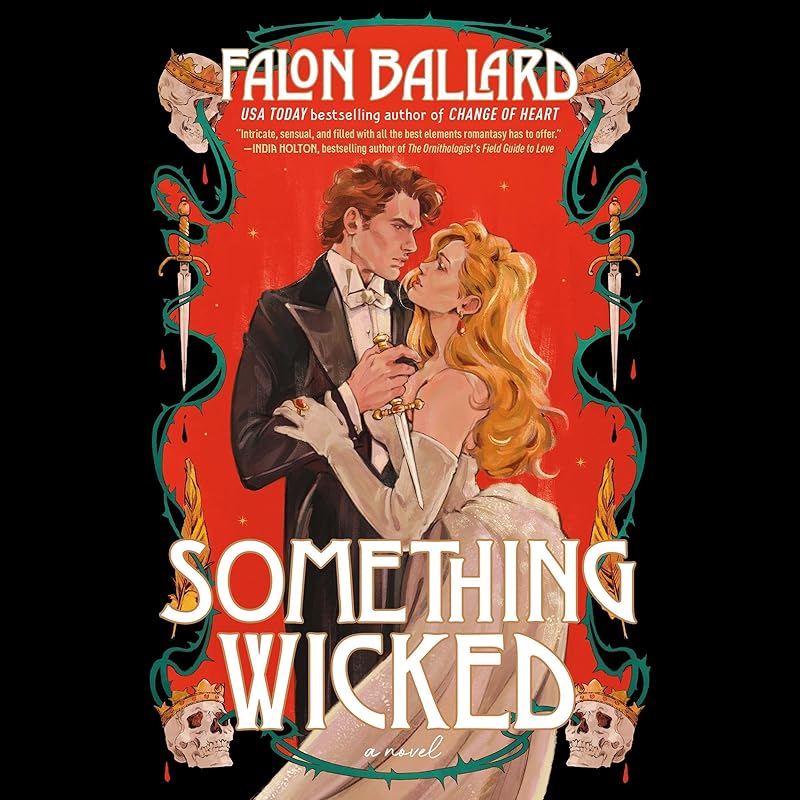
Patty K Rivera: Hi, listeners. I'm Audible Editor Patty K. Rivera, and today I'm joined by bestselling author Falon Ballard. After winning over listeners with her contemporary romance novels such as Lease on Love and Just My Type, she's taking us somewhere darker and more magical with her romantasy debut, Something Wicked. Falon, welcome.
Falon Ballard: Thank you so much for having me. I'm so excited to chat with you today.
PR: Oh, I'm so happy that you're here, and I can't wait to chat all about Something Wicked. Now, Something Wicked opens with such an intimate, high-stakes scene. What made you choose that moment as our entry point into Cate's life and the world around her?
FB: I think that's one of the things that I have really learned as a writer as I've gotten a little bit more experience, is the best way to start a story is to just throw the reader directly into the action. I feel like when I was first getting started with writing, one of the things that they tell you not to do is to have your first scene where your character is like waking up and getting out of bed and thinking about their day. I always used to fall into that pattern, and now I have learned definitely don't do that, do the opposite of that, and just up the stakes from the very beginning and get right to the good stuff.
PR: Just right off the bat, you've got us started with this intense and steamy scene.
FB: And then it just goes up from there [laughs].
PR: It just goes up from there. Thank you. You took the words right out of my mouth. Your previous work lives in contemporary romance. Now we're in a completely different world with magic, power systems, and political stakes. Why romantasy? And what did the research or craft prep look like to make that shift feel authentic and earned to you?
FB: I really have always written romantasy. I actually wrote the first draft of Something Wicked in 2020, so it's something that I have been working on for a really long time, and it's just something I always love to play around with because I'm a big fantasy reader. I really didn't ever know if I would publish any romantasy, but it was always a fun sort of playground I could go to when I needed a break from the rom-coms. When I finished writing a contemporary and I wanted to just do something totally different, I would go play in the romantasy space and just let my brain do whatever it wanted.
So, it's always sort of been there. I think when I first decided I wanted to pursue getting Something Wicked published, that's when I started to be like, "Okay, I really have to look at this a little bit more seriously." Because, obviously, it's very different. You have to create this whole world, and it has to make sense. I think there's this thought about fantasy where it's like, “Oh, you just make everything up and so you can kind of do whatever you want.” There is that aspect to it, but it still has to make sense and there has to be some sort of logic to tie it all together, so that was a challenge for me.
"I wanted a series where characters from different Shakespeare plays were all interacting with each other."
I'm also not a plotter in any way, shape, or form. When I'm writing a rom-com, I just sit down and go, and you can't really do that with a fantasy. You have to have at least some idea of what is going to happen, and not just with this book, but also what's going to happen in the next book, because I have to set up the world to extend beyond just this book, book 1. So that was a whole other challenge in and of itself.
I think for the craft aspect of it, and this is always my advice to anyone that wants to be a writer, is just reading everything that you can get your hands on. So, of course, romantasy. I've always been a huge romantasy reader, but I also read a lot of high fantasy, a lot of cozy fantasy. I really just dove into every fantasy book I could get my hands on, because to me that's the best way to prepare yourself, is to find the tropes and the beats and the expectations that the reader is going to have when they pick up a fantasy book. That, of course, is the best kind of research because I'm just reading all day long, which is my lifelong dream. That part was very fun and really cool to do.
I think what really inspired me to pursue getting Something Wicked published is I finished the first draft of this book in 2020. I sort of sat on it. I think in those pandemic years I didn't really want to be thinking about anything heavy or super high stakes. I really wanted everything to just be light and fluffy and happy and perfect and funny. That's sort of where my brain was, taking comfort in the moment. Then, as time has gone on, I've just been filled with lots of female rage at the world around us. To me, that's the most fun part of romantasy, is that my female main characters can stab people and do magic and take down the patriarchy and do these things that obviously you can't do in real life. You get to let out a little bit of that aggression, which is nice.
PR: So, because you talked about female rage, there is a political pressure building under nearly every interaction in Something Wicked, even in the romantic scenes. How did you decide how much of that tension to reveal early on without letting it overshadow the emotional arc of the story?
FB: Yeah, I think that was one of the bigger challenges for me. I'm not honestly sure how I did it. It was really more of a vibe check than anything. That was I think the biggest learning curve for me, figuring out how to reveal those moments, how much time to spend on those moments versus how much time to spend on the romance, and really looking at sort of the big picture. Because obviously, in a perfect world, this series is going to be four books long, and so I want to get the reader engaged right away, but also make sure that I'm leaving some of those questions unanswered so that there is that desire to go forward and figure out what happens in these subsequent books.
PR: Oh, my goodness. That you did, Falon. That's all I'm going to say, that you did. You surely left us guessing. I do have to say that once I heard the line “Moulin Rouge meets Macbeth,” I was like, “Okay.” I admittedly will say that I had not ventured into either, so I was like, “Okay, this is going to be interesting.” I read Something Wicked and then I actually ended up watching both Moulin Rouge and Macbeth. So, you sent me on that journey also. But both Moulin Rouge and Macbeth have such distinct emotional energies. How did you decide which elements to draw from those influences and which to redefine so that the story stayed uniquely yours?
FB: So, the first version I wrote of Something Wicked was not set in this world that we ended up in, in the Moulin Rouge-inspired world. I wrote it thinking I would just set it in more of a traditional fantasy sort of Western European space. And then it just didn't work. I was really looking around for this sort of perfect inspiration, and I am obsessed with the Broadway musical version of Moulin Rouge. I was obsessed with the movie also. They're both incredible. And something sort of just clicked in my brain and I was like, "Oh, this is the perfect balance."
I am a huge Shakespeare nerd. I used to teach theater, and I worked in professional theater for many years, so I really am honed in on the Shakespeare of it. One of the first inspirations for this series was I wanted a series where characters from different Shakespeare plays were all interacting with each other. And you do see that, obviously, in book 1, but it'll become a little bit more obvious who those characters are as you get into these further reads. But I thought that would be so cool. Macbeth, to me, was just the perfect one to start with because, first of all, I think it's a little bit of an easier plot to understand than some of Shakespeare's plays. But to me what's so fascinating about Macbeth is that Lady Macbeth is really the true villain of the story, I think. I wanted her to balance—we have Cate and we have the gifted, who are of course suffering and have been through all of these terrible things and have been persecuted. Obviously, there are many men in the story who are villains as well, but the Lady Macbeth character is the one who's truly driving a lot of the drama and the behind-the-scenes evil. I really wanted to play with that and then have that be the balance of this very emotional love story on the other side of it.
PR: Lady M is written with intentional cruelty. She manipulates, threatens, and controls without apology. I'm in total spoiler territory here, listeners. I'm thinking to the one part in the book where Cate finally, they get in, she's trying to get to her sister, and Lady M is like, “You're not going anywhere. I'm very much going to keep you here, but you're about to go tell this guy that you don't love him so that he doesn't fight for you.” I'm sitting there like, “You know that man is not going to stop fighting for her. You are just chaos, personified chaos.” What made you want a villain who does not need sympathy crumbs, redemption hints, or a softened backstory to justify who she is?
FB: I mean, really, it truly all comes down to I support women's rights and I support women's wrongs [laughs]. She's the true definition of that to me. But I'll say that's the surface level of it, of course. I did actually spend a lot of time writing out Lady M's backstory. It wasn't really, truly planned to be part of the book. It was just sort of something that I needed to do to figure out who this character is. So, I do think that she does have moments where you could find sympathy for her, because obviously she is gifted, she has also been persecuted and also gone through some things because of the way that this world runs and is operated. But she really takes it to the extreme, and you will see more of her in the second book, and even more of that will become clear. You're going to spend a lot more time with Lady M. She was really fun to write because I don't get to spend a lot of time being a villain. There's no real villains in rom-coms, for the most part. Even just being able to write out her backstory was really fun because she has these reasons why she turned out the way she did. But obviously, part of it is just that she's a bad person.
"I think what really makes a family is that you can mess up and you can make mistakes, and those people are still going to be there to support you at the end of the day."
PR: I found her to be just such an intriguing character. You're absolutely right, because there are moments, like at first when she's making all these changes. For the most part, Cate and the other girls are noticing that the changes are being made for good, but then she comes out of nowhere and she drops this bomb like, "Hey, y'all gotta pay to stay." And poor Harold. Not poor Harold, but poor Harold. He's here and he’s there, and he is in the middle of all of this. Because—and again, I'm in spoiler territory, listeners—we find out that he and Lady M are mates. He wants to protect the women of La Puissance, but he just can't. Love and the relationship that he has with Lady M, that love, that mate bond, is kind of bringing him toward the dark, literally. Then we have this reveal. The Harold reveal, it hits quietly, but it hits hard. He's set up as this calm, steady, and almost background-level, harmless character, until he's not. Did you always know he would carry that darkness? Or did that shift happen while writing?
FB: Some of it revealed itself as I was writing, but for the most part I always knew who he was. I think one of the things that excited me most about doing this retelling is that usually if you hear “Oh, it's a Macbeth retelling,” you would assume that Macbeth and Lady Macbeth are the two main characters, but they're not in this one. So that was kind of a fun thing to get to play with because, again, Macbeth as a character in the Shakespeare play is the bad guy. He is the hero in a sense, because the play is about him, but he is the one who does all these terrible things. But he's driven to do these terrible things because of the women in his life, with the three witches who are giving him these prophecies, with Lady Macbeth who's constantly pushing him to be more ambitious and go for things.
I really looked at Macbeth, but then also the character of Zidler from Moulin Rouge, who is this very sort of paternal figure to the women working at the club. I wanted to bring both of those characters together. I love Harold. Obviously, he makes a lot of stupid mistakes and does a lot of things he shouldn't do. But truly, his heart is good, and his intentions are good. I think that that is always an interesting character to look at, just sort of in general, is a character who has really good intentions, but the actions don't necessarily live up to what is in his heart.
PR: I agree. I found that that was like a reoccurring, I want to say almost a reoccurring theme, right? Because even some of the women, they don't necessarily, at first, believe Cate. There's this part between Cate and Bianca where Bianca [says] the closest thing to an apology we're going to get from her. She's like, “Oh, you were right.” I feel like Cate needed to hear that, of course. Just like, “Okay, yes, I was right. I'm sorry, we're still family” type of thing. I find that found family does show up here. It's something that shows up across your contemporary romances. Like Lease on Love, she has a really amazing friend group. Throughout your contemporary romances, we really do see that reoccurring theme of found family. But here it has a sharper edge, because survival is part of the bond. Within La Puissance, what does loyalty look like when trust is something that has to be earned not offered? And why did you want to go with this different take on found family?
FB: I think this was also another one that sort of progressed naturally as I was writing, as I was discovering these characters and who they are. I think with the women of La Puissance, they have all basically gone through incredibly dark and difficult times, and that's what led them to come to this place and live together in the club and have this sort of safety net of being able to really be taken care of for the first time in most of their lives. I think that that automatically adds a lot of layers of trust issues.
For Cate, in particular, she definitely has a lot of trust issues. But I think when Lady M first comes onto this scene, it's very easy when you've been through so many dark times to say, “This is a person who is doing good and I want to just believe that this is good, for the first time.” And they do feel safe in this environment, and they trust Harold and they trust his opinions. So, for them, it's kind of like, “We gotta go with what we see.” They're a little bit willingly ignoring some of the red flags because it's just easier and it feels better to live in this moment of peace and calm for a little bit.
I think that all of them together, when it really comes down to it, they're going to have each other's backs and they're going to be there for each other. Because in a lot of ways, they're the only ones who have ever really been there for each other. I think what really makes a family is that you can mess up and you can make mistakes, and those people are still going to be there to support you at the end of the day. For me, found family is so important because so many people aren't born into the best family situation. Everybody's family is always going to look different. You have to lean on the people that are there for you. Whoever those people are, that's your family, and it can look like whatever you want it to look like.
PR: That's absolutely beautiful. I really did see that in Something Wicked. I saw them have those tough relationships. I saw them have those moments where they didn't agree with each other. I saw those moments where they kept things from each other, even. You see that with Andra and Cate. Andra's going through it. My girl gets put through the wringer. My God, Falon, you really messed with us with that one. Andra's going through it. She's being forced to continuously show Lady M these visions. And with that found family that you were talking about, protecting Cate for Andra is keeping her from all of Lady M's evils. Then, on the other side, you have Cate who's protecting her sister by keeping her own things to herself, too, and not telling her like, "Hey, I'm stressed out because they just put this monetary amount that we have to make, and I'm not doing it for the money. I'm doing it for the honor of healing people."
And you see Callum walk in, and I'm not going to say he took all her attention, but he kind of just has her take a look at things, has her really evaluate some of the stuff that's going on, how she spends her time. I find Callum to be such an intriguing character because he walks a line where he is sure of what he wants, but you can also feel the cost of what he's trying to become. How did you figure out where his emotional limits were without making him feel just unreachable?
FB: Yeah, Callum was an interesting character because I think when I first was like, “I'm going to write a romantasy," in my head a romantasy hero is a huge jerk. He is sort of the bad boy. He's like the Rhysand. That's what I think of when I think of a fantasy hero. I really, truly sat down with the intention of giving Callum that sort of personality. And then he was just like, “No, sweetie, that's not who I am.” [laughs] I learned that I apparently only am able to write cinnamon rolls, and I'm okay with that. I'm just going to embrace it. That is who I am. But he really turned out to be a lot softer than I thought he was going to.
Of course, he has his moments where he is very rigid in his opinions. He has a lot of thoughts about the gifted. He has some past trauma of his own that really contributes to this sort of prejudice that he has against them. But I never wanted him to be so set in his ways that he wasn't open to learning that he was wrong. I mean, all we want in life is a man who will admit that he's wrong, right? Like, truly. So that was really important to me, is that he was able to really listen to Cate. Obviously, she has experiences that he's never had. He has experiences that she has never had. And I wanted them to really be open to each other and really listen to one another and be able to communicate a lot of those things.
PR: I'm just going to continue to say it was so beautifully done. Because you do see him have, at the beginning of the story, he's like, “Gifted, no, absolutely not. My mom, the way she's set up, like, no, no, no.” And then he starts this relationship with Cate, and Cate, even when she hears that he has these preconceived notions and prejudices toward the gifted, she's like, “Well, but I'm also not going to hold that against you” type of thing. I feel like within that, it was so beautifully done, because seeing her be that character, from my perspective, it felt like she was pulling him out of being that character. So, toward the end, you have this man who is now willing to hear the gifted out, at least, or recognize that they are not all the same. He's not discounting his lived experience, but he's also saying, “Hey, not everyone is like this.” And again, to your point, yes, we would all love a man who admits he's wrong when he's wrong [laughs].
FB: Wouldn't that be nice?
PR: Perfect world. Perfect world. Okay, shifting gears to the performance now. Listening to Something Wicked on audio was just a joy. It was truly, truly wonderful. The audio adds another layer to the emotions, power dynamics, and tension, especially with the performances from M.K. Blackwood, Marie Hawkins, Elliot Strong, and Connor Barragan. What was it like hearing their performances and bringing those characters to life? And did their performances reveal anything new to you about any of the characters in Something Wicked?
"I learned that I apparently only am able to write cinnamon rolls, and I'm okay with that. I'm just going to embrace it. That is who I am."
FB: I'm going to be fully and completely honest. I cannot listen to the full audio recording of my own books. It just is too much for me, like, emotionally, mentally. So, I always listen to the little previews and the little snippets that they send me, because of course I want to hear it, but I cannot sit down and listen to the whole thing from start to finish because I think it would send me into a full-blown spiral.
PR: Why?! The audio is so beautiful, Falon.
FB: I know it is. I constantly hear from readers and listeners that are like, "Your audiobooks are so good." And I'm like, "I will take your word for it, but I know what you're saying is true." I think what I love when you get to have multiple narrators is that you really get to hear each character. I love in Something Wicked that we also get to hear these little interstitials, like the journal entries and things like that, in these different character voices. That, to me, is always so cool. It's really fun to listen to the audio because when I'm just sitting here on my computer and I'm typing away, I sort of hear things in my head, but not really. Then when you actually hear them, with the inflections and the emotion, it's just like—and again, as a theater person, that to me is just the coolest thing because it feels like you're watching a performance.
I think one thing for this one that is also very cool is Shakespeare's plays, in particular, most of us experience them now reading them. But that's not how they are intended to be consumed. I think that's one of people's biggest issues is they're like, "Oh, well, I read Romeo and Juliet and I thought it was so boring." And it's like, “Well, if you actually watch it or you listen to it and you hear it, that's how it was meant to be delivered.” So, I think that having that sort of tie-in with the Shakespeare and with the audiobook is really cool, because it does bring another layer to the emotions and the depth of the characters when you're actually hearing them speak the words.
PR: Yeah, and that last journal entry, Falon, how could you do this to me?
FB: Okay, I'm going to listen to that one. I'm going to go listen to just that part.
PR: So, last question: If Cate or Callum could recommend an Audible listen to me, what would it be?
FB: Oh, my goodness. That's such a good question. Well, I'm going to say Cate would recommend what I am currently listening to, and that is Mate by Ali Hazelwood. I just feel like Cate would really appreciate the dynamic there. I think she would really get on board with that.
PR: Cate being an Omegaverse girlie, outta left field. But I love it.
FB: Yeah, I feel like that feels right to me. That feels right in my soul. Now that I have said it out loud, it's even more true than before. I love this journey for her that she's about to embark on. I feel like Callum, I don't want to say this is boring, because obviously I don't think any audiobooks or books are really boring, but I feel like Callum is a nonfiction kind of guy. He's going to go with something about a war or something that's going to teach him something important about history.
PR: Some country leadership skills or something.
FB: Yeah. Opposite end of the spectrum there.
PR: Right. Exactly. Oh, my goodness. All right, Falon.
FB: But I feel like if Callum happened upon Cate while she was listening to Mate that he would probably sit down and listen with her and be like, “Actually, this is pretty good.”
PR: We like a couple that listens together.Those who listen together, stay together.
FB: That's right [laughs].
PR: All right, Falon, it has been just such a fun time and a pleasure speaking with you today about Something Wicked. Listeners, you can get Falon Ballard's Something Wicked on Audible now. Happy listening.