Note: Text has been lightly edited for clarity and does not match audio exactly.
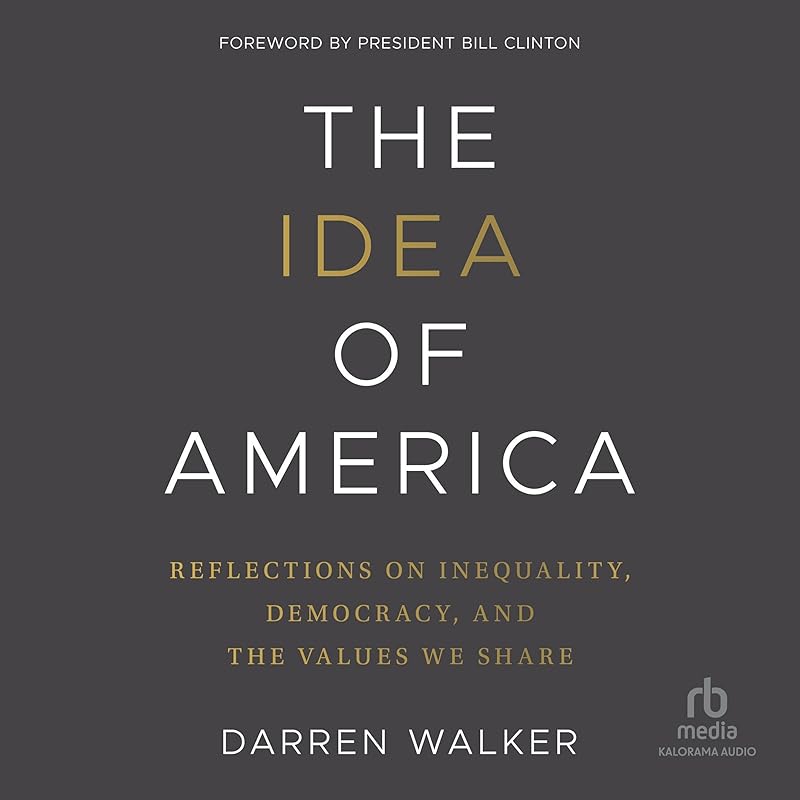
Jermaine Charles: Hello. I am Jermaine Charles from the Creative Development Team here at Audible, and I am joined today by Darren Walker, who just recently ended his tenure of 12 years as president of the Ford Foundation. The Ford Foundation is one of the most influential philanthropic organizations in America, if not the world, and during his leadership he advocated for a philanthropic vision centered on justice rather than just generosity. His new audiobook, The Idea of America: Reflections on Inequality, Democracy, and the Values We Share, was released in September, and it's a collection of reflections, essays, and speeches that he's composed over the years leading the foundation. Welcome, and thank you for joining me today, Darren.
Darren Walker: Thank you, Jermaine. Happy to be with you.
JC: So, the audiobook was narrated by Jonathan Todd Ross, and many of the chapters in the book began as speeches that you delivered in different rooms over the years. Do you think that there are any aspects of the message in the book that are served by being heard as oratory versus traditionally read? And what do you hope that will inspire with listeners listening to your words?
DW: Well, many of the speeches were commencement addresses or keynote addresses at convenings, conferences, but the themes of the health of the American democracy are things that resonated with a diversity of audiences, from academics to business leaders to social justice advocates. I think that is because, Jermaine, we all care deeply about our country. I personally, because of my own journey in America, built a deep sense of gratitude to this country, to what it has provided me and for the mobility escalator I was able to ride as far as my dreams and my ambitions took me.
"Yes, I'm Black, but it's more important that I'm American, because that is what binds us together: a set of values, beliefs, understandings of how we engage with each other, how we sustain this nation."
But there is a growing concern that the America we all love and hope can exist in the future is imperiled. And some of the speeches I gave were meant to hopefully inspire, motivate, encourage people to think about our own commitments and our own actions in support of our democracy, our democratic institutions, and our own participation and responsibility to ensure that we have a vibrant and healthy America.
JC: Thank you for that. Now, you mentioned your own personal journey, and in the book, you talk about how that journey has inspired your work. Some of the intersectional aspects of your identity—you come from what some would categorize as an underprivileged background, you're a Black man, you're a gay man—how has that intersectionality informed your work? And there's nuance, because I feel like, while it informs your work, I don't feel like you've put it in a frame of identity politics. So, how do you approach that nuance of allowing that to inform what you do without it overpowering the message?
DW: One of the essays in the book is my 4th of July, 2023, essay on American identity. I speak of how my identity, my intersectional identity as Black, as gay, is important and has in many ways defined my lived experience, but most importantly, the identity that matters is that I'm an American. And while being Black or gay may distinguish me from you or someone else, we all share the identity of being Americans, and we must not allow ourselves to lose that or to subordinate that identity to these other identities.
So, yes, I'm Black, but it's more important that I'm American, because that is what binds us together, a set of values, beliefs, understandings of how we engage with each other, how we sustain this nation, this country, what we owe to each other and to our country. So, I'm a big believer in identity, I'm not a big fan of identity politics as a progressive person. I think it's important that we be inclusive and that we recognize the richness and excellence that exists in the diverse and varied places and spaces across this country. But I think it's a real risk for us if we don't allow ourselves to be focused on that American identity first.
JC: That makes a lot of sense. When it comes to diversity and our differences, I want to touch on a James Baldwin quote that you bring up in the book. That quote says, "Ignorance allied with power is the most ferocious enemy justice can have." And you expand upon that to talk about how privilege can exacerbate this and create blind spots for different people who don't understand our differences. Your prescription for that is to increase empathy and humility. So, in your work at the Ford Foundation, what did you find to be the most effective way to invoke that empathy and humility for people, especially those who may have privileged standings that don't relate to what else is going on?
DW: I have lived, Jermaine, with privilege and without privilege. As a little boy, I lived in a shotgun house on a dirt road with an outhouse in the back of our little shack. I live a very different life today, but proximity is what has helped me remain grounded. I think one of the challenges is, as we become more privileged, as one becomes more privileged, it is easier to insulate oneself from the realities, the vicissitudes of everyday life for average working-class American folks.
That's what I worry about, is that people who are privileged don't understand how inequality is harming our country, in a practical way, what it is doing to communities, to workers, to families. So, I think proximity is how we have empathy, because when you experience the everyday life of a person who's unemployed or who is dealing with the stress of losing their job because the plant's going to close, or is homeless, when you are proximate to those lived experiences, you can't help but be empathetic. And empathy is critical, because we cannot have a fair and just America if we as a people are not empathetic to the suffering of our fellow Americans.
JC: Yeah, completely agree. That segues nicely into my next question, about empathy and another quote you have in the book, "Without art, there is no empathy, and without empathy, there is no justice." Can you share some examples of places where supporting the arts has contributed to social justice outcomes? And how do you measure the effectiveness of that if there's no fiscal metric to measure the return? How has that worked over the years at the foundation?
DW: Well, Einstein said that not everything that matters can be measured. I think our obsession with metrics can be a problem for us here because there is something called the moral imagination that cannot easily be put in an Excel spreadsheet or a randomized control trial evaluation, but we need it desperately. The arts help us because through the arts, we come to see our humanity in all its forms, and if we're willing to engage in beautiful literature, in the visual arts, in theater, in the things that give life meaning, bring us joy, we are more likely to be helpful.
"I think our obsession with metrics can be a problem for us here because there is something called the moral imagination that cannot easily be put in an Excel spreadsheet."
We know from the research, actually, we have measured that school children who are exposed to the arts are less selfish. They share more, they are more empathetic with their classmates. So, we need the arts, we need the arts not just because they make us empathetic, but because everyone deserves beauty in their life. And it does not work for me to say, "Well, because they're poor, what they need really is food and we'll worry about the rest later." Practically speaking, I understand that argument, but it's insufficient, because we aren't going to be this country if we basically eviscerate the arts. We aren't going to be America. This country has been the envy of the world in part because of our artistic traditions, because we have not completely adhered to European ideas of what is worthy and valuable art, what is culture. That we have iterated and created our own unique forms of culture and artistic expression, like jazz, that people around the world love and that is uniquely American.
JC: Yeah, I feel personally that our cultural exports are probably a lot more impactful worldwide than our commodity exports from the US.
DW: There's no doubt that American culture informs, influences—sometimes to the chagrin of people in those countries—what people are experiencing and what they are prioritizing in terms of culture.
JC: So, you mentioned in your answer there the philosophy that some people may impose “these people need food versus needing the arts” or dictating what is needed for the underprivileged people that your work services. You also mentioned that philanthropy is necessary but not a sufficient tool for social change. I know you've got a relationship with Anand Giridharadas, who in his book Winners Take All talks about the nonprofit industrial complex and points out how people who benefit from current systems in place often become the arbiters and architects of what philanthropy will look like. They get to choose which solutions are worth investing in and which aren't. So, with that paradox, how do you think about that in your work? Clearly, you keep it forefront of your mind.
DW: Well, I think, Jermaine, about what Dr. King said about philanthropy. In 1968, a few weeks before he was murdered, he said the following: "Philanthropy is commendable, but it should not allow the philanthropist to overlook the economic injustice which makes philanthropy necessary." And so what Dr. King was saying was the people who themselves have most benefited from economic injustice and other forms of inequality become philanthropists and then are charged with solving the very problems that they have benefited from. So, it is a very complicated conundrum for philanthropists, that wealthy people are challenged to solve problems that they in some ways are culpable for.
I think as a person who's very privileged today, I think about my own responsibility and culpability for some of the things that I worry about. I mean, I'm worried about homelessness and affordable housing in my home city of New York City. But am I doing all that I can to ensure that more affordable housing can be built? Am I supporting the NIMBY codes that make it hard for affordable housing to be built? Am I supporting the efforts that generate more housing vulnerability?
What Dr. King does in those words is hold the mirror up to us and he says, "All right, privileged Americans, look at yourself. Are you who you say you are? Do you really mean that you want to reduce poverty, reduce injustice, or are you allowing it to continue unabated?" It's a very uncomfortable position to be in, but it's one we must place ourselves in if we are to be accountable and if we are to actually have the kind of impact we need to have in the world and in our country on so many of these issues.
JC: Yeah, and when it comes to how to approach these issues, I know we have the disability community to thank for the slogan "Nothing about us without us," meaning, "We need to be involved in coming up with the solutions. We know what our struggles are day-to-day." I've heard you speak before about some of your engagement with that community and some of the learning opportunities that came from that. Do you want to share with our listeners today what that looks like?
DW: Sure. I have been on a journey in my own knowledge, which I should say started with ignorance. I had some sense of the challenges for people with disabilities, but I had no construct of where they fit in the larger challenges around inequality, because I was often thinking about them in the traditional categories of women or minorities or rural people, et cetera. And one of the things I learned after I wrote an essay on inequality that named many communities, but ignored the disabilities community, that I was just ignorant.
It was with the help of leaders in the disability community that I came to understand both the institutional, practical, and cultural barriers to their full participation in American life. And it just emboldened me to take up this cause, and it's been one of the most gratifying areas of work at the Ford Foundation, because there are so many people who are impacted. If we are lucky enough to live long enough, Jermaine, we will be in a wheelchair or we'll be walking with a cane or we will be impaired. We will be disabled at some point in our lives, if we are lucky to live long enough.
"We aren't going to be this country if we basically eviscerate the arts. We aren't going to be America. This country has been the envy of the world in part because of our artistic traditions."
This is not something that is uniquely about a category of a small number of people in our country. This is a significant number of people, and we make it very hard for this population. We make it hard for them to get out of poverty if we require them to remain poor in order to get any support from the government. We make it harder if we have barriers to employment or we have a separate minimum wage for people with disabilities, as we've had in this country over most of the 20th century, and certainly most of the periods since we enacted the minimum wage.
So, there are institutional, cultural norms that we have allowed that fundamentally marginalized Americans, and we've got to address that. I'm very proud that we at the Ford Foundation have done significant work, the largest funder in this space. But also embarrassed, embarrassed by my own ignorance and my own lack of understanding of the depth of the problem, even though I was running a big foundation. I had no idea of the challenges for people with disabilities.
JC: Thank you for sharing that. So, another quote that you bring up in the book is you describe hope as “the oxygen of democracy.” You've mentioned moments where democracy feels fragile. A lot has happened in our country in recent years, and recent months, even. So, how does that hope translate into the action you give? I know Rebecca Solnit has a book, Hope in the Dark, where she says, “Hope is not a lottery ticket you can sit on the sofa and clutch, feeling lucky. It is an axe you break down doors with in an emergency.” So, speaking to the action that comes from hope and not just using hope as a warm blanket when things seem dire, how do you use that as a motivation?
DW: For me, hope is the oxygen of democracy, and it is so important that we do all we can to create it, to build it, to sustain hope, and that comes in different forms. But hope, at its best, gives people motivation to want to live for the future, to be aspirational, remain positive about the outlook for them and their families. So, from wherever we sit, whether we are an employer, whether we are an educator, a parent, wherever we are, we should be thinking about hope. Ralph Waldo Emerson said that the purpose of life is not happiness. It is being useful, and in being useful, hopefully the world is improved because you lived. And if you're useful, you can find happiness.
I believe that I have a purpose in being useful to provide people with hope, as inspiration, imagination, validation, and that I should be doing all that I can to achieve that, and being mindful and intentional about that. I say that because I, sitting in this very nice office, I live in a very nice apartment, I have all the privileges that this great country has provided me, and yet I am not happy. And I'm not happy because there are too many Americans who do not have enough, who do not live with dignity, who do not believe that their future is bright. So, I have to be useful in doing all I can to change that. That's my work, and that's been the work of the Ford Foundation.
Now that I am no longer the president of the Ford Foundation, Jermaine, and I'm unemployed, literally unemployed as we talk, I have to think about what's the next act for me, because I have to do something, whatever it is, that is about giving people hope, and being a part of our culture, and using my voice and having a platform, hopefully, that makes it possible for me to have that impact and to be useful. [Editor's note: Since this interview was conducted, Darren Walker was named president and chief executive of the innovative production company Anonymous Content.]
JC: I literally just this morning was revisiting the work of Mihaly Csikszentmihalyi, and he talks about the flow state, and the passage I was reading this morning, he specifically talks about how finding purpose is what really induces that flow state and enhances your life experience. So, it just resonates that you bring it up in that way right now. I want to be mindful of your time, but before you leave, your successor, Heather K. Gerken, says that her tenure with the Ford Foundation is going to focus on preserving democracy, protecting elections and the rule of law. What are your thoughts on that shift in focus? It feels very timely. And what words of advice do you leave for her and all of our listeners in that pursuit?
DW: Well, I could not be more excited, ecstatic, that the board of trustees of the Ford Foundation appointed Heather Gerken as my successor, because she is an extraordinary leader and human being. And they chose her in part because she is a distinguished scholar and leader in an area that is critical and will be critical. Democracy, rule of law, elections are all her areas of scholarship, and she is not only a scholar but she is a practical leader who bridges the ground game and the boardroom game and brings it all together.
My advice, Jermaine—it's a great question—people have said to Heather, and she said to me, "Well, people feel I've got really big shoes to fill because I'm succeeding you." And what I've said to Heather and to the board is, "I am taking my shoes with me. There are no shoes for you to fill, Heather. You will bring your own shoes, and you will be the leader that is needed for the next 12 years and should not be burdened by or responsible for what I did during my 12 years."
I believe firmly that she is going to take the foundation to new heights, and I am proud that she stands on the shoulders of 10 presidents who came before her and that she is mindful of that legacy, but that she knows that it is a new day, that there are new challenges, and therefore new leadership is needed.
JC: That's excellent. Thank you very much, and God speed in whatever endeavors your shoes step toward next. I want to thank you for your time today, and let all our listeners know that they can find The Idea of America, along with your previous book, From Generosity to Justice, right here on Audible. Thank you again, Darren. Hope you have a great day.
DW: Thank you, Jermaine. It's been my pleasure.