

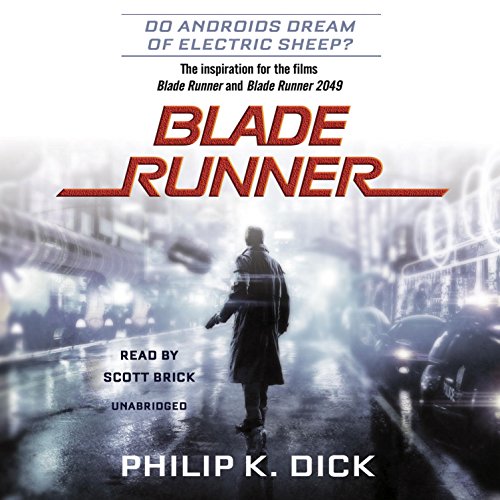
Blade Runner
Originally published as Do Androids Dream of Electric Sheep?
Failed to add items
Add to Cart failed.
Add to Wish List failed.
Remove from wishlist failed.
Adding to library failed
Follow podcast failed
Unfollow podcast failed
Audible Standard 30-day free trial

Blade Runner
Buy for $15.73
-
Narrated by:
-
Scott Brick
-
By:
-
Philip K. Dick
By 2021, the World War has killed millions, driving entire species into extinction and sending mankind off-planet. Those who remain covet any living creature, and for people who can’t afford one, companies build incredibly realistic simulacra: horses, birds, cats, sheep. They’ve even built humans. Immigrants to Mars receive androids so sophisticated they are indistinguishable from true men or women. Fearful of the havoc these artificial humans can wreak, the government bans them from Earth. Driven into hiding, unauthorized androids live among human beings, undetected. Rick Deckard, an officially sanctioned bounty hunter, is commissioned to find rogue androids and “retire” them. But when cornered, androids fight back—with lethal force.
Praise for Philip K. Dick
“[Philip K. Dick] sees all the sparkling—and terrifying—possibilities . . . that other authors shy away from.”—Rolling Stone
“A kind of pulp-fiction Kafka, a prophet.”—The New York Times©1968 Philip K. Dick; (P)2007 Random House, Inc. Random House Audio, a division of Random House, Inc.
Accolades & Awards
Listeners also enjoyed...






Editorial review
By Emily Martin
IF YOU READ ONLY ONE ANDROID NOVEL IN YOUR LIFETIME, IT SHOULD BE BLADE RUNNER
I have a poster of Ridley Scott's Blade Runner hanging up in my living room, but, like any self-respecting book person, before I'd seen the famous movie adaptation, I read Do Androids Dream of Electric Sheep? The first time I read Philip K. Dick's novel, straightforward but filled to the brim with invention and thought-provoking concepts, was for a science fiction class as an undergrad. At the time, I had no idea what "cyberpunk" meant, and I certainly didn't understand the difference between an android and a robot. But Do Androids Dream of Electric Sheep? opened up my eyes to how sci-fi could engage the imagination.
If you've seen Blade Runner and have read or listened to the novel it’s based on, then you know that the film is not exactly what one would call a "faithful" adaptation. In fact, when I teach this book and this film in my dystopian fiction courses, students are often disappointed in the movie after reading the book first. But I think both the movie and the film are essential parts of the sci-fi canon. Both works are in conversation with each other. And both have significant things to say about the meaning of life, what it means to feel emotions, and (most essentially) what it means to be human.
Simply put, science fiction would not be where it is today without the influence of Blade Runner. And yet the audiobook is more than just an important part of sci-fi history. It's actually an incredibly engrossing, edge-of-your-seat, unforgettable ride. The future world that Philip K. Dick paints for us in his novel is a bleak one, filled with desperate characters fighting to find meaning in a world that has left them behind. But it's also a world where humanity—including androids—fights to do so much more than just survive. They're fighting for a life that feels full. Just like the rest of us.
Continue reading Emily's review >
Featured Article: Audible Essentials—The Top 100 Screen Adaptations of All Time
As the category of great page-to-screen storytelling continues to grow, we scoured our libraries, grilled audiophiles and cinephiles, and vetted the entire Audible catalog for the 100 greatest screen adaptations for watchers and listeners alike. These are the stories that inspired some of the greatest on-screen stories of all time, from Academy Award winners and cult classics to must-see TV. They're well worth the price of admission.

People who viewed this also viewed...




This is the original Do Androids Dream of Electric
Something went wrong. Please try again in a few minutes.
The questions that this book tackles are difficult, and the way Dick attempts (and just manages to attempt) these questions is well-rounded; topics such as atheism versus theism and reality versus unreality (or perhaps surreality). They're handled with elegance and the beauty of imperfection and incompletion. The attempt to answer only leads to more questions. And such fantastic questions.
For a science fiction novel, it's also pretty accessible. Dick takes a lot of pointers from the noir and detective fiction genres; there's a lot of satisfying action alongside the difficult, intellectual subject matter.
As for the audiobook, the narrator is much too slow. Listening to him on 3x speed sounded like the normal speed of most narrators. But he was good, otherwise. Don't let it deter you from listening.
The Title Is A Question
Something went wrong. Please try again in a few minutes.
Counting electric sheep
Something went wrong. Please try again in a few minutes.
Better world than story
Something went wrong. Please try again in a few minutes.
Would you say that listening to this book was time well-spent? Why or why not?
I would not say that reading or listening to anything is mis-spent; this is a dumb question.Even the worst of books has some redeeming value; this book is no where near the worst; even though I did not care for it that is not a good enough reason to say it was time mis-spent; if in fact I decided it was not worth listening then I would have quit. So once again dumb question.
Would you be willing to try another book from Philip K. Dick? Why or why not?
Probably not. but maybe.Have you listened to any of Scott Brick’s other performances before? How does this one compare?
he is excellent; his reading is always great.Do you think Blade Runner needs a follow-up book? Why or why not?
no.Any additional comments?
Not having seen the movie I went into this novel without the pre-conceptions of having seen the film 1st. The genre within Science Fiction that of the dystopic or anti utopia is one I was more attracted to when I was younger. Brave New World, A Canticle for Leibowitz, 1984, and others of that ilk had more attraction back then, just like Camus, or Sartre did too I suppose. This novel set in a post nuclear world has no real hope of redemption, the supposed connection to the collective, the empathy box is a device created to share emotions and the collective pain of Mercer, it seemed to me to be technology imposed by the state to create an alternate reality in a world radioactive and wasting away in kibble. The only other solace is perhaps buying one of the few remaining animals left after the nuclear bombs destroyed most life, and this is embedded in a capitalistic system that placed it outside of most peoples ability to own. And the androids? No more likable than the warm blooded humans. There is some attempt at collective behavior, for kicks they snip off a spiders legs, and revenge results in a goat flying off a roof.The other two considerations I have regarding this book is Decker's view of human sexuality, and that includes human/android intercourse, for a culture that speaks of empathy sex is as mechanical as the named sheep in the title. There is so little true emotion that Decker's wife needs to program depression in order to feel. The other really interesting question is reality.. does Mercer really exist? Is Decker really Mercer? a metaphor for all of us pushing Sisyphus's rock up the hill being all of us so separate from love, passion, and true empathy.. we are supposed to feel connected to humanity by observing this man's suffering? his cross on the way to crucifiction, only to roll down again.. no hope, or as Kerouac said
Distopia wears on me...
Something went wrong. Please try again in a few minutes.