Episodios

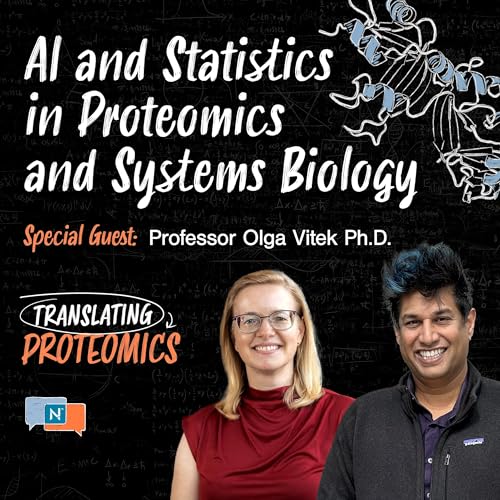
  • AI and Statistics in Proteomics and Systems Biology
    Feb 25 2026

    Professor Olga Vitek has a deep understanding of statistics, machine learning, and computational biology. She puts her know-how to work to develop computational tools enabling high-quality proteomic analysis and systems biology approaches. She hopes to apply these tools to the quantitative analysis of large-scale mass spectrometry-based investigations and thereby advance our understanding of organismal function. In this episode, Parag and Professor Vitek discuss:

    1. Why statistics is important for experimental design
    2. How statistics and AI can help researchers understand biology
    3. Gaps keeping us from using AI and statistics to their maximum potential in biology

    Resources

    Statistical methods for studies of biomolecular systems website

    1. Olga’s personal lab website

    Beyond protein lists: AI-assisted interpretation of proteomic investigations in the context of evolving scientific knowledge

    1. Gyori and Vitek, 2024 discuss how AI can be used to interpret proteomics data and its biological meaning.

    A Bayesian Active Learning Experimental Design for Inferring Signaling Networks

    1. Ness et al., 2018 show how statistical methods can guide the selection of experiments that optimally enhance understanding

    Más Menos
    46 m
  • OMICS IN SPACE
    Feb 4 2026

    Host Parag Mallick chats with Professor Afshin Beheshti who is a Professor of Surgery, Director of the Center for Space Biomedicine, and Associate Director of the McGowan Institute for Regenerative Medicine at the University of Pittsburgh. In addition, Professor Beheshti has a visiting researcher appointment at the Broad Institute of MIT and Harvard and is president of two non-profits – the COVID-19 International Research Team and Kwaai. The latter aims to democratize access to artificial intelligence through the design, construction, and maintenance of a free personal AI called Kwaai.

    Professor Beheshti’s research covers a range of topics focused on how circulating mirco RNAs and mitochondria impact health, but this conversation focuses primarily on Professor Beheshti’s work advancing our understanding of how spaceflight impacts biology. We cover:

    1. How research on spaceflight and biology is done
    2. Gaps that remain in our understanding of spaceflight and biology
    3. Omics studies of spaceflight and biology
    4. How studying spaceflight and biology enhances our understanding of human health more broadly

    Resources

    Trivedi Institute for Space and Global Biomedicine

    1. New Institute at the University of Pittsburgh focused on “advancing human health through space-driven innovation”

    NASA Open Science Data Repository

    1. "Provides open access to biological and physical science datasets from spaceflight and ground studies, enabling data reuse for discovery and innovation."

    Camera et al., 2024. Agining and putative frailty biomarkers are altered by spaceflight

    1. Study on molecular biomarkers and frailty phenotypes in space

    Overbey et al., 2024. The Space Omics and Medical Atlas (SOMA) and international astronaut biobank

    1. An “integrated data and sample repository for clinical, cellular, and multi-omic research profiles” from a variety of space missions
    2. Space Omics and Medical Atlas (SOMA) website

    Corti et al., 2024. To boldly go where no microRNAs have gone before: spaceflight impact on risk for small-for-gestational-age infants

    1. Explores how miRNA signatures of “small-for-gestational-age” are impacted by the space environment

    Beheshti et al., 2013. Age and space irradiation modulate tumor progression: implications for carcinogenesis risk

    1. Some of Professor Beheshti’s early...
    Más Menos
    51 m
  • Reflections on Proteomics - 2025 Yea-End Wrap-Up
    Dec 22 2025

    On this episode of Translating Proteomics, Parag and Andreas share their reflections on proteomics developments in 2025 largely inspired by their observations at the World HUPO 2025 conference in Toronto. Whether you agree, disagree, or simply want to share some of your own observations on proteomics, please post your thoughts in the comments.

    We look forward to even more exciting developments in 2026!

    Chapters

    00:00 - 00:35 – Intro

    00:36 – 07:00 - Increased focus on applications of proteomics and less on method development

    Learn more about One Health from our conversation with Professor Jennifer Geddes-McAlister

    https://youtu.be/JFwvTdkb5bw

    07:01 – 12:47 - Increase in people talking about the importance of proteoforms

    Learn more about proteoforms in our episode featuring proteoform pioneer Professor Neil Kelleher

    https://youtu.be/3pPuxVrMxpw

    12:47 – 17:26 - An increase in multiomics studies

    17:27 – 20:03 - A shift to larger scale proteomics studies

    For a great example of a multi-platform comparison study, check out Kirsher et al., 2025

    https://www.nature.com/articles/s42004-025-01665-1

    20:03 – 25:07 - Increased integration of AI into proteomics workflows

    For an example of how proteomics workflows can be modified with multiomic data, check out Suhre et al., 2025

    https://www.nature.com/articles/s41588-025-02413-w

    25:08 – 30:05 – Recognition of the need to assess quality across proteomics workflows

    30:06 – 32:19 – Less of a focus on spatial proteomics this year than in past years

    32:20 – 35: 13 - Parag and Andreas share their predictions for 2026

    35:14 – End – Outro

    Más Menos
    36 m
  • Hosts, Microbes, Molecular Pharming, and More with Professor Jennifer Geddes-McAlister
    Nov 6 2025

    On this episode of Translating Proteomics, Parag speaks with Professor Jennifer Geddes-McAlister from the University of Toronto. Professor Geddes-McAlister is an expert at using proteomics to study host-microbe interactions from a systems biology perspective. Her exciting work spans studies of pathogenic fungi all the way to engineering plants to produce pharmaceutics (so-called “molecular pharming"). On top of all that, Professor Geddes-McAlister also founded “Moms in Proteomics” to support and encourage an intentional focus on the inherently unique physical, emotional, and biological commitments of Mothers, and the ensuing balance required to excel within the diverse STEM fields encompassing Mass-Spectrometry-based proteomics.

    Dive into this episode to:

    • Learn why it’s critical to study hosts, pathogens, and molecular pharming from a systems point of view
    • Discover what Professor Geddes-McAlister is excited about for the upcoming Human Proteome Organization (HUPO) conference
    • Find out what “Moms in Proteomics” has planned for HUPO

    Chapters

    00:00 - Intro

    01:39 - Professor Geddes-McAlister's initial interest in host-microbe interactions

    06:13 - Why it's important to study host-microbe interactions

    08:10 - Pathogens vs helpful microbes

    10:06 - Thinking about microbes through the lens of "One Health"

    14:34 - Why Professor Geddes-McAlister works primarily in proteomics as opposed to other omes

    19:44 - Professor Geddes-McAlister's favorite thing that she's learned from the proteome and couldn't learn from the other omes

    24:56 - Molecular pharming

    29:35 - The need for accessibility in proteomics

    34:09 - The need for all-in-one workflows in proteomics

    36:08 - HUPO 2025

    39:56 - Moms in Proteomics

    42:36 - The future of proteomics

    43:59 - Outro

    Resources

    Geddes et al., 2015. Secretome profiling of Cryptococcus neoformans reveals regulation of a subset of virulence-associated proteins and potential biomarkers by protein kinase A

    https://pubmed.ncbi.nlm.nih.gov/26453029/

    Some of Professor Geddes-McAlister’s early work using proteomics to study pathogenic fungi

    Prudhomme et al., 2024. Bacterial growth-mediated systems remodelling of Nicotiana benthamiana defines unique signatures of target protein production in molecular pharming

    https://onlinelibrary.wiley.com/doi/10.1111/pbi.14342

    Researchers from Professor Geddes-McAlister’s lab use multiomic techniques to discover factors impacting the production of a pharmaceutical in an engineered plant


    Woods et al., 2023. A One Health approach to overcoming fungal disease and antifungal resistance

    https://wires.onlinelibrary.wiley.com/doi/full/10.1002/wsbm.1610

    Review on the importance of incorporating “One Health” principals into efforts to fight pathogenic fungi


    Moms in Proteomics website

    https://momsinproteomics.ca

    Learn all about the Moms in Proteomics initiative and its international community

    Más Menos
    44 m
  • “Ask me anything” with Parag Mallick, Andreas Huhmer, and featuring special guest Don Kirkpatrick, Ph.D.
    Jul 15 2025

    On this episode of Translating Proteomics, Parag, Andreas, and special guest Don Kirkpatrick answer questions submitted by the Translating Proteomics community. They cover:

    • Needs in plasma proteomics
    • How proteomics impacts drug development – with special guest Don Kirkpatrick, Ph.D.!
    • How lifestyle impacts the proteome
    • How the Nautilus Proteome Analysis Platform is impacting tau and Alzheimer’s disease research

    References

    Shome et al., 2022 - Serum autoantibodyome reveals that healthy individuals share common autoantibodies

    https://www.sciencedirect.com/science/article/pii/S2211124722006489

    LaBaer Lab paper investigating autoantibody levels in plasma and their relationship to health.

    Sylman et al., 2018 - A Temporal Examination of Platelet Counts as a Predictor of Prognosis in Lung, Prostate, and Colon Cancer Patients

    https://www.nature.com/articles/s41598-018-25019-1

    Mallick lab paper investigating temporal changes in platelets and their associations with cancer biology.

    Krönke et al., 2014 - Lenalidomide causes selective degradation of IKZF1 and IKZF3 in multiple myeloma cells

    https://www.science.org/doi/10.1126/science.1244851

    Seminal paper describing selective protein degradation caused by lenalidomide.

    Fink and Ebert 2015 - The novel mechanism of lenalidomide activity

    https://ashpublications.org/blood/article/126/21/2366/34644/The-novel-mechanism-of-lenalidomide-activity

    Review of research elucidating the mechanisms of lenalidomide activity

    Ndoja et al., 2025 - COP1 Deficiency in BRAFV600E Melanomas Confers Resistance to Inhibitors of the MAPK Pathway

    https://www.mdpi.com/2073-4409/14/13/975

    Describe links between kinase inhibitor vemurafenib and changes in ETV transcription factor degradation

    Song et al., 2022 - RTK-Dependent Inducible Degradation of Mutant PI3Kα Drives GDC-0077 (Inavolisib) Efficacy

    https://aacrjournals.org/cancerdiscovery/article/12/1/204/675622/RTK-Dependent-Inducible-Degradation-of-Mutant-PI3K

    Use proteomics to discover that inavolisib acts through selective degradation of mutant PI3Kα

    Canon et al., 2019 - The clinical KRAS(G12C) inhibitor AMG 510 drives anti-tumour immunity

    https://www.nature.com/articles/s41586-019-1694-1

    Covers the development of an inhibitor of KRAS mutant KRAS (G12C).

    Schneider et al., 2024 - Feeding gut microbes to nourish the brain: unravelling the diet-microbiota-gut-brain axis

    https://www.nature.com/articles/s42255-024-01108-6

    Review on the gut-brain axis

    Webpage for Johanna Lampe’s Lab at Fred Hutch Cancer Center

    Más Menos
    46 m
  • Spatial Proteomics with Fiona Ginty Ph.D.
    May 28 2025

    On this episode of Translating Proteomics, host Parag Mallick discusses spatial proteomics with special guest Fiona Ginty Ph.D. Fiona is a Senior Principal Scientist in Precision Diagnostics at the GE Healthcare Technology & Innovation Center. She is a leader in the development of spatial proteomics technologies and their application in precision diagnostics and medicine.

    Their discussion covers:

    · How Fiona began working in spatial proteomics

    · Why spatial biology is important

    · What the future holds for spatial biology

    Chapters:

    00:00 – Introduction

    01:54 – Fiona’s journey to biology

    05:26 – Fiona’s transition to tool development

    07:20 – Working at GE Research

    11:26 – Identifying the importance of spatial biology

    14:43 – How Cell DIVETM works

    18:25 – The importance of single cell

    23:01 - When Fiona realized the technology worked

    28:04 – Spatial biology projects Fiona is excited about

    30:08 – Fiona’s role in HuBMAP

    36:50 – Learnings from HuBMAP so far

    38:35 – The future of spatial proteomics in the clinic

    46:56 – Current limits on spatial proteomics

    49:56 – Current and future uses of AI in spatial proteomics

    53:30 – The most exciting thing Fiona learned in her spatial proteomics journey

    56:08 – Outro

    Resources:

    Method of the Year 2024: Spatial Proteomics

    Paper covering the spatial proteomics technology Fiona worked on at GE Healthcare

    • Highly multiplexed single-cell analysis of formalin-fixed, paraffin-embedded cancer tissue

    HubMAP – Human BioMolecular Atlas Program

    Human Tumor Atlas Network

    Cell DIVE Multiplex Imaging Solution

    Papers discussing what makes colorectal cancer cells undergo apoptosis in response to chemotherapy

    • An atlas of inter- and intra-tumor heterogeneity of apoptosis competency in colorectal cancer tissue at single-cell resolution
    • Integrated multiplex analysis of cell death regulators in stage II colorectal cancer suggests patients with ‘persister’ cell profiles fail to benefit from adjuvant chemotherapy

    Paper discussing how the distance between tumor cells and cytotoxic t-cells correlates to caspase level

    • Spatial effects of infiltrating T cells on neighbouring cancer cells and prognosis in stage III CRC patients - Azimi - 2024 - The Journal of Pathology - Wiley Online Library

    Paper showing it takes 3 hits from cytotoxic...

    Más Menos
    57 m
  • Intro to Proteomics
    Apr 16 2025

    On this special episode of Translating Proteomics, Parag and Andreas break down the basics of proteomics — perfect for anyone with a background in molecular biology looking to get started in the field.

    Seasoned experts: We hope you can share this episode as a teaching tool or to inspire others to explore proteomics.

    Parag and Andreas cover the following questions in the episode, and links to additional Nautilus resources can be found below each question.

    What is proteomics?

    • Blog post – What is proteomics? Techniques, applications, and methods

    What are key questions proteomics can answer?

    • Blog category – Applications of proteomics

    Why is it important to measure the proteome?

    • FAQ on the Nautilus Resources page
    • Blog post – Genomics vs. proteomics: Two complementary perspectives on life

    What can and can't you do with proteomics?

    • Translating Proteomics episode – Plasma Proteomics: The Dream and the Nightmare
    • Learn how the Nautilus Platform is designed to enable comprehensive broadscale proteomics and targeted proteoform studies

    What are key proteomics methods and techniques?

    • Blog series – Traditional protein analysis methods
    • Blog series – Next-generation proteomics technologies

    What are the major pitfalls when doing proteomics?

    What are the challenges in proteomic data analysis?

    • Translating Proteomics episode – Biology in Space and Time
    • Blog post – What is multiomics?

    What are people excited about in proteomics?

    • Translating Proteomics episode – Poised for a Proteomics Breakthrough
    • Translating Proteomics episode - US HUPO 2025 – Key Takeaways, Trends, and Future Directions for Proteomics
    • Translating Proteomics episode –
    Más Menos
    15 m
  • Proteomics Podcast Crossover - The Proteomics Show
    Apr 2 2025

    If you listened to our episode focused on science communication featuring proteomics leaders Ben Orsburn Ph.D. and Ben Neely Ph.D., then you've already heard about their excellent podcast, The Proteomics Show. On The Proteomics Show, they interview researchers in the proteomics community to learn about their motivations, their backstories, and their work. Today, we're sharing an episode of The Proteomics Show where the Bens interview Translating Proteomics host Parag Mallick. Check it out to learn about Parag's journey to proteomics, his efforts advocating for open data sharing, and his work as a professional magician.

    After listening, be sure to check out more episodes of The Proteomics Show on their feed where you'll find over 70 interviews with many, many interesting people in the proteomics community. Find their feed here:

    https://us-hupo.org/Podcasts

    Más Menos
    48 m