The Voice of Early Childhood Podcast Por The Voice of Early Childhood arte de portada

The Voice of Early Childhood

The Voice of Early Childhood

De: The Voice of Early Childhood
Escúchala gratis

The Voice of Early Childhood Podcast: involving you in thought-provoking discussions around early childhood. This weekly podcast brings you discussion, reflection, debate and a window into the minds of advocates working with our young leaders of tomorrow.Copyright © 2023 The Voice of Early Childhood
Episodios
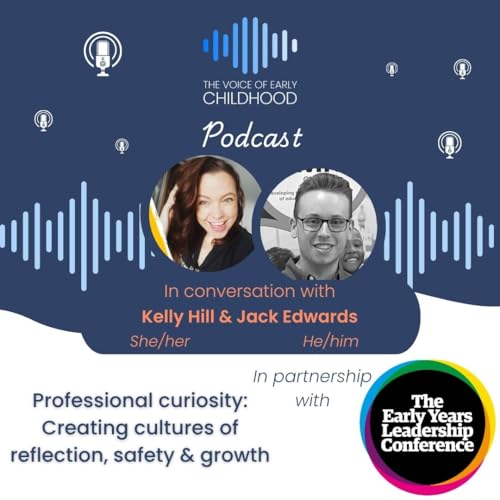
  • Professional curiosity: Creating cultures of reflection, safety and growth
    Apr 13 2026

    Professional curiosity is often spoken about in early childhood practice, yet its meaning can remain abstract until it is grounded in everyday interactions with children, families and colleagues. This article and podcast episode explore what professional curiosity looks like in practice, why it matters, and how it can be nurtured within early childhood communities.

    Read the article here:

    https://thevoiceofearlychildhood.com/professional-curiosity-creating-cultures-of-reflection-safety-and-growth/

    This episode is in partnership with The Early Years Leadership Conference

    To find out more and grab your tickets visit: https://theearlyyearsleadershipconfer6.godaddysites.com/

    Listen to more:

    If you enjoyed this episode, you might also like:

    · What is professional confidence? – with Dr Lewis Fogarty - https://thevoiceofearlychildhood.com/professional-confidence-finding-the-confidence-to-speak-out/

    · Hurt from conception: The impact of domestic abuse on children – with Tina Pokuaah - https://thevoiceofearlychildhood.com/hurt-from-conception-reflecting-on-the-impact-of-domestic-abuse-on-children/

    Get in touch and share your voice:

    Do you have thoughts, questions or feedback? Get in touch here! – https://thevoiceofearlychildhood.com/contact/

    Episode break down:

    00:00 – Introducing the topic: what is professional curiosity?

    02:31 – Defining professional curiosity: going deeper, not asking more

    03:11 – Reflection as a foundation for learning

    04:24 – Balancing curiosity with respect and non-intrusiveness

    06:23 – Psychological safety and creating open cultures in settings

    07:51 – Communication skills and asking questions in the right way

    09:01 – Supporting apprentices and recognising different starting points

    11:24 – Building reflective team cultures (example of shared communication approaches)

    12:42 – Learning from each other and empowering educators as leaders

    14:38 – Risks of lacking professional curiosity (complacency and stagnation)

    16:04 – Impact on staff wellbeing, retention and relationships

    17:42 – Early intervention and the dangers of assumptions

    19:34 – Challenging bias and recognising personal perspectives

    21:24 – Role modelling curiosity, vulnerability and reflective leadership

    22:44 – Strengthening relationships with families through curiosity

    24:22 – Generational impact of professional curiosity on children's learning

    26:44 – Curiosity in training, CPD and professional development

    28:58 – Supporting educators to develop their own pedagogy

    30:45 – Moving beyond fixed approaches and embracing critical thinking

    32:11 – The importance of collaboration beyond individual settings

    34:38 – Introduction to the early childhood leadership conference

    37:01 – Creating community, safe spaces and inclusive dialogue at events

    39:02 – Amplifying diverse voices, including apprentices

    41:15 – Encouraging participation and shared learning at conferences

    43:28 – Final reflections: what should listeners take away?

    43:44 – Closing remarks and episode wrap-up

    For more episodes and articles visit The Voice of Early Childhood website: https://www.thevoiceofearlychildhood.com

    Más Menos
    44 m
  • Supporting children's language through shared stories and sustained dialogue
    Mar 30 2026
    This article explores the TWiTCH (Talk with Tales for Children) programme, outlining its pedagogical foundations and structure, alongside findings from an independent pilot evaluation. It highlights how coach-led professional development and dialogic story practices can strengthen educators' confidence and support children's language, reasoning, and engagement during shared book reading. Read the article here: https://thevoiceofearlychildhood.com/supporting-childrens-language-through-shared-stories-and-sustained-dialogue/ This episode is in partnership with TWiTCH and Sheffield Hallam University To find out more about the TWiTCH programme visit: https://research.shu.ac.uk/twitchefficacytrial/ To take part in the TWiTCH programme, submit an interest form: https://forms.office.com/e/Rq3pwJGUiT?origin=lprLink Listen to more: If you enjoyed this episode, you might also like: · Helicopter stories: Bringing every child's story to life, with Trisha Lee: https://thevoiceofearlychildhood.com/helicopter-stories-bringing-every-childs-story-to-life/ · Stories that connect us: How books foster belonging in the early years with Laura Henry-Allain: https://thevoiceofearlychildhood.com/stories-that-connect-us-how-books-foster-belonging-in-the-early-years-2/ Get in touch and share your voice: Do you have thoughts, questions or feedback? Get in touch here! – https://thevoiceofearlychildhood.com/contact/ Episode break down: 00:00 – Welcome and episode overview 00:36 – Guest introduction: Fufy Demissie 00:54 – Fufy's background and experience 01:27 – What is the TWiTCH programme? 02:37 – Origins: language gap and research context 03:11 – Funding, development, and trial expansion 03:55 – What TWiTCH stands for 04:11 – Structure: nine stories across the year 04:46 – Week one: story immersion and strategies 05:36 – Week two: RCRI and reasoning discussions 06:40 – Decontextualised talk and critical thinking 07:25 – Week three: continuous provision and play 08:11 – Embedding vocabulary through practice 08:32 – Repetition of cycle across stories 08:52 – Dialogue, dilemmas, and child engagement 09:30 – Practitioner concerns and outcomes 10:18 – Pedagogical approaches underpinning TWiTCH 10:44 – Use of puppets and modelling language 11:05 – Hanan approach and responsive interaction 12:31 – Importance of repeated reading 13:31 – Educator training and coaching model 14:33 – Coaching visits and reflective practice 15:21 – Practitioner agency and flexibility 16:48 – Programme reach and implementation scale 17:52 – Inclusion of childminders 18:40 – Pilot findings: practitioner confidence 19:36 – Impact on reading and discussion practices 20:05 – Increased confidence in reading aloud 20:46 – Outcomes for children's language development 21:41 – Next steps: large-scale trial 22:36 – Recruitment of settings 23:50 – Trial design and evaluation approach 24:40 – Measuring children's language outcomes 25:52 – Future potential and expansion 27:05 – Key takeaway: value of repetition 28:01 – Final reflections on practice 28:41 – Closing remarks and how to get involved For more episodes and articles visit The Voice of Early Childhood website: https://www.thevoiceofearlychildhood.com
    Más Menos
    25 m
  • Unconditional positive regard in early childhood: What we can still learn from Carl Rogers and Mister Rogers?
    Mar 16 2026

    What might early childhood practice look like if relationships truly came first?

    In this article and podcast episode, we explore the idea of unconditional positive regard through the work of two influential figures who shared more than a surname: Carl Rogers and Fred Rogers. Although they worked in different spaces, both highlighted the power of acceptance, connection, and respect in supporting children's growth.

    Read the article here:

    https://thevoiceofearlychildhood.com/unconditional-positive-regard-in-early-childhood-what-we-can-still-learn-from-carl-rogers-and-mister-rogers/

    This episode is in partnership with BookedIn

    BookedIn is a CPD booking platform that connects organisations with verified speakers, trainers and consultants – so you can find the right fit faster, based on your brief, audience and outcomes.

    You can discover, compare, and manage bookings in one place – designed to help you book with more clarity and confidence.

    Whether you're booking CPD or are a speaker yourself, they're opening early access soon, and if you want to be first to hear when it's live, join the waiting list NOW!

    To find out more and sign up to the wait list visit: https://waitlist.bookedin.online/

    Listen to more:

    If you enjoyed this episode, you might also like:

    · Growth mindset in early childhood by Matt Bawler: https://thevoiceofearlychildhood.com/growth-mindset-in-early-childhood-2/

    · Proactively promoting positive mental health by Matt Bawler: https://thevoiceofearlychildhood.com/proactively-promoting-positive-mental-health/

    Get in touch and share your voice:

    Do you have thoughts, questions or feedback? Get in touch here! – https://thevoiceofearlychildhood.com/contact/

    Episode break down:

    00:00 – Introduction and welcome
    02:15 – Katie and David share their journeys into counselling and early childhood education
    05:20 – Why they wrote together about unconditional positive regard
    08:15 – What unconditional positive regard looks like in everyday practice
    11:00 – How to balance empathy with clear boundaries using the ACT approach
    14:30 – Practical examples of setting limits with children
    16:45 – How boundaries can communicate care, safety and love
    19:10 – Why connecting Carl Rogers and Fred Rogers matters for the early childhood community
    22:30 – The ongoing lack of respect and support for early childhood educators
    26:00 – Emotional labour and how educators manage feelings in the classroom
    27:15 – Natural emoting, surface acting and deep acting explained
    31:30 – When "faking it" protects relationships and when it leads to burnout
    34:00 – Why teaching in early childhood is emotionally intense and highly complex
    37:00 – Helping children build a richer vocabulary for emotions
    41:00 – Why modelling emotions is central to children's social and emotional learning
    44:00 – Reflecting on whether children feel genuinely wanted and valued
    46:00 – Final reflections and episode close

    For more episodes and articles visit The Voice of Early Childhood website: https://www.thevoiceofearlychildhood.com

    Más Menos
    57 m
Todavía no hay opiniones