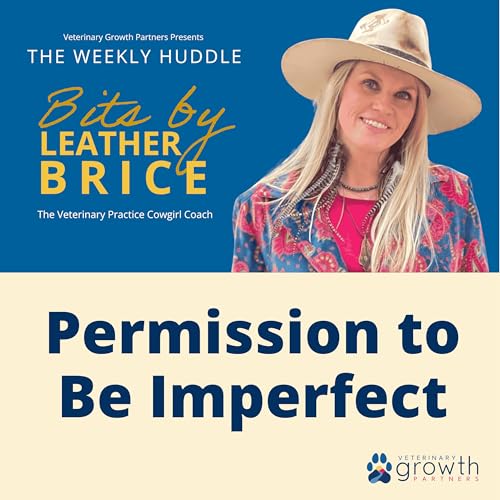
The VetMed Weekly Huddle Podcast Por Veterinary Growth Partners arte de portada

The VetMed Weekly Huddle

The VetMed Weekly Huddle

De: Veterinary Growth Partners
Escúchala gratis

The VetMed Weekly Huddle is provided by Veterinary Growth Partners to help support you and your team to have a great start to their workday. Topics range from Emotional Intelligence to Team Dynamics.Copyright 2026 Veterinary Growth Partners Desarrollo Personal Economía Gestión Gestión y Liderazgo Éxito Personal
Episodios
  • Permission to Be Imperfect
    Apr 2 2026

    In this episode, Leather Brice dives deep into the art of handling nerves before important conversations, especially those involving conflict. Leather shares personal insights and actionable steps to help you set yourself up for success, from reframing your inner monologue to practicing with trusted colleagues. Discover why vulnerability is a strength, not a weakness, and how embracing imperfection can actually lead to more authentic and productive dialogue. Whether you’re a leader or team member, these tips will help you keep communication open and effective, even when the stakes are high.

    🐴 Key Takeaways:

    1. Reframe Your Inner Monologue: The story you tell yourself before a conversation shapes your confidence and outcome. Make it positive!
    2. Practice Makes Progress: Role-play tough conversations with a trusted peer, especially when conflict is involved.
    3. Confidentiality Matters: When practicing, choose someone appropriate to maintain trust and avoid triangulation.
    4. Embrace Vulnerability: It’s okay to admit you’re nervous or imperfect—authenticity builds trust.
    5. Keep the Conversation Going: No matter how nervous you feel, open communication is essential for resolution and growth.

    #Leadership #Communication #Podcast #ConflictResolution #BitsByLeather #LeatherBrice

    Más Menos
    3 m
  • Reframing Mental Health at Work
    Mar 26 2026

    When “my mental health” becomes the final word in a tough one-on-one, leaders can leave without clarity, accountability, or a plan. In this episode, Harmony Butler reframes mental health in the workplace—not as a measure of comfort, but as a reflection of capacity and adjustment. Drawing on the formal definition of mental health (including adequate adjustment and the ability to meet the demands of life), Harmony challenges listeners to recognize when “mental health” is being used as a shield to avoid discomfort versus a tool for growth, resilience, and responsibility.

    🔑 Key takeaways

    1. Mental health isn’t about constant comfort; it reflects capacity to adjust, relate, and meet demands.
    2. Using “mental health” as a shield enables avoidance; using it as a tool promotes growth and accountability.
    3. Adequate adjustment and resilience are evidence of healthy mental health.
    4. Support matters, but responsibility still rests with the individual.
    5. In performance conversations: state the problem, describe impact, invite response—then ensure a concrete plan.

    Más Menos
    6 m
  • From Rodeo to Role Play
    Mar 19 2026

    In this episode of Bits by Leather, Leather Brice dives into the art of preparing for meaningful conversations—whether it’s giving feedback, confronting a challenge, or simply communicating more effectively. Drawing parallels between horse training and human interaction, Leather shares why mindset and practice are essential for building confidence and success in any dialogue. She offers practical tips, including the value of role play and structured feedback frameworks, to help listeners overcome nerves and avoid conversation avoidance. If you want to communicate with more clarity and care, this episode is for you!

    🐴 Key Takeaways:

    1. The story you tell yourself before a conversation shapes your experience—shift your mindset to set yourself up for success.
    2. Preparation is crucial: just like training a horse, practicing conversations builds confidence and skill.
    3. Nerves and avoidance are normal, especially when you’re not used to holding difficult conversations—practice is the antidote.
    4. Use tools like feedback frameworks (e.g., six steps for giving feedback) to guide your conversations.
    5. Role play with colleagues or coaches can help you refine your approach and ensure your message lands with care.
    6. Communication is a skill—invest in coaching and structured practice to improve your effectiveness.

    #Leadership #Communication #Podcast #Feedback #PracticeMakesPerfect #BitsByLeather #LeatherBrice

    Más Menos
    5 m
Todavía no hay opiniones