Episodios

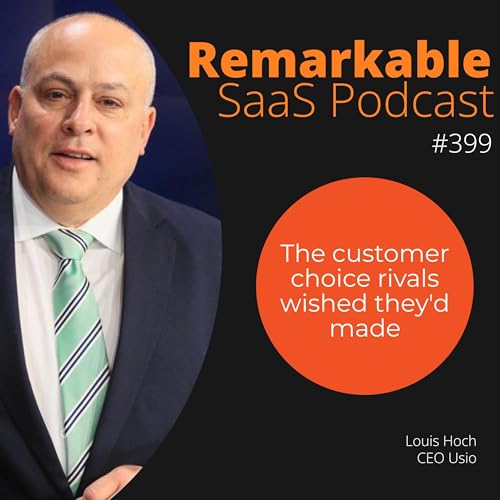
  • #399 – How Louis Hoch rejected the obvious customers—and grew when rivals collapsed
    Apr 1 2026

    A story about choosing who not to serve—and building competitive advantage no crisis can touch.

    This episode is for sales-led SaaS founders who've never tested whether their revenue would survive a major market shock — and aren't sure they want to know the answer.

    Most software companies are built to serve as many customers as possible. Louis Hoch, CEO of Usio, chose differently.

    Louis has been building in payments since 1998. He raised $50 million while competitors raised $200 million—and won. He built a company that processes enough direct bank payment volume to rank as the 50th largest bank in the United States. When COVID hit and rivals saw revenue drop by as much as 80%, Usio grew. That outcome wasn't luck. It was a customer decision made years earlier that most CEOs would never make.

    What Louis did—deliberately, by design—was say no to entire industries. Not because he couldn't serve them. Because serving them would have cost him everything else.

    And this inspired me to invite Louis to my podcast. We explore how deliberate customer rejection builds a resilience that no market crisis can touch. Louis shares insights about turning regulatory hurdles into early competitive positioning, building payment channel diversity while staying ruthlessly focused on vertical, and why the companies that fail are often the ones who stayed truest to their original idea. You'll discover what happens to your revenue when a crisis hits — and you made the right customer choices years earlier.

    We also zoom in on two of the 10 traits that define remarkable software companies:

    • Acknowledge you cannot please everyone
    • Aim to be different, not just better

    Louis's story proves that remarkable companies don't just pick their market—they pick what they will never serve, and build their advantage from that constraint.

    Here's one of Louis's quotes that captures his philosophy on what it takes to survive as a founder:

    "What you think you're going to be when you start a software company and what you end up being are often different. The companies that are successful understand that. The companies that fail try to maintain their focus on what their original product or service is."

    By listening to this episode, you'll learn:

    • Why going public before your first customer can be your strongest sales move
    • Why giving customers the conditions to choose beats telling them what they need
    • Why your original business plan may be the biggest threat to your survival
    • Why operating leverage has to be designed in from the start — not stumbled into later

    Guest: Louis Hoch, CEO and Chairman of Usio

    Website: usio.com

    Más Menos
    46 m
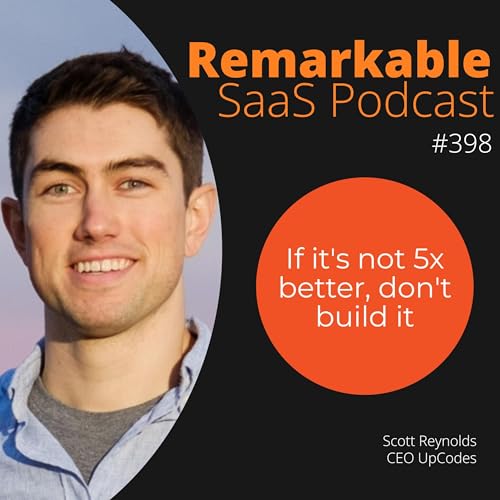
  • #398 – How Scott Reynolds bet on depth over breadth and built a position that sticks
    Mar 25 2026

    A story about choosing the hard problem—and winning because of it.

    This episode is for sales-led SaaS founders who feel their product lead shrinking—and wondering what actually creates a position competitors can't close.

    Most founders chase obvious markets. Scott Reynolds chose a complicated one nobody else wanted.

    Scott, co-founder and CEO of UpCodes, is a trained architect who has lived the pain of navigating construction regulations. Weeks buried in phone-book-sized regulations that no software had organized—until he built it.

    While others built broad tools for obvious problems, Scott went narrow and deep. His conviction: if it's not dramatically better, it isn't worth building.

    And this inspired me to invite Scott to my podcast. We explore why going deep into one vertical beats building broad for everyone. Scott shares what forces professionals to call a tool irreplaceable, why vertical depth compounds, and what a decade of quiet data does when AI arrives. You'll discover why his bet keeps getting stronger.

    We also zoom in on two of the 10 traits that define remarkable software companies: – Aim to be different, not just better – Offer something valuable and desirable

    Scott's story proves that remarkable companies find the problems others walk past—and build advantages that compound.

    Here's one of Scott's quotes that captures his thinking on competition in the AI era:

    "We view that marriage of our data and their data to give them a unique instance of AI that can just answer questions better than their competitor could. And I think that's a very critical component of competition in an AI era."

    By listening to this episode, you'll learn:

    • Why a 10% improvement rarely moves anyone—and what threshold actually drives adoption
    • What choosing a vertical others ignore reveals about long-term defensibility
    • When combining your data with customer data creates an advantage nobody else can access
    • Why the hardest problems to solve are often the strongest positions to own

    For more information about the guest from this week:

    Guest: Scott Reynolds, Co-founder and CEO UpCodes

    Website: up.codes

    Más Menos
    45 m
  • #397 – How Dean Mathews rejected conventional growth and built a company 170,000 people rely on every month
    Mar 18 2026

    A story about measuring success differently—and what that single decision builds.

    This episode is for SaaS founders who sense their growth metrics are missing something — and can't put their finger on what.

    Many SaaS companies track monthly active users. Dean Mathews asks a different question when he looks at that number.

    Dean Mathews, Founder and CEO of OnTheClock, launched his time-tracking company in 2004 after reading complaints in a small business forum. For the next decade, he ran it as a side project — patient, focused, and measuring success by one question: are we actually helping people?

    That question changed what he built, how he hired, and why customers keep coming back.

    And this inspired me to invite Dean to my podcast. We explore how measuring success by people rather than revenue changes what a software company becomes. Dean shares why monthly active users became his north star, why 20 years of patience in one segment compounds in ways rapid growth never does, and what really drives customers to recommend you without being asked.

    You'll discover how a 4.9 out of 5 customer support rating and 7–8% word-of-mouth referrals trace back to one belief about what business is actually for.

    We zoom in on two of the 10 traits that define remarkable software companies: – Turn customers into fans – Master the art of curiosity

    Dean's story proves remarkable companies don't obsess over revenue metrics—they obsess over the people those metrics are supposed to represent.

    Here's one of Dean's quotes that captures his philosophy on what makes a team culture actually work:

    "The biggest one for me is connecting their work to the actual value that's delivered to a customer, and showing them that their work actually matters. That's like gold."

    By listening to this episode, you'll learn:

    • Why measuring success by people helped—not revenue—changes how your whole team behaves
    • What turns occasional users into customers who recommend you to friends and colleagues
    • Why staying in one segment for 20 years compounds in ways most founders never see
    • Why connecting every team member to customer outcomes creates effort no salary can buy

    For more information about the guest from this week:

    Guest: Dean Mathews, Founder & CEO of OnTheClock

    Website: ontheclock.com

    Más Menos
    40 m
  • #396 – Why Hewitt Tomlin reversed course at $10M
    Mar 11 2026

    A story about admitting your own strategy pulled you away from what matters.

    This episode is for sales-led SaaS founders wondering whether their expansion strategy is building strength—or spreading them thin.

    Most SaaS founders treat $10M as proof the playbook works. Hewitt Tomlin, CEO of TeamBuildr, treated it as a reason to question everything.

    He and his college teammate James Peters built TeamBuildr from a frustration with paper workout programs into a $10M strength and conditioning platform—with fewer than 50 employees and zero outside capital.

    But at $10M, Hewitt made a choice most founders wouldn't. He stopped building new products—and started rebuilding the one that got him there.

    And this inspired me to invite Hewitt to my podcast. We explore why a bootstrapped founder at $10M chose restraint over expansion—and what that decision reveals about building real competitive advantage. Hewitt shares hard-won lessons about a pricing mistake he calls his biggest error, an acquisition that taught him the cost of scarcity thinking, and why he now hires from the profession he serves. You'll discover what happens when a founder stops chasing more and starts going deeper.

    We also zoom in on two of the 10 traits that define remarkable software companies: – Focus on the essence – Master the art of curiosity

    Hewitt's story proves that remarkable companies don't keep adding—they challenge everything that doesn't move the needle, even when it's their own strategy.

    Here's one of Hewitt's quotes that captures his long-term conviction:

    "Our existing application is responsible for 10 million in revenue. It's not bad. There's a good argument there for not changing anything, and continuing to tack on 2 million in revenue a year. But no, we're convinced it's the right thing to do, because we feel like, if it's gotten us so far for 10 years, then the new version will carry us for 10 years into the future."

    By listening to this episode, you'll learn:

    • Why early revenue matters less than the insight your first customers carry
    • What happens when a $10M founder chooses depth over new product lines
    • Why analysis without intuition leads to your most expensive mistakes
    • How hiring from your customer's profession builds a moat competitors can't copy

    For more information about the guest from this week:

    Guest: Hewitt Tomlin, CEO & Co-Founder

    Website: teambuildr.com

    Más Menos
    52 m
  • #395 – How Bassem Hamdy created something no competitor can touch
    Mar 4 2026

    A story about destroying your own work—and creating what lasts.

    This episode is for sales-led SaaS founders who suspect their product is slowly becoming a custom shop—and don't know how to stop it.

    Bassem Hamdy, CEO and Co-Founder of Briq, has spent 25 years in construction technology—three software revolutions, three companies.

    He says Briq found product market fit every 24 months. Each time meant tearing something down to build the next version.

    Each time, the same thing triggered the rebuild — the company had started solving for individual customers instead of the market.

    And this inspired me to invite Bassem to my podcast. We explore why the instinct to please your biggest customers creates exactly the kind of fragility that kills companies. Bassem shares hard lessons about killing a product he spent two years building, the moment his QA team exposed how far the company had drifted, and why domain expertise—not platform size—determines who wins in vertical AI.

    We also zoom in on two of the 10 traits that define remarkable software companies: – Acknowledge you cannot please everyone – Master the art of curiosity

    Bassem's journey proves that remarkable companies refound themselves before the market forces them to.

    Here's one of Bassem's quotes that captures what happens when a company starts drifting:

    "Software is like jello. You slap that thing, it's going to shake the hell out of it. So the moment you inject that code, that's client specific, you're pooched."

    By listening to this episode, you'll learn:

    • Why saying yes to customers can turn your product into something nobody else wants
    • When to check whether your team is building a product or managing client tickets
    • Why deep domain expertise matters more than platform size in the age of AI
    • How one metric—revenue per employee—changes every decision a CEO makes

    For more information about the guest from this week:

    Guest: Bassem Hamdy, CEO and Co-Founder of Briq

    Website: briq.com

    Más Menos
    47 m
  • #394 – Jon Jorgensen on how Access Group went from £50M to £9.2B valuation
    Feb 25 2026

    A story about what happens when you build a Forever Business—instead of chasing the next exit.

    This episode is for sales-led SaaS founders who feel the business is getting slower the bigger it gets—and starting to accept that as normal.

    Most software companies slow down as they scale. Access got faster.

    Jon Jorgensen, Co-CEO of The Access Group, joined as a telesales trainee straight from school. In 2011, the company was doing £24 million. Fifteen years later, it's a £1.2 billion business with 160,000 customers.

    His belief: if you build what he calls a "Forever Business," growth compounds instead of stalling—even after six private equity transactions.

    And this inspired me to invite Jon to my podcast. We explore why companies that never stop learning outgrow everyone else. Jon shares lessons about what shifted when Access moved from profit-driven to value-creation thinking, why he pushed equity to over 50% of employees, and what a "Forever Business" actually demands. You'll discover how a company survives six private equity transactions and 9,000 employees—without becoming the corporate machine everyone expects.

    We also zoom in on two of the 10 traits that define remarkable software companies: – Master the art of curiosity – Master creating momentum

    Jon's journey proves that remarkable companies treat curiosity as a daily practice, not a poster on the wall—and that's what creates momentum competitors cannot replicate.

    Here's one of Jon's quotes that captures his leadership philosophy:

    "I can't change you. You've got to want to change. I can't make you do something. You've got to want to do it."

    By listening to this episode, you'll learn:

    • Why shifting from profit-driven to value-creation thinking changes everything about growth
    • What happens when you push equity deep into the organization instead of hoarding it
    • Why the psychology of belonging matters more than strategy at scale
    • How building a "Forever Business" protects against short-term pressure from investors

    For more information about the guest from this week:

    Guest: Jon Jorgensen, Co-CEO, The Access Group

    Website: theaccessgroup.com

    Más Menos
    51 m
  • #393 – How Andrei Pitis killed a working product and grew 10x in months
    Feb 18 2026

    A story about betting on what's coming—not what's working.

    This episode is for SaaS founders questioning whether their current traction is real momentum—or just comfortable motion.

    Traction can be the most dangerous thing in a startup.

    Andrei Pitis, CEO of Genezio, built a serverless developer platform with real users and real momentum. Then he killed it. Andrei Pitis built Vector Watch, a smartwatch with 30-day battery life, and sold it to Fitbit. With Genezio, he did something harder—killed a working product because he spotted a shift most founders missed.

    And this inspired me to invite Andrei to my podcast. We explore why reading the future matters more than optimizing the present—and how that belief shaped a company pivot that produced 5-10x growth in months. Andrei shares candid insights about saying no to big customer money, choosing conversations over search terms, and why the best products are sculptures, not feature lists.

    We also zoom in on two of the 10 traits that define remarkable software companies: – Acknowledge you cannot please everyone – Master the art of curiosity

    Andrei's journey proves that remarkable companies don't optimize what exists—they spot what's coming and build for it before the market catches up.

    Here's one of Andrei's quotes that captures his philosophy on building products:

    "A good product is not about the features that you put in. It's more about the things that you take out. Like a block of stone—you make a sculpture. You take out a lot of the stone, and you are left with something that appeals to certain kinds of people."

    By listening to this episode, you'll learn:

    • Why walking away from traction can be the boldest growth decision a founder makes
    • What separates reading trends from following them in fast-moving markets
    • Why saying no to big customer money protects long-term product value
    • How building for global from day one shapes competitive advantage

    For more information about the guest from this week:

    Guest: Andrei Pitis, CEO & Founder at Genezio

    Website: genezio.com

    Más Menos
    53 m
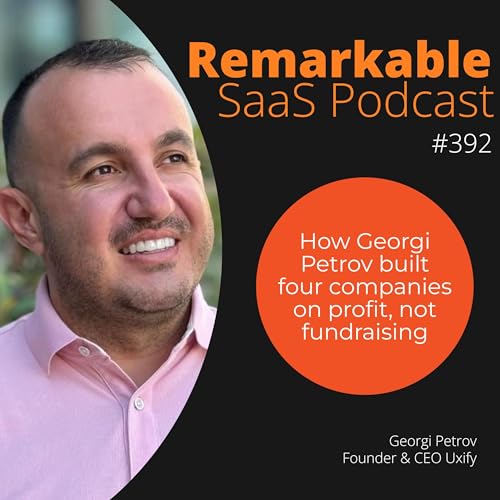
  • #392 – How Georgi Petrov built four companies on profit, not fundraising
    Feb 11 2026

    A story about choosing margins over momentum—and letting investors call you wrong.

    This episode is for SaaS CEOs stuck around 20% EBITDA and wondering what it actually takes to double it without cutting their way there.

    Most SaaS companies treat 20% EBITDA as a healthy number. Georgi Petrov targets 50.

    Georgi, CEO of Uxify, has founded four companies in 15 years with two exits—including one to WP Engine. He doesn't get there by cutting. He gets there by building differently from day one: small teams with high ownership, self-service at premium prices, and a refusal to add cost before it earns its place.

    And this inspired me to invite Georgi to my podcast. We explore why targeting 50% EBITDA changes every hiring decision, every pricing decision, and every partnership decision a founder makes. Georgi shares hard-won lessons on why small teams outperform large ones, why focus beats optionality, and why selling business outcomes—not product features—makes premium self-service pricing work.

    We also zoom in on two of the 10 traits that define remarkable software companies: – Acknowledge you cannot please everyone – Focus on the essence

    Georgi's journey proves that starting from profit forces every decision to earn its place.

    Here's one of Georgi's quotes that captures how he actually gets to 50% EBITDA:

    "Most of the high-leverage decisions that we made turn out to be not so good decisions. We find the good somewhere in the middle. Not having a support team sounds like a high-leverage decision, but that's ultimately bad, because customers need 24/7 support. So, ultimately, expand the support team, but do it in a smarter way, and that's how we end up. If we're super able to leverage a lot, very likely we can achieve much more than 50%, but I think you end up somewhere about 50% ultimately."

    By listening to this episode, you'll learn:

    • Why profitability shapes better decisions than fundraising ever will
    • What self-service at premium prices requires to actually work
    • Why the biggest partners rarely deliver the biggest results
    • When adding people stops creating productivity and starts destroying it

    For more information about the guest from this week:

    Guest: Georgi Petrov, CEO of Uxify

    Website: uxify.com

    Más Menos
    46 m