The Remarkable SaaS Podcast Podcast Por Ton Dobbe arte de portada

The Remarkable SaaS Podcast

The Remarkable SaaS Podcast

De: Ton Dobbe
Escúchala gratis

For B2B SaaS founders who are done blending in.

The Remarkable SaaS Podcast features unfiltered conversations with SaaS founders navigating the real challenges of building software that matters.

Hosted by Ton Dobbe, author of The Remarkable Effect, each episode zooms in on one of the 10 traits that define remarkable software companies—like offering something truly valuable and desirable, and aiming to be different, not just better.

Some guests are scaling fast. Others are still in the trenches—but all share hard-won lessons about what it really takes to create pull, shorten sales cycles, and become the only logical choice in their market.

Expect:

Honest conversations—no hype, no theory

Tactical insights from sales-led SaaS founders

Practical ideas you can apply to sharpen your product and your positioning

If you're building a SaaS business that deserves attention—not just more noise—this podcast is for you.

All rights reserved 2022-25
Episodios
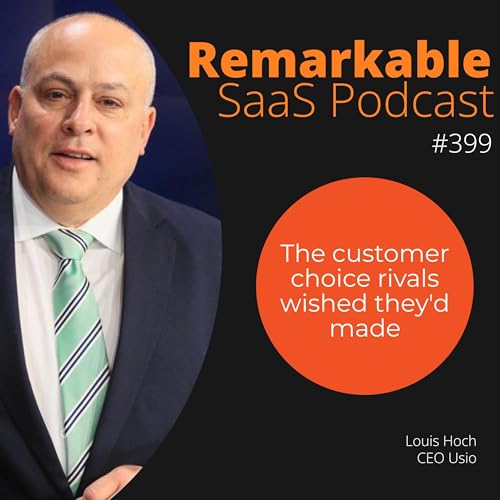
  • #399 – How Louis Hoch rejected the obvious customers—and grew when rivals collapsed
    Apr 1 2026

    A story about choosing who not to serve—and building competitive advantage no crisis can touch.

    This episode is for sales-led SaaS founders who've never tested whether their revenue would survive a major market shock — and aren't sure they want to know the answer.

    Most software companies are built to serve as many customers as possible. Louis Hoch, CEO of Usio, chose differently.

    Louis has been building in payments since 1998. He raised $50 million while competitors raised $200 million—and won. He built a company that processes enough direct bank payment volume to rank as the 50th largest bank in the United States. When COVID hit and rivals saw revenue drop by as much as 80%, Usio grew. That outcome wasn't luck. It was a customer decision made years earlier that most CEOs would never make.

    What Louis did—deliberately, by design—was say no to entire industries. Not because he couldn't serve them. Because serving them would have cost him everything else.

    And this inspired me to invite Louis to my podcast. We explore how deliberate customer rejection builds a resilience that no market crisis can touch. Louis shares insights about turning regulatory hurdles into early competitive positioning, building payment channel diversity while staying ruthlessly focused on vertical, and why the companies that fail are often the ones who stayed truest to their original idea. You'll discover what happens to your revenue when a crisis hits — and you made the right customer choices years earlier.

    We also zoom in on two of the 10 traits that define remarkable software companies:

    • Acknowledge you cannot please everyone
    • Aim to be different, not just better

    Louis's story proves that remarkable companies don't just pick their market—they pick what they will never serve, and build their advantage from that constraint.

    Here's one of Louis's quotes that captures his philosophy on what it takes to survive as a founder:

    "What you think you're going to be when you start a software company and what you end up being are often different. The companies that are successful understand that. The companies that fail try to maintain their focus on what their original product or service is."

    By listening to this episode, you'll learn:

    • Why going public before your first customer can be your strongest sales move
    • Why giving customers the conditions to choose beats telling them what they need
    • Why your original business plan may be the biggest threat to your survival
    • Why operating leverage has to be designed in from the start — not stumbled into later

    Guest: Louis Hoch, CEO and Chairman of Usio

    Website: usio.com

    Más Menos
    46 m
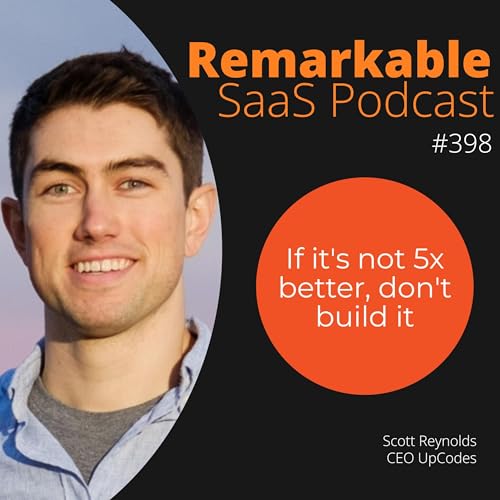
  • #398 – How Scott Reynolds bet on depth over breadth and built a position that sticks
    Mar 25 2026

    A story about choosing the hard problem—and winning because of it.

    This episode is for sales-led SaaS founders who feel their product lead shrinking—and wondering what actually creates a position competitors can't close.

    Most founders chase obvious markets. Scott Reynolds chose a complicated one nobody else wanted.

    Scott, co-founder and CEO of UpCodes, is a trained architect who has lived the pain of navigating construction regulations. Weeks buried in phone-book-sized regulations that no software had organized—until he built it.

    While others built broad tools for obvious problems, Scott went narrow and deep. His conviction: if it's not dramatically better, it isn't worth building.

    And this inspired me to invite Scott to my podcast. We explore why going deep into one vertical beats building broad for everyone. Scott shares what forces professionals to call a tool irreplaceable, why vertical depth compounds, and what a decade of quiet data does when AI arrives. You'll discover why his bet keeps getting stronger.

    We also zoom in on two of the 10 traits that define remarkable software companies: – Aim to be different, not just better – Offer something valuable and desirable

    Scott's story proves that remarkable companies find the problems others walk past—and build advantages that compound.

    Here's one of Scott's quotes that captures his thinking on competition in the AI era:

    "We view that marriage of our data and their data to give them a unique instance of AI that can just answer questions better than their competitor could. And I think that's a very critical component of competition in an AI era."

    By listening to this episode, you'll learn:

    • Why a 10% improvement rarely moves anyone—and what threshold actually drives adoption
    • What choosing a vertical others ignore reveals about long-term defensibility
    • When combining your data with customer data creates an advantage nobody else can access
    • Why the hardest problems to solve are often the strongest positions to own

    For more information about the guest from this week:

    Guest: Scott Reynolds, Co-founder and CEO UpCodes

    Website: up.codes

    Más Menos
    45 m
  • #397 – How Dean Mathews rejected conventional growth and built a company 170,000 people rely on every month
    Mar 18 2026

    A story about measuring success differently—and what that single decision builds.

    This episode is for SaaS founders who sense their growth metrics are missing something — and can't put their finger on what.

    Many SaaS companies track monthly active users. Dean Mathews asks a different question when he looks at that number.

    Dean Mathews, Founder and CEO of OnTheClock, launched his time-tracking company in 2004 after reading complaints in a small business forum. For the next decade, he ran it as a side project — patient, focused, and measuring success by one question: are we actually helping people?

    That question changed what he built, how he hired, and why customers keep coming back.

    And this inspired me to invite Dean to my podcast. We explore how measuring success by people rather than revenue changes what a software company becomes. Dean shares why monthly active users became his north star, why 20 years of patience in one segment compounds in ways rapid growth never does, and what really drives customers to recommend you without being asked.

    You'll discover how a 4.9 out of 5 customer support rating and 7–8% word-of-mouth referrals trace back to one belief about what business is actually for.

    We zoom in on two of the 10 traits that define remarkable software companies: – Turn customers into fans – Master the art of curiosity

    Dean's story proves remarkable companies don't obsess over revenue metrics—they obsess over the people those metrics are supposed to represent.

    Here's one of Dean's quotes that captures his philosophy on what makes a team culture actually work:

    "The biggest one for me is connecting their work to the actual value that's delivered to a customer, and showing them that their work actually matters. That's like gold."

    By listening to this episode, you'll learn:

    • Why measuring success by people helped—not revenue—changes how your whole team behaves
    • What turns occasional users into customers who recommend you to friends and colleagues
    • Why staying in one segment for 20 years compounds in ways most founders never see
    • Why connecting every team member to customer outcomes creates effort no salary can buy

    For more information about the guest from this week:

    Guest: Dean Mathews, Founder & CEO of OnTheClock

    Website: ontheclock.com

    Más Menos
    40 m
Todavía no hay opiniones