Episodios

  • Stop Investing Wrong What the Top 1% Do Differently
    Apr 7 2026

    Stop Investing Wrong: What the Top 1% Do Differently Most people are told to save, invest, and hope.

    But that's not how real wealth is built. In this episode of The Practical Wealth Show, Curtis May sits down with Dave Wolcott (Founder of Pantheon Investments) to break down how high-level investors actually create predictable cash flow, tax efficiency, and long-term wealth. But more importantly—we expose where most people go wrong: Investing before they have liquidity Chasing returns instead of control Building portfolios without a strategy If you've ever wondered why investing alone isn't working… this episode will change how you think about money.

    What You'll Learn:

    ✔️ How the top 1% actually builds wealth

    ✔️ Why passive income isn't enough

    ✔️ The role of liquidity before investing

    ✔️ Where Infinite Banking fits into a real strategy

    ✔️ Why most financial advice is incomplete

    🚨 Want to build your own wealth strategy? Start here: https://practicalwealth.net/FreedomSession

    Más Menos
    34 m
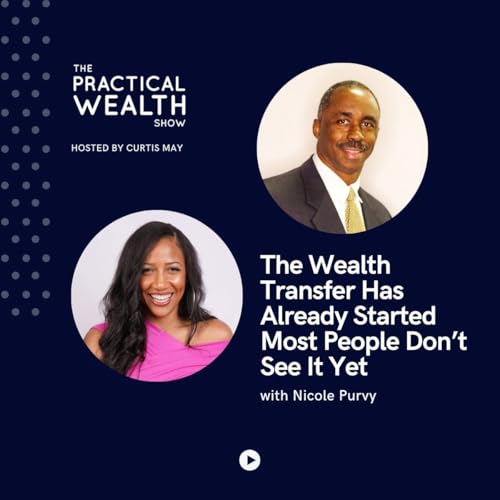
  • The Wealth Transfer Has Already Started Most People Don't See It Yet
    Mar 25 2026
    EPISODE SUMMARY

    In this episode of The Practical Wealth Show, Curtis May sits down with entrepreneur, investor, and former Wall Street bond trader Nicole Purvy.

    Nicole shares her journey from trading on Wall Street to building businesses, investing in real estate, and launching her growing YouTube platform The Profitor. As the managing partner of Invictus Elite Capital Group, she helps investors deploy capital into multifamily real estate while bringing a powerful macro-economic perspective to investing.

    Nicole explains why smart investors must pay attention to capital flows, volatility, and macroeconomic signals instead of relying on headlines or conventional financial advice.

    In this conversation, Curtis and Nicole discuss:

    • Why volatility in markets is not random

    • How macroeconomic shifts impact real estate investing

    • The housing affordability crisis and what it means for investors

    • How massive money printing changed the financial landscape

    • The mindset shift entrepreneurs must make to step into their authority

    • How Nicole overcame imposter syndrome after leaving Wall Street

    • Why studying history and economic patterns helps investors position themselves ahead of market changes

    Nicole also shares the story of how she was fired from Wall Street for teaching financial education online, which ultimately pushed her into entrepreneurship and building multiple successful ventures.

    If you want to understand what's really happening in the economy and how smart investors prepare for uncertainty, this episode is packed with insights.

    LINKS & RESOURCES
    • If you make good money but still feel tight, you're probably not broke—you're illiquid. Start here: practicalwealth.net

    • npurvy@gmail.com

    KEYWORDS

    macroeconomics volatility investing real estate private equity wealth transfer inflation housing crisis speculative investing capital allocation financial strategy mindset entrepreneurship liquidity financial education economic cycles asset management personal development

    EPISODE HIGHLIGHTS

    00:00–02:06 – Nicole's transition from Wall Street trader to entrepreneur and investor
    02:06–03:32 – Getting fired for YouTube and discovering her real purpose
    03:32–05:22 – Building a business from scratch and entering real estate
    05:22–07:05 – The "lowest barrier to entry" moment in real estate history
    07:05–09:19 – Imposter syndrome and playing small despite expertise
    09:19–11:23 – Breaking limiting beliefs and stepping into authority
    11:23–13:04 – The power of a one-page business plan
    13:04–15:23 – Early career experiences shaping mindset and confidence
    15:23–19:40 – Wall Street lessons and the illusion of expertise during the 2008 era
    19:40–23:06 – What volatility really means (and why it's not random)
    23:06–27:20 – The four forces behind today's economic instability
    27:20–31:07 – Housing affordability vs. housing supply explained
    31:07–35:08 – Human behavior as the missing variable in macroeconomics
    35:08–41:13 – Investing vs. speculation (and why most people get it wrong)
    41:13–56:19 – Strategies for investing during volatility and the future of real estate

    Más Menos
    1 h y 13 m
  • Stop Accumulating. Start Deploying: The Real Path to Financial Freedom
    Mar 18 2026
    Episode Summary

    What happens after you build your private banking system?

    In this episode of The Practical Wealth Show, Curtis May sits down with Ben Buzek — former Special Operations leader turned real estate investor and collaborator with Wealth Without Wall Street — to discuss how to strategically deploy capital into cash-flowing assets.

    If you've implemented the Infinite Banking Concept (IBC) and built cash value, the next step is deployment. But most investors skip due diligence, chase returns, and lock their money inside qualified plans like 401(k)s.

    We break down:

    • Why traditional 401(k)s limit liquidity and control

    • The difference between accumulation theory vs cash flow strategy

    • What separates serious investors from hobby investors

    • How to create a "buy box" to vet deals

    • Risk management lessons from Special Operations

    • Multifamily investing explained

    • How to use cash value life insurance to fund investments

    • The biggest misconception about passive income

    • Why liquidity beats rate of return

    Sequence matters:

    Cash Flow Control → Private Reserve → Strategic Deployment → Financial Freedom

    If you want income, not speculation — this episode is for you.

    Links & Resources
    • practicalwealth.net

    • WWWS Podcast with Special Guest, Ben Buzek

    • https://www.linkedin.com/in/buzekb/

    • Home

    • ben@wealthwithoutwallstreet.com

    Keywords

    Passive Income
    Infinite Banking Concept
    Cash Flow Strategy
    401k Alternatives
    Private Banking
    Capital Deployment
    Liquidity
    Financial Freedom
    Buy Box
    Due Diligence
    Multifamily Investing
    Syndications
    Cash Value Life Insurance
    Wealth Allocation
    Velocity of Money
    Control vs Accumulation
    Statement Wealth
    OPM (Other People's Money)
    Investor Profile
    Asset-Based Income

    Episode Highlights

    00:00–02:26 - From accumulation theory to control-based wealth building
    02:26–05:39 - What happens after you build cash value? The "What's next?" problem
    05:39–08:07 - Why 401(k)s limit liquidity and control
    08:07–10:03 - Financial freedom formula: Passive income exceeds expenses
    10:03–12:36 - Buy boxes, shiny object syndrome, and investor discipline
    12:36–14:26 - Special Operations risk management: PACE planning (Primary, Alternate, Contingency, Emergency)
    14:26–17:40 - Serious investors vs hobby investors
    17:40–20:18 - Defining your investor profile before deploying capital
    20:18–22:00 - Principles → Strategy → Tactics framework
    22:00–24:06 - You can't eat equity: cash flow vs capital gains
    24:06–26:05 - Finding and redeploying "lazy cash"
    26:05–28:06 - The biggest misconception about passive income
    28:06–29:31 - LP investing, syndications, and operator due diligence
    29:31–32:54 - Liquidity, capital access, and why you'll run out of money before deals
    32:54–34:56 - Case study: $2,300/month in passive income in 12 weeks
    34:56–37:16 - Why coaching accelerates results and reduces costly mistakes
    37:16–40:46 - Retirement math reality check and the 4% rule problem
    40:46–43:35 - How the Passive Income Lab works (structure, accountability, cohorts)
    43:35–46:06 - Earn → Bank → Borrow → Spend → Repay framework
    46:06–49:38 - Final call to action: stop sitting on the sidelines

    Más Menos
    47 m
  • Before You Buy a Franchise, Watch This with Cliff Nonnenmacher
    Mar 11 2026
    EPISODE SUMMARY

    Franchising is often marketed as passive or semi-absentee—but that misunderstanding costs investors millions.
    In this episode, I'm joined by franchise veteran Cliff Nonnenmacher, who has spent over 25 years owning, scaling, and advising franchise businesses across multiple industries.
    We talk candidly about:

    • Why franchisees really fail

    • The operator vs. owner mindset

    • Capital mistakes that quietly kill good businesses

    • Who should walk away from franchising immediately

    • Trends vs. hype in today's franchise market

    If you're considering franchising or advising someone who is—this episode will save you time, money, and regret.

    LINKS & RESOURCES
    • If you make good money but still feel tight, you're probably not broke—you're illiquid.
      Start here: practicalwealth.net

    • cliffn@franocity.com

    • www.franocity.com

    • cliffn@franocity.com

    KEYWORDS

    Family council

    generational wealth

    legacy planning

    financial wisdom

    speculative investing

    trust funds

    family governance

    intergenerational learning

    wealth mindset

    progress principle

    purposeful communication

    financial stewardship

    baby steps strategy

    structured conversations

    wealth transfer

    EPISODE HIGHLIGHTS

    00:00–01:20 - Younger generations turning to speculation as traditional wealth feels out of reach
    01:20–02:15 - Gambling vs. investing in the age of bots and AI
    02:15–03:32 - Story of a trust fund protected by anti-gambling restrictions
    03:32–04:28 - The wisdom function of a family council
    04:28–05:22 - Family councils beyond blood relatives: boards, mentors, advisors
    05:22–06:43 - Four generations under one roof: mutual value exchange
    06:43–07:35 - What younger generations actually bring to the table
    07:35–08:32 - Why asking better questions unlocks generational wisdom
    08:32–09:47 - Simple starting point: weekly cadence calls
    09:47–10:36 - Two powerful questions: What's working? What's not?
    10:36–11:45 - The "gap" vs. progress principle
    11:45–12:50 - Starting small instead of waiting for a formal family retreat
    12:50–13:45 - Purposeful structure vs. hoping conversations happen naturally
    13:45–End - Why progress compounds when family conversations become intentional

    Más Menos
    55 m
  • Be the Bank Blueprint: What Good Looks Like
    Mar 4 2026
    Episode Summary

    "Good" doesn't feel exciting.
    Good feels calm.

    In this episode, Curtis defines what financial stability actually looks like in real life—and walks through the Be the Bank Blueprint that turns chaos into control.

    What you'll learn
    -The clearest definition of financial stability:
    -Nothing feels urgent
    -Money moves without panic
    -Decisions aren't permission-based
    -Why most people confuse "busy" with "progress"
    -The 4-step Money for Life Blueprint:
    -Cash flow control
    -Private Reserve (properly structured whole life)
    -Protection and stress-testing
    -Legacy and continuity
    -How to think like a banker instead of a borrower

    Key insight
    Bad finances feel urgent.
    Good finances feel boring and boring is freedom.

    Episode Resources

    • Take the Next Step with Curtis May:

    • Business Owners: Assess Your Challenges with Cash Flow → https://curtis-73no5r8j.scoreapp.com
      Private Banking Readiness Assessment → https://curtis-qljorw8q.scoreapp.com

    • How Ready Are You to Be Your Own Bank? → https://curtis-hzw1jezd.scoreapp.com

    • The Practical Wealth Show with Curtis May

    Keywords

    Be the Bank Blueprint
    Money for Life Process
    Private reserve
    Cash flow control
    Financial calm
    Liquidity and control
    Whole life insurance strategy
    Infinite banking
    Personal economy
    Financial freedom
    Legacy planning

    Episode Highlights

    00:00–00:31 - Introducing the Be the Bank Blueprint and defining "what good looks like"
    00:31–01:27 - When systems work, nothing feels urgent
    01:27–01:56 - Calm, boring money systems lead to better decisions
    01:56–02:23 - What bad looks like: pressure, fragility, constant scrambling
    02:23–03:32 - What "good" looks like for business owners, investors, and W-2 earners
    03:32–04:23 - Borrowing by choice, not necessity
    04:23–05:32 - Step one: stabilize cash flow and fix symptoms vs causes
    05:32–06:31 - Raising your "ceiling of complexity" lowers anxiety and risk
    06:31–06:55 - Tell your money where to go instead of asking where it went
    06:55–07:46 - Step two: save 15–20% and build liquidity before investing
    07:46–08:53 - Building a private reserve with properly structured whole life
    08:53–09:46 - Principles → strategy → tactics (products come last)
    09:46–10:12 - Earn it. Bank it. Borrow it. Spend it. Repay it.
    10:12–10:52 - Protect the kingdom: stress-test your plan
    10:52–11:29 - The destination: four pillars of a strong personal economy
    11:29–12:48 - Pillar 1 & 2: freedom from debt and cash when needed
    12:48–14:01 - Pillar 3: financial freedom through cash-flowing assets
    14:01–15:05 -Think like a banker: borrow with purpose, repay with discipline
    15:05–16:17 - Clarity before action—next steps
    16:17–17:37 - Pillar 4: legacy of wealth and wisdom

    Más Menos
    18 m
  • The Myth of Free Markets
    Feb 25 2026
    Episode Summary

    Free markets only work when signals are honest.
    Today's money signals are distorted so people work harder, earn more, and still feel stuck.

    In this episode, Curtis exposes the myth of free markets, explains why money friction is engineered into the system, and reveals the three silent wealth leaks draining households and business owners every day.

    What you'll learn

    • Why distorted money signals break personal decision-making

    • How locked money forces debt as default liquidity

    • The real reason people feel behind even with good incomes

    • The three wealth leaks most people never measure:

    -Interest
    -Taxes
    -Opportunity cost

    -Why budgeting fails when the system itself is broken

    Most people don't overspend they're oversiloed.
    Their money exists, but it's trapped when life happens.

    Want help identifying your leaks and rebuilding cash flow control?

    Go to practicalwealth.net and book a Clarity Call.
    We'll map your cash flow, find the leaks, and outline your first corrective moves.

    Episode Resources

    • Take the Next Step with Curtis May:

    • Business Owners: Assess Your Challenges with Cash Flow → https://curtis-73no5r8j.scoreapp.com
      Private Banking Readiness Assessment → https://curtis-qljorw8q.scoreapp.com

    • How Ready Are You to Be Your Own Bank? → https://curtis-hzw1jezd.scoreapp.com

    • The Practical Wealth Show with Curtis May

    Keywords

    Myth of free markets
    Debt paradigm
    Cash flow control
    Money signals
    Liquidity and control
    Opportunity cost
    Household capitalism
    Private reserve
    Infinite banking
    Personal economy
    Cash flow mapping
    Financial systems

    Episode Highlights

    00:00–00:31 - The myth of free markets and distorted money signals
    00:31–01:24 - The debt paradigm and why institutions don't play by the same rules
    01:24–02:08 - Asset-rich, cash-poor: why high earners still feel broke
    02:08–02:58 - The leaky bucket: interest, taxes, and opportunity cost
    02:58–03:26 - What if you could use money and still keep it growing?
    03:26–04:26 - Real-world example: business owners saving, borrowing, and leaking simultaneously
    04:26–05:22 - Wealth leaks beyond interest: mortgages, retirement, education
    05:22–06:16 - Institutional incentives and why people play a rigged game
    06:16–06:55 - Why budgeting isn't the solution—structure is
    06:55–08:04 - Cashflow mapping vs reactive money management
    08:04–08:44 - Parkinson's Law and why money disappears without systems
    08:44–09:38 - Separating accounts and creating cash flow clarity
    09:38–10:47 - Cash flow stress, revenue targets, and business discipline
    10:47–11:43 - The "red pill" moment of understanding money systems
    11:43–12:55 - Control, liquidity, and why structure reduces stress
    12:55–14:04 - Earning more by creating more value
    14:04–15:27 - Stewardship, leadership, and becoming the bank
    15:27–15:49 - Final call to action and next steps

    Más Menos
    17 m
  • Capitalism Without Apology
    Feb 18 2026
    Episode Summary

    Most people think they live in capitalism. They don't.
    They live in a permission-based money system—where access to capital requires approval, delays, or debt.

    In this episode, Curtis breaks down what capitalism actually is, why most households aren't participating in it, and how Infinite Banking represents household-level capitalism in action.

    This isn't political. It's structural.

    What you'll learn
    -Why your biggest money problem is usually lack of liquidity, not lack of income
    -The difference between capitalism, corporatism, and crony finance
    -Why most people are trained to save money they can't access
    -How "buy term and invest the difference" often creates cash-poor households
    -The three pillars of real financial control: liquidity, control, continuity

    Key takeaway
    If you don't control liquidity, you don't control decisions.
    And if you don't control decisions, you're not practicing capitalism—you're reacting.

    If this episode exposed cracks in your money system, don't try to budget harder.
    Fix the structure.

    Go to practicalwealth.net and book a 15–20 minute Clarity Call to identify where control is leaking and what to fix first.

    Links & Resources

    Episode Resources

    • Take the Next Step with Curtis May:

    • Business Owners: Assess Your Challenges with Cash Flow → https://curtis-73no5r8j.scoreapp.com
      Private Banking Readiness Assessment → https://curtis-qljorw8q.scoreapp.com

    • How Ready Are You to Be Your Own Bank? → https://curtis-hzw1jezd.scoreapp.com

    • The Practical Wealth Show with Curtis May

    Keywords

    Household economics
    Personal economy
    Capitalism without apology
    Infinite banking
    Liquidity and control
    Private reserve strategy
    Permission-based spending
    Debt paradigm
    Capital storage
    Financial independence
    Institutional finance
    Cash flow control

    Episode Highlights

    00:00–01:06 - Capitalism without apology and the idea of a personal economy
    01:06–02:04 - Why you can't control the global economy—but you can control your household economy
    02:04–02:45 - Capitalism as control, not investments or rates of return
    02:45–03:34 - Liquidity defined: why access to money determines decision-making
    03:34–05:07 - High income, low liquidity—and why professionals still feel tight
    05:07–06:15 - Debt as a symptom of illiquidity, not irresponsibility
    06:15–07:36 - What capitalism actually is (and what it isn't)
    07:36–08:51 - How locking money away forces life to be financed with debt
    08:51–10:01 - The debt paradigm vs the "pay cash" illusion
    10:01–11:37 - Institutional rules that shape how people are taught to use money
    11:37–12:55 - Why most personal economies show no evidence of financial freedom
    12:55–14:15 - Signals, interest rates, and distorted financial behavior
    14:15–15:49 - Infinite banking as a system—not a product
    15:49–17:16 - Liquidity, control, and uninterrupted compounding
    17:16–18:17 - Outsourcing knowledge and control to institutions
    18:17–20:12 - Capitalism practiced at the household level—and the call to action

    Más Menos
    21 m
  • Become an Investor: The Cash-Flow System Behind Financial Freedom
    Feb 11 2026
    Summary Curtis sits down with Joey Mure (Wealth Without Wall Street) to talk straight about what financial freedom really is and why most people never reach it. Joey breaks down the mindset shift away from "retirement someday" toward building enough passive income to cover monthly expenses so you own your calendar today. From there, the conversation goes tactical: why your cash flow system must change, how Infinite Banking becomes the most efficient "parking and leverage" tool, and why the real missing piece is becoming an investor—not just being a saver. They also dismantle the myth that being debt-free equals freedom, explain why you can never "pay off the cost of living," and highlight the two biggest bottlenecks that stop people: thinking differently and fear of investing. Joey shares real examples of alternative cash-flow assets (including land flipping partnerships, private lending, and small "operator-run" deals like Turo) and how stacking repeatable wins is what builds momentum. What you'll learn Joey's definition of financial freedom (passive income > expenses = owning your calendar) Why "retirement" is a broken model—and why freedom is a today goal The simple test for whether your money supports freedom: Does it increase passive income or reduce a monthly expense? Why a 401(k) often delays financial freedom (not income-producing today) Infinite Banking as a foundational asset (great tool, not the finish line) Why "Become Your Own Banker" really implies "become an investor" Why debt freedom isn't freedom—and why you can't pay off the cost of living The top two bottlenecks: mindset + fear (no confidence, no repeatable investing process) Joey's favorite cash-flow plays and why operator-run deals can be powerful -How to stack passive income in repeatable steps (first $500/month, then scale) -Resources mentioned / concepts to explore -Wealth Without Wall Street community + monthly Passive Income Report -Infinite Banking / Becoming Your Own Banker -Rich Dad Poor Dad framework (cash-flowing assets vs accumulation) -Alternative cash-flow assets: land flipping partnerships, private notes, Turo rentals, vending Episode Highlights 01:02 - Reeducating about financial freedom. 05:37 - Creating passive income today. 09:13 - The infinite banking foundation. 15:48 - Transition to becoming an investor. 19:26 - Bottlenecks in financial transition. 25:00 - Land flipping success story. 31:15 - Business ownership vs. job ownership. 35:10 - Being a steward of resources. 40:25 - Breaking limiting beliefs for financial freedom. 50:10 - Financial freedom as a process. 52:30 - Spiritual freedom and stewardship. Episode Resources Take the Next Step with Curtis May: Business Owners: Assess Your Challenges with Cash Flow → https://curtis-73no5r8j.scoreapp.com Private Banking Readiness Assessment → https://curtis-qljorw8q.scoreapp.com How Ready Are You to Be Your Own Bank? → https://curtis-hzw1jezd.scoreapp.com The Practical Wealth Show with Curtis May Joey Mure Guest Emailjoey@wealthwithoutwallstreet.com Additional guest information Co owner and Host at Wealth Without Wallstreet joey@wealthwithoutwallstreet.com (205) 236-0075 Keywords Practical Wealth Show Joey Mure Wealth Without Wall Street financial freedom reeducate business owners passive income financial independence cashflow system Investing alternatives mindset shift Rich Dad Poor Dad retirement Nelson Nash infinite banking alternative assets become an investor passive income operating system debt freedom constructive debt destructive debt land flipping private loans TURO vending machine business Robert Kiyosaki E-Myth stewardship faith-based financial approach
    Más Menos
    43 m